Follow Us on Google Discover
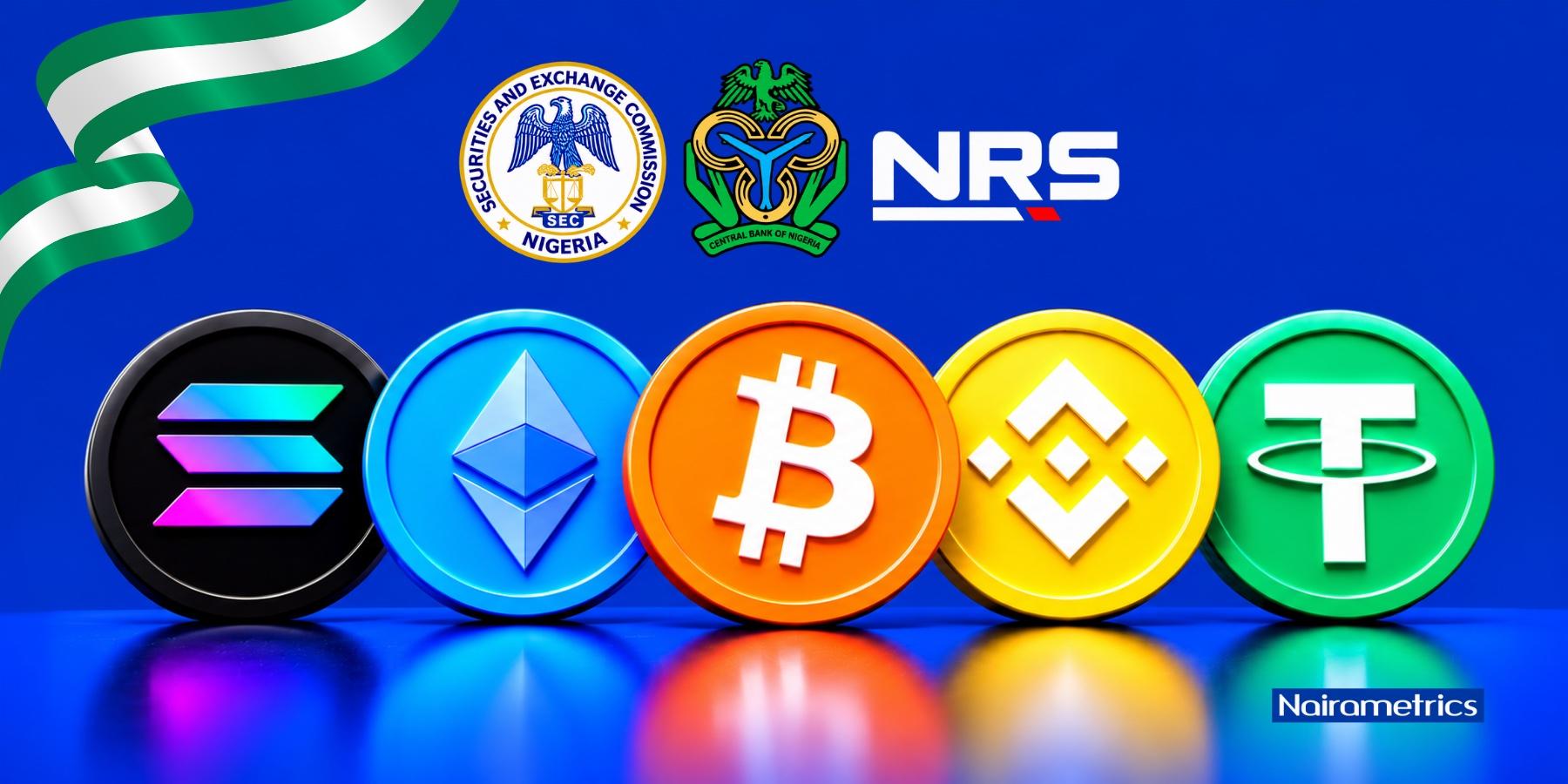
Nigeria has made significant progress in bringing digital assets under formal regulation, but overlapping responsibilities among government institutions are creating uncertainty for operators, investors and businesses seeking to participate in the emerging market.
Industry experts, who spoke to Nairametrics, said the absence of a coordinated regulatory framework has left cryptocurrency exchanges, payment providers and other blockchain-based businesses navigating different compliance expectations from the Securities and Exchange Commission (SEC), Central Bank of Nigeria (CBN) and Nigeria Revenue Service (NRS).
The situation raises questions about licensing, minimum capital requirements, taxation and the approval processes for businesses offering digital asset services, potentially slowing investment and wider adoption.
Although the government has introduced several measures to formalise the sector, industry participants argue that the challenge has shifted from regulatory recognition to effective coordination and implementation.
Also Read
Lack of coordination creates market uncertainty
Speaking with Nairametrics, Roimot Ibitoye, Chief Compliance Officer at Roqqu, a Nigerian cryptocurrency exchange and fiat-to-crypto gateway, said the country had yet to establish a sufficiently coordinated and predictable regulatory environment.
- “We have made real progress, but we are not yet at the point where we can confidently say that we have a fully coordinated, predictable and comprehensive regulatory framework for digital assets.
- “We have had a fragmented regulatory approach. The SEC, the CBN, the Nigeria Revenue Service, the financial intelligence and security agencies, and other relevant institutions each have legitimate interests in the same ecosystem.
- “The problem is not that we have multiple regulators; it is that the boundaries between their respective responsibilities have not always been sufficiently clear, and their approaches have not always been adequately coordinated,” she said.
Also speaking, Abdul Akubo, Founder and Chief Executive Officer of Graph Finance, said the absence of convenient and clearly regulated channels for converting stablecoin payments into naira remained a challenge for businesses and individuals receiving payments in digital assets.
According to him, some users are forced to rely on informal peer-to-peer (P2P) traders to convert their digital assets into naira and transfer the proceeds into their bank accounts.
Such arrangements expose users to fraud and counterparty risks, particularly where transactions take place outside clearly established regulatory channels.
- “Low awareness and uncertainty over tax treatment have also contributed to hesitation among individuals and businesses to formally consider the technology for transactions,” Akubo said.
His observation highlights how regulatory uncertainty can affect the development of legitimate payment channels and discourage businesses from incorporating digital assets into their operations.
How Nigeria’s crypto regulatory framework has evolved
Nigeria’s shift towards formal cryptocurrency regulation gained momentum in March 2025, following President Bola Tinubu’s assent to the Investments and Securities Act (ISA) 2025.
- The legislation formally recognised virtual assets and investment contracts as securities, bringing Virtual Asset Service Providers (VASPs), Digital Asset Operators (DAOPs) and digital asset exchanges under the regulatory oversight of the SEC.
- The development marked a significant departure from the uncertainty that had characterised the industry for years, providing a statutory basis for regulating businesses operating in the digital asset ecosystem.
However, subsequent interventions by other government institutions have expanded the regulatory landscape, creating the need for clearer boundaries between their respective responsibilities.
- The CBN, for instance, has increased its engagement with the industry through a dedicated Virtual Asset Service Provider track under the second cohort of its Regulatory Sandbox, launched in August 2026.
The initiative covers activities involving stablecoins, virtual asset payments, wallets, custody services, exchanges and related financial infrastructure.
Through the sandbox, eligible businesses can test qualifying products under regulatory supervision, while the CBN assesses associated risks and operational challenges.
- The SEC has also continued to expand its Accelerated Regulatory Incubation Programme (ARIP), admitting seven additional companies into the programme in July to broaden the number of digital asset businesses operating within its regulatory incubation framework.
However, SEC Director-General, Emomotimi Agama, disclosed in October that no digital asset operator in Nigeria had secured final registration under ARIP, highlighting the gap between regulatory incubation and full operational authorisation.
- In August, the commission also proposed a broader regulatory framework featuring revised registration fees and minimum capital requirements for digital asset businesses.
- Under the proposed requirements, Digital Asset Exchanges (DAXs) and Digital Asset Custodians (DACs) would each require minimum capital of N2 billion.
Digital Asset Platform Operators (DAPOs), Digital Asset Offering Platforms (DAOPs) and Real World Asset Tokenisation Platforms (RATOPs) would require N500 million each, while Virtual Asset Service Providers would have a minimum capital requirement of N200 million.
Beyond financial regulation, the NRS introduced cryptocurrency tax guidelines in August, providing additional direction on the taxation of digital asset transactions.
Under the tax provisions described, medium and large companies earning profits from cryptocurrency and other virtual asset transactions would be subject to a 30% corporate income tax on taxable profits.
While these interventions provide greater visibility into the government’s regulatory expectations, businesses must contend with requirements from institutions whose mandates sometimes intersect.
Tinubu’s executive order seeks to harmonise regulation
The Federal Government has acknowledged the need for better coordination among institutions overseeing the digital asset ecosystem.
- In July 2026, President Tinubu signed the Virtual Assets Executive Order, establishing a framework for a CBN-led council to harmonise oversight of cryptocurrencies, tokenised assets, stablecoins and other digital assets without creating an entirely new regulator.
- The proposed arrangement is expected to improve cooperation among existing institutions, clarify regulatory responsibilities and reduce overlapping mandates.
- However, the framework is yet to be fully translated into operational guidelines, leaving industry participants waiting to see how the proposed coordination mechanism will work in practice.
The issue has also attracted the attention of lawmakers, particularly as global interest in tokenisation and blockchain-based investment products increases.
Senator Osita Izunaso, Chairman of the Senate Committee on Capital Market and Institutions, recently challenged the SEC and other relevant regulators to accelerate the development of digital asset and tokenisation regulations.
He warned that delays could prevent Nigeria from benefiting from emerging investment opportunities in the rapidly expanding global tokenisation market.
Questioning the country’s preparedness to participate in the sector, Izunaso asked:
- “Do we have an enabling law guiding the issue of token development in Nigeria?”
He urged regulators to speed up the process, noting that digital assets were already being traded across international markets and that Nigeria needed an enabling regulatory environment to compete effectively.
What digital asset operators want from regulators
For industry participants, the priority is not necessarily reducing the number of regulators but ensuring that their respective responsibilities, approval processes and compliance requirements are clearly defined.
Gideon Atere, Head of Legal at Roqqu, said Nigeria needed a coordinated regulatory structure that clearly established which institution was responsible for specific digital asset activities and the authorisations businesses would need to operate.
- “The starting point should be a common understanding of which regulator is responsible for which activity, what authorisations are required and how businesses should proceed where their products fall within the mandates of multiple institutions.
- “The Virtual Asset Council provides an opportunity to establish a common classification framework, coordinated application procedures and a transparent mechanism for resolving jurisdictional disagreements. The Virtual Asset Office should help operationalise that approach through information sharing and coordinated supervisory processes,” he said.
Atere also advocated a proportionate, risk-based regulatory approach that reflects the nature and scale of different digital asset activities.
He called for clearer regulatory guidelines, predictable licensing pathways, stronger consumer protection and asset safeguarding requirements, as well as sustained consultation between regulators and industry stakeholders.
He further emphasized the importance of effective implementation, institutional capacity and accountability in ensuring that the proposed coordination framework delivers meaningful results.