Follow Us on Google Discover
Big borrowers cut about N2.26 trillion of debt in nine months. Smaller companies that depend on Nigerian banks are still paying close to 30%.
Nigeria’s biggest companies are doing something they rarely manage: paying down debt.
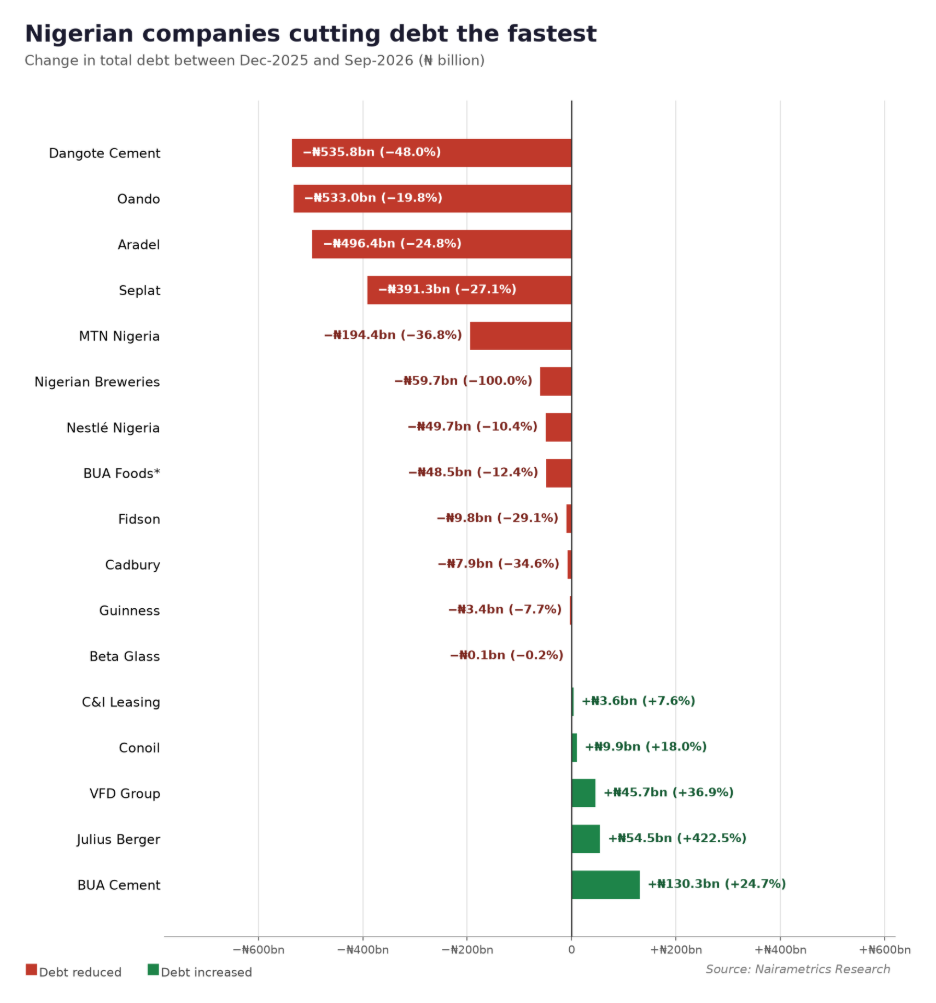
Seven of the largest non-bank borrowers on the Nigerian Exchange cut their combined borrowings by about N2.26 trillion in the nine months to September.
That is according to a review of third-quarter filings of more than a dozen companies. Dangote Cement alone shed N536 billion, nearly half of its debt; Nigerian Breweries owed N137 billion a year ago and now owes nothing.
Also Read
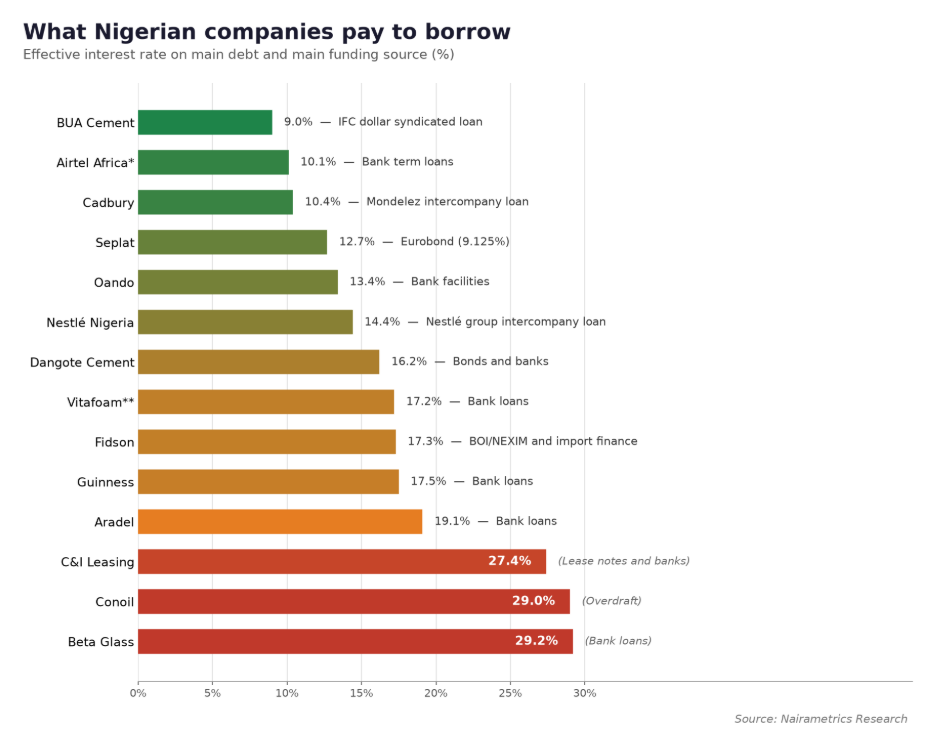
Not everyone is deleveraging, as BUA Cement, Julius Berger, VFD Group and Conoil added about N240 billion between them. The cost of borrowing also varies widely, with companies that can borrow from development lenders or their foreign parents paying 8% to 10% in interest rates. Those that rely on Nigerian banks pay close to 30%; the gap is now one of the clearest dividing lines in corporate Nigeria.
The great paydown
Most of the debt reduction came from cement, oil and telecoms. Dangote Cement’s borrowings, counting overdrafts and loans from related parties, fell from N1.12 trillion at the end of 2025 to N580 billion. The company repaid N209.6 billion of commercial paper. It also cleared a N299.6 billion loan from its parent, Dangote Industries. Nine-month interest expense fell 63% to N102.9 billion.
- The oil producers are working down acquisition debt. Oando cut its borrowings 20% to N2.16 trillion. Aradel’s debt swelled past N2 trillion when it consolidated Renaissance Africa Energy on Dec. 31, and it has since cut that by a quarter. Seplat’s debt fell to $792 million from $1.01 billion after it repaid most of a $300 million advance-payment facility.
- MTN Nigeria cut its borrowings 37% to N333 billion, even after paying N860.8 billion in dividends. The telecom company now earns more interest on its cash than it pays on its loans.
A firmer naira helped by shrinking the naira value of dollar loans. Seplat recorded N99 billion of exchange differences on its borrowings this year. Nestlé Nigeria recorded a N33.9 billion unrealised exchange gain on its loans.
Parents pull back
The biggest change is in who is doing the lending. Loans from parent companies and other related parties are shrinking fastest.
- At Dangote Cement, related-party loans fell to N63.8 billion from N373 billion. At the end of 2025, a third of its debt came from the Dangote group. Now it is 11%, and the rest comes from bonds and bank loans. Interest charged to the company by its parent fell to N9.9 billion in nine months, from N29.2 billion.
- Multinationals are following the same path. Nestlé Nigeria’s debt, almost all of it an intercompany loan from the Nestlé group, fell 10% to N426 billion. It still paid the group N58.5 billion in interest over nine months. Cadbury Nigeria cut its Mondelez loan by about a third, to N14.9 billion.
- Smaller companies are swapping insider loans for shares. Ellah Lakes converted N7.1 billion of directors’ loans into equity at N2.80 a share, while Fortis Global Insurance replaced a yen-denominated loan from Daewoo Securities with a convertible bond.
Short-term market debt is also falling out of favour. Dangote Cement and Fidson Healthcare each repaid all of their commercial paper. Fidson had been paying 23% to 24.75% on its notes and now borrows from the Bank of Industry at 14% to 15% and from Nigeria’s export-import bank at 9%. Its interest bill fell 27%.
The price of money
What a Nigerian company pays to borrow depends mostly on who it borrows from.
BUA Cement’s interest bill works out to about 9% a year on its average debt, as most of its N657 billion of borrowings is a dollar loan syndicated by the International Finance Corp., the World Bank’s private-sector arm. Airtel Africa’s average borrowing rate fell to 10.1% from 12.4% a year earlier, while Cadbury pays about 10% on its loan from Mondelez.
At the expensive end, Beta Glass pays about 29% on N40 billion of bank loans priced off the central bank’s policy rate. Its interest bill rose 67% this year even though its debt barely changed. Conoil is funded entirely by bank overdrafts, which its filing says cost about 32%. The overdraft grew 18% to N64.8 billion, and interest expense at least doubled.
Beta Glass also raises a related-party question. While paying close to 30% to banks, it has lent N48.4 billion to its parent, Packaging Industries, part of a group owned by Helios Investment Partners. Most of that loan’s growth this year was unpaid interest: N8.2 billion accrued, but only N2.4 billion was repaid in cash.
Cheap dollar debt has its own risk. BUA Cement’s borrowing is cheap only while the naira holds. The company booked N36.1 billion of exchange gains on its borrowings and cash in nine months, and those gains would reverse if the currency weakens.
Going the other way
Most of the companies adding debt are also borrowing to invest, and the most indebted is still trying to swap its loans for equity.
- BUA Cement drew N233 billion of new loans in nine months, lifting its borrowings 25% to N657 billion. The IFC syndicated loan alone now stands at N563 billion, up from N392 billion. The company also has N266 billion of cash, so net debt is about N390 billion.
- Julius Berger, the construction company, took out a N67.4 billion long-term loan and paid off its overdraft. Its Q3 filing names no lender, rate or currency; however, loan interest of N672 million in the quarter implies about 4% a year, far below naira bank rates, which suggests foreign-currency or concessionary funding. The company still holds N185 billion of cash.
What changed is its customer funding which it relies on to stay liquid. Advance payments from clients, long Julius Berger’s free source of working capital, fell N121 billion to N409 billion. Spending on plant and equipment rose to N36.3 billion from N6.8 billion.
- VFD Group, an investment holding company, has moved from bank loans to the money market. Its commercial notes and private placements more than doubled to N151.7 billion. Bank borrowings fell to N10.6 billion from N48.4 billion. That leaves 89% of its debt in short-dated instruments that must be rolled over.
- Oando is the most heavily indebted. Interest payments of N143.9 billion took half of the cash its operations generated in nine months. The company plans to raise up to N500 billion of equity, starting with a N220 billion rights issue now with the Securities and Exchange Commission.
It also plans to convert $300 million of debt into shares and to launch a refinancing programme of up to $1.5 billion. Until those deals close, its shareholders are mainly working for its lenders.
How this analysis was done: We reviewed third-quarter 2026 filings and results releases from more than 30 non-bank companies listed on the Nigerian Exchange. Borrowings include bank loans, bonds, commercial paper, overdrafts and loans from related parties. Interest rates are approximations: nine-month interest annualised and divided by average debt. Conoil reports three different prior-year interest figures. C&I Leasing’s notes disagree on its year-end term loans.