Follow Us on Google Discover
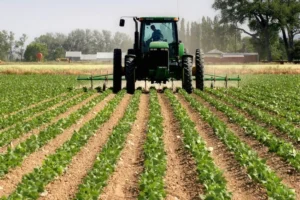
The World Bank has proposed $250 million in financing for Kenya’s irrigation projects to expand farmers’ access to water, improve agricultural productivity and strengthen food production.
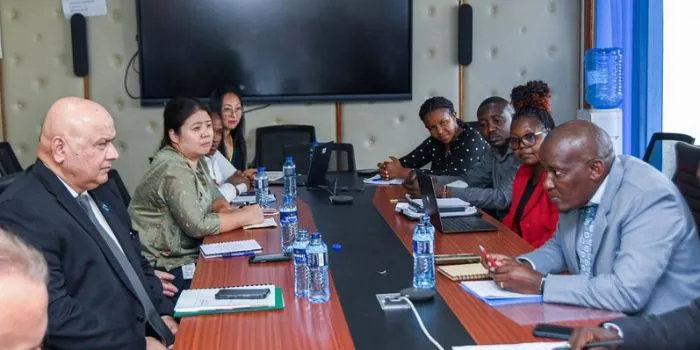
In a report published on Thursday, November 12, Agriculture Principal Secretary Ephantus Kimotho disclosed the proposed financing following a consultative meeting with a World Bank delegation led by its Director of Global Water Practice, Saroj Kumar Jha, in Nairobi on November 11.
The proposed financing will support the Kenya Resilient Irrigation for a Sustainable Economy (K-RISE) programme, alongside an additional grant to strengthen implementation and improve water management.
World Bank Backs Kenya Irrigation Plans
Kenya is expected to receive Ksh32.5 billion under the proposed $250 million financing, alongside a $2 million grant to support irrigation projects.
Also Read
Kimotho said discussions with the World Bank delegation focused on finalising the financing and grant arrangements, as well as completing the necessary steps before the programme moves into implementation.
- “I held a consultative meeting with a World Bank Group delegation. The discussions focused on finalising the proposed $250 million IDA financing and $2 million grant,” Kimotho said.
The proposed funding is expected to improve farmers’ access to reliable water supplies for agricultural activities, helping them increase crop production and contribute to Kenya’s food security objectives.
The funding will be channelled through K-RISE, while the additional grant will be provided under the Global Water Security and Sanitation Partnership (GWSP).
K-RISE to Transform Irrigation Development
The K-RISE programme will give farmers a bigger role in developing and managing irrigation schemes while introducing new financing methods and technology to improve irrigation services and water management.
According to Kimotho, the initiative represents a shift from fragmented, infrastructure-focused interventions towards a coordinated approach that prioritises institutional reforms and better management of irrigation projects.
- “K-RISE represents a paradigm shift in Kenya’s irrigation development, moving beyond fragmented, infrastructure-focused interventions towards a coordinated, programmatic approach that prioritises institutional reforms,” Kimotho said.
The World Bank also commended Kenya’s National Irrigation Sector Investment Plan, describing it as a model and an important reference point for irrigation development across Africa and beyond.
The lender expressed confidence that Kenya’s approach could guide other countries seeking to expand irrigation through farmer-led initiatives, strategic public investment and increased private-sector participation.
The government and the World Bank also discussed plans to establish a National Irrigation Informatics Centre to strengthen irrigation planning, investment prioritisation, water management and performance monitoring.
Nigeria Expands World Bank-Funded Irrigation Projects
Nigeria has also partnered with the World Bank to strengthen irrigation infrastructure and improve agricultural productivity.
- On March 10, 2026, Nairametrics reported that the Federal Government and the lender inaugurated the $500 million Sustainable Power and Irrigation for Nigeria (SPIN) Project to modernise irrigation infrastructure, improve dam safety and strengthen food security across the country.
- In another development, the World Bank had approved a $500 million credit for Nigeria’s Sustainable Agricultural Value-Chains for Growth (AGROW) Project.
- The six-year programme aims to increase smallholder farmers’ productivity, strengthen agricultural value chains and improve food security. It is expected to benefit up to one million smallholder farmers and attract an additional $220 million in private agribusiness investment.
Earlier, on July 29, 2024, Nairametrics reported that Nigeria was seeking a $500 million World Bank loan under SPIN to improve dam safety and water-resource management, modernise irrigation systems and strengthen institutional capacity to address water-security challenges and boost agricultural production.