Follow Us on Google Discover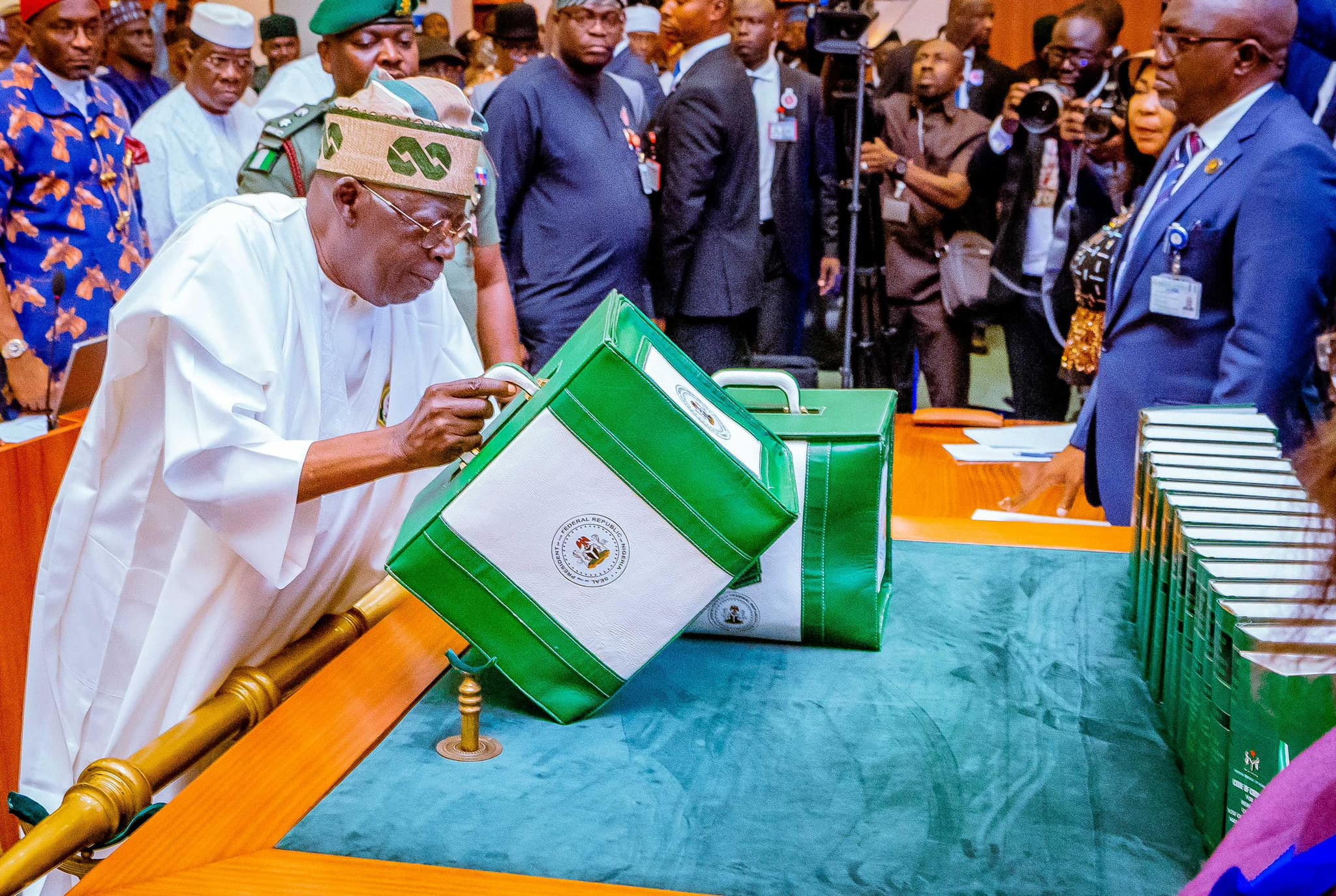
On 17 April 2026, President Bola Tinubu signed the 2026 Appropriation Act, the largest in Nigerian history at N68.32 trillion ($48.80 billion).
The State House announcement was precise about expenditure: N4.799 trillion ($3.43 billion) in statutory transfers, N15.8 trillion ($11.29 billion) in debt service, N15.4 trillion ($11.00 billion) in recurrent spending and N32.2 trillion ($23.00 billion) in capital, roughly half the budget. It did not state the deficit.
That omission is the subject of this article.
The deficit is the figure that tells a citizen whether the state is living within its means, and it is the figure the Fiscal Responsibility Act 2007 constrains at 3% of gross domestic product (GDP). A budget announcement that itemises four categories of spending while omitting the gap between spending and income has disclosed everything except the number that matters.
Also Read
The gap is derivable rather than hidden. Projected revenue is N36.87 trillion ($26.34 billion); subtracted from N68.32 trillion ($48.80 billion) of spending it yields N31.45 trillion ($22.46 billion), or 6.41% of GDP, more than double the statutory ceiling. That is not an estimate but a subtraction performed on two figures the government itself published.
The central finding is not that the deficit is large. Nigeria has run large deficits for years. It is that the deficit has become difficult to state with confidence, and that the difficulty is doing political work. Three deficit figures circulate for the same financial year: N31.45 trillion ($22.46 billion) at 6.41% from BudgIT, N23.85 trillion ($17.04 billion) at 4.28% from a separate analysis of the original presidential budget proposal, and N25.91 trillion ($18.51 billion) at bill stage in February, when the Senate was defending the borrowing. They differ by well over N7 trillion Naira and all were reported in good faith.
The discrepancies are explicable, reflecting the difference between bill and Act, the treatment of government-owned enterprises, and which measure of output sits in the denominator. The point is not that anyone is lying, but that a citizen wishing to know whether his government has broken its own borrowing law must first choose a definition, because the government has not chosen one for him.
Amilcare Puviani, the Italian economist, described this in 1903 as fiscal illusion: the tendency of states to arrange their finances so the burden appears smaller than it is, achieved not through falsehood but through the structure of presentation. James Buchanan restated the mechanism plainly, that the more complicated the fiscal structure, the less accurately the citizen perceives accurately the taxes he bears and the true cost of government.
A budget that publishes its spending categories and leaves its deficit to be derived is a compact instance of exactly this. Nothing untrue has been said, and in a country where most people meet the budget through a headline rather than a spreadsheet, the absence is the whole of the difference.
The consequence falls on the 3% ceiling, which has stopped functioning as a ceiling. Every figure in circulation breaches it: the highest at more than double, the most conservative at 4.28%, still a third above the limit. Yet no reading commands sufficient agreement to make the breach a fact anyone must answer for.
Douglass North argued that institutions are the rules that reduce the cost of knowing where one stands. A rule that cannot be measured against raises that cost rather than lowering it, because there is now a rule and a dispute about the rule. The ceiling has become a transaction cost rather than a constraint.
A second finding concerns what happened between presentation and signature. The President presented a bill of ₦58.18 trillion ($41.56 billion); the Act he signed was ₦68.32 trillion ($48.80 billion), an increase of N10.14 trillion ($7.24 billion), or about 17.4%. The National Assembly increased the figure on its way through, with an expansion larger than Nigeria’s entire federal budget as recently as 2021.
BudgIT identifies roughly N6.93 trillion ($4.95 billion) of 11,122 questionable projects inserted during the legislative process: line items appearing in no ministry’s plan and clustering with suspicious geographic precision. A deficit already breaching its statutory limit was widened further to accommodate them.
Janos Kornai’s soft budget constraint describes the resulting behaviour. An organisation that knows its overspending will be covered does not treat its budget as a limit. The Nigerian federal budget has repeatedly breached its deficit ceiling in recent year and each breach has been financed rather than corrected. An institution that knows its constraint is soft will press against it annually, because pressing carries no cost and considerable benefit.
The most surprising finding concerns the oil assumptions, where the conventional criticism proves wrong. The standard complaint is that Nigerian budgets assume implausible oil prices and collapse when reality arrives, a pattern Jeffrey Frankel has documented across commodity exporters generally.
This time the price assumption was conservative. The budget is built on $64.85 a barrel; Nigerian crude passed $70 in February and Brent traded at about $104 on 25 September. On price the Ministry of Finance was pessimistic, and the pessimism has been rewarded.
However, the optimism is in the barrels. The budget assumes 1.84 million barrels a day including condensates. Nigeria produced 1.678 million in August and has fallen short in May, June, July and August. 2026 first-half production was about 294.6 million barrels against 333.0 million budgeted, a shortfall of 38.4 million barrels worth roughly $2.49 billion in foregone gross oil value at the budget’s own price.
This distinction carries the argument. The oil price is a world market variable no Nigerian official controls, and being wrong about it is forgivable. Production volume depends on pipeline security, contract administration, terminal maintenance, regulatory clarity and whether contractors have been paid, which makes it almost entirely a function of how well the Nigerian state governs the Nigerian oil sector. The budget was prudent about what it could not influence and optimistic about what it could, placing Frankel’s forecast bias on the variable that indicts the forecaster most directly.
The article also flags a circulating figure that does not compute. One widely repeated report puts the five-month shortfall at 1.36 million barrels and the loss at $3.6 billion, though at any price Nigeria has seen this century 1.36 million barrels is worth under a hundred million. The number is wrong by roughly fortyfold and has been repeated regardless, because in a degraded information environment a figure with a currency symbol acquires authority it has not earned.
Revenue performance is consistent with the production shortfall. At face value, H1 gross Federation Account Allocation Committee (FAAC) revenue was broadly on a straight-line trajectory toward the N36.87 trillion annual projection. But that does not eliminate the revenue risk: Q1 tax collections were already N2.24 trillion below target, and the H1 FAAC figure is gross revenue rather than the amount actually available for distribution. Revenue is rising, but not at the speed the appropriation assumed, and the appropriation was passed knowing the trajectory.
The debt position converts this from an accounting argument into a generational one. The International Monetary Fund (IMF) projects interest payments alone consuming 53.7% of government revenue in 2026, up from 40.8% in 2024. Interest, not principal. Once principal repayments are included, estimates of the total debt-service burden have placed it at roughly 70-90% of revenue. Yet 46.1% of the 2026 budget is itself dependent on borrowing and loans: slightly under fifty-four kobo in every Naira of federal spending comes from revenue actually collected.
The article links this to the preceding piece in the series. The $5 billion total return swap with First Abu Dhabi Bank, secured against Naira bonds at 133% collateral in the strongest reserve year in eighteen, was not an isolated misjudgment but this deficit looking for a lender. It also notes the Monetary Policy Committee’s decision of 22 September, cutting the policy rate (MPR) 350 basis points to 23% while leaving the cash reserve ratio at 45%. The fiscal position is not separate from the monetary one; it is substantially why the monetary one is set where it is.
Five remedies are proposed, none requiring new legislation.
Firstly, the Budget Office should publish the deficit as a headline figure in every budget announcement, in Naira and as a share of GDP, with both definitions stated on the same page. Secondly, the Fiscal Responsibility Commission should publish a compliance opinion on each Appropriation Act within thirty days of assent, stating whether the ceiling has been breached and by how much.
Thirdly, every item inserted during the legislative process should be published as a separate schedule naming the inserting committee and sponsoring member. Fourthly, the production assumption should be set by the Nigerian Upstream Petroleum Regulatory Commission (NUPRC) from the preceding twelve months of actual output rather than by the Ministry of Finance from what the spending plan requires. Fifthly, the revenue projection should carry a published confidence range, with the deficit stated at the pessimistic end as well as the central one.
The underlying problem is not arithmetic and will not be solved by better arithmetic. Nigeria has developed a fiscal process in which the budget is a statement of aspiration rather than a plan of record, and in which everyone involved understands this and none says so. Revenue figures are what the spending requires; spending is what the politics requires; the deficit is whatever remains, and it is not announced. The ceiling is breached and nobody rules on it. The borrowing is arranged afterwards, on whatever terms the market offers a borrower with no alternative. A barn drawn on paper cannot be robbed, and it cannot be eaten either.
- Akinola Morakinyo (Ph. D) writes on MINT economies from the Department of Economics, Finance & Quantitative Analysis, Kennesaw State University, GA, USA