Follow Us on Google Discover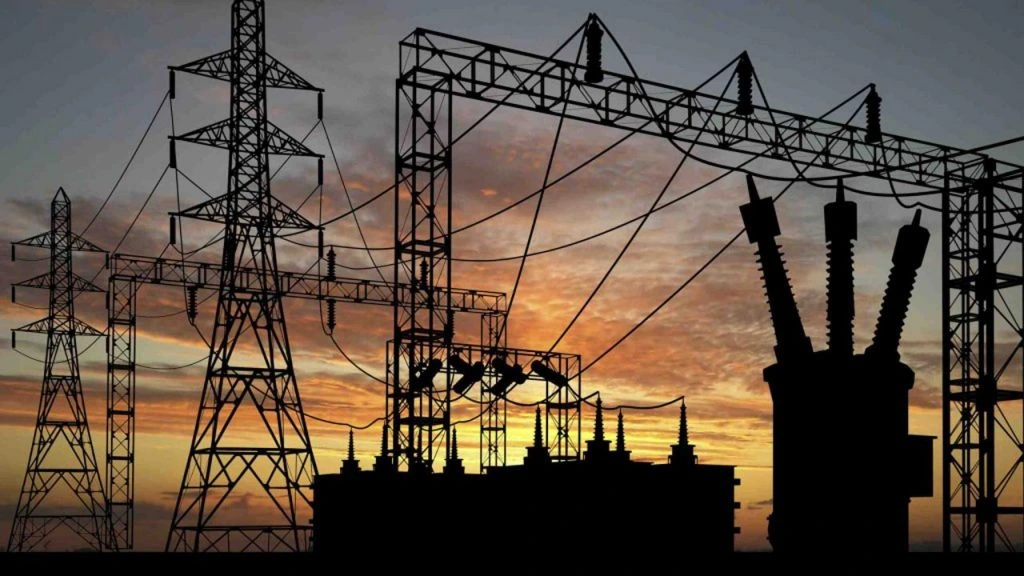
Ask how Nigeria’s power problem is going, and you will be handed a number: the megawatts the country generated last week, last month, last year.
It is the wrong number to watch.
The revealing figure is not how much electricity Nigeria produces, but how much its people pay to avoid needing the grid at all.
By that measure, Nigeria has quietly built a second electricity system, privately, one generator at a time, at ruinous cost. It may now be larger than the public one. And it is among the heaviest hidden taxes on the trillion-dollar economy the country says it wants.
Also Read
Start with the figure that gets quoted. Nigeria’s installed generation capacity is about 13,600 megawatts, which sounds like the beginnings of a serious power system. But installed capacity is a promise, not a delivery. In practice, only around 5,000 megawatts ever reach Nigerians, little more than a third of what is supposedly there.
The gap is not mainly a shortage of power stations. It is that the stations cannot get what they need to run: the plants that burn gas receive less than half the gas required to work at full capacity, and the wires meant to carry the power and the companies meant to sell it lose much of the rest. Installed capacity counts turbines that sit idle for want of fuel or a working line to the customer. It is the most quoted and least useful number in the debate.
So Nigerians built their own grid. Not by any plan, but one purchase at a time. Estimates of its size vary with who is counting and what they count, so the honest way to put it is carefully. By several estimates, privately owned generating capacity now runs to somewhere between fifteen and twenty thousand megawatts, set against a public grid that struggles to deliver five thousand megawatts to more than two hundred million people.
By some accounts, close to half of the electricity Nigerians actually use is generated privately rather than drawn from the grid. Estimates of what all these costs run to somewhere between ten and fourteen billion US dollars a year in machines and the fuel they burn. Even at the low end of these estimates, the private system is as large as the public grid. This is no scattering of backup generators behind a few shops; it is a second power system, paid for household by household and factory by factory.
The scale can be hard to picture until you look at a single company. Aliko Dangote’s industrial group generates around 1,500 megawatts for its own use, a private supply larger than what many whole states draw from the grid. The power plant at his refinery alone is rated at 435 megawatts, which, by the group’s own account, is enough to supply the entire area served by the electricity distribution company in Ibadan.
When the country’s largest industrialist concludes that the surest route to reliable electricity is to build his own power stations, he is stating, in the most expensive way imaginable, what every Nigerian business already knows: the grid cannot yet be relied upon, so those who can afford to leave it, do.
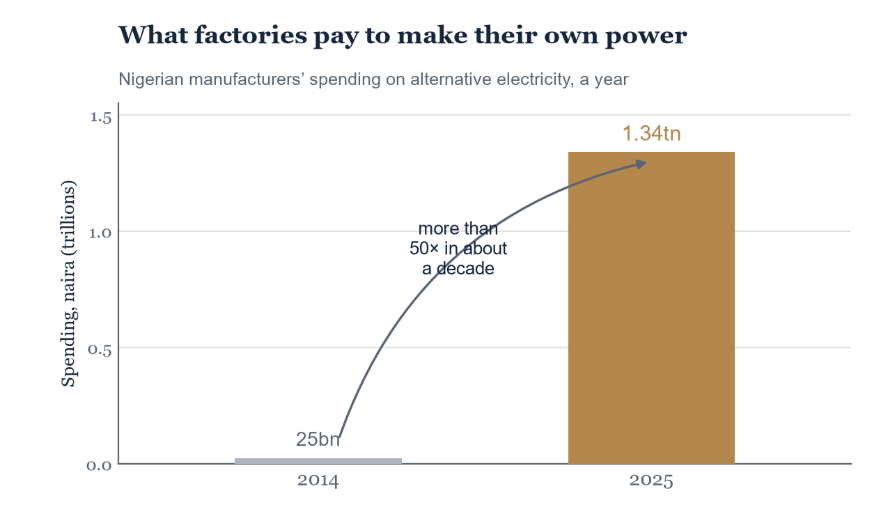
Buying a generator is not a failure of imagination, any more than staying informal was. It is the rational response of a business that cannot trust the grid to be there when an order falls due. But what is rational for each is ruinous for all. Nigeria’s manufacturers alone spent about 1.34 trillion naira powering themselves in 2025, a fifth more than the year before and more than fifty times what they spent a little over a decade ago.
Energy now swallows around forty percent of what it costs to run a factory. Roughly seven in ten businesses depend on a generator. Every one of those naira buys not a better product, a new hire or a lower price, but merely standing still: manufacturing the electricity that a rival in Morocco or Vietnam simply takes from a socket in the wall. This is a coordination failure of the most expensive kind. One generator is sensible; millions of them are a fractured, duplicated private power industry that no one designed, and that costs far more than a single working grid ever would. The paradox is not that Nigeria lacks an electricity market, but that the market it has cannot be relied on to deliver. Unable to count on buying power when they need it, each business and household pays to make its own.
It is not only the factories. The tailor runs her machines off a small petrol generator and prices the fuel into every garment. The barber, the welder, the seller of cold drinks, the boarding school, the hospital theatre, each keeps a machine humming in the yard and folds its cost into whatever they charge.
Multiplied across tens of millions of enterprises, this is an entire economy paying twice for power: once, in taxes and tariffs, for a grid that underdelivers, and again, out of pocket, for the private one that fills the gap. That second bill is largely invisible in the power statistics. It is the cost of generators, fuel, batteries, maintenance and lost hours that keep the lights on, and it may well be the larger of the two.
And notice what kind of spending this is. When a business sinks part of its capital into generators, fuel tanks, inverters and the wiring to run them, in the statistics it counts as investment like any other. But it is defensive investment: it adds no new productive capacity, only replaces a public service that failed. Picture two identical factories, one in Vietnam and one in Nigeria, each with ten million dollars to invest.
The Vietnamese firm puts it all into machinery that makes things to sell. The Nigerian firm spends perhaps seven million on machinery and three million building the power system the grid did not supply. Both have invested ten million; only one has spent it all on becoming more productive. That, in a single comparison, is the trillion-dollar problem. Scarce capital that should be making the economy more productive is quietly diverted, year after year, into making it merely function. Seen this way, the generator economy is not just a workaround for the power crisis. It is one of the reasons the economy stays poorer than it needs to be.
And it strikes the ambition exactly where it is weakest. The previous piece in this series argued that a trillion-dollar economy has to be built by formal firms making complex, valuable things at scale, not by more people each selling a little by the roadside. Those are precisely the firms the power deficit punishes hardest. A trader with a stall needs almost no electricity; a factory, a cold store, a data centre, a steel mill lives or dies by it. Power a business must make for itself is a tax that falls most heavily on exactly the sophisticated, formal economy the country says it wants to grow. You cannot survive your way to a trillion dollars in the informal economy, and you certainly cannot industrialise on a generator.
Look, too, at what the statistics record. Nigeria’s measured electricity use is only about 170 units per person a year, against roughly 1,800 in Egypt and nearly 4,000 in South Africa, and even that counts only grid supply. The World Bank puts the cost of this unreliability at five to seven percent of national income, somewhere near 25 billion US dollars a year, a sum no economy can lose to darkness year after year and still expect to double in size.
For those of us who invest in Nigerian businesses, the generator is priced into everything. When we value a company here, we quietly carry an energy penalty that a comparable firm in a country with reliable power does not bear, and it surfaces as higher operating costs, as working capital tied up in fuel and machines, and as good projects that never clear the hurdle rate.
The single fastest way to lift the value of a great swathe of Nigerian enterprises is not a new product or a clever strategy; it is reliable power. Whoever solves electricity reliably, whether the grid itself, embedded generation, captive plants, mini grids, or solar and storage for commercial and industrial users, is not merely selling a utility. They are handing an entire economy back the margin it currently burns in the yard. Reliable power would not, on its own, summon investment; a business also needs stable prices, security, sound rules and finance. But it would remove one of the largest and most stubborn obstacles standing between Nigerian firms and the capital they need to grow.
Here the government has done something genuinely difficult. In 2024 it began charging the customers who receive the most reliable supply, the Band A group who get around twenty hours of power a day, a price that actually covers the cost of producing and delivering it, rather than maintaining the pretence that electricity is nearly free. Honest pricing is the unglamorous foundation everything else rests on. No investor will put the billions required into gas supply, transmission and distribution in order to sell the result at a guaranteed loss. Like removing the fuel subsidy and floating the naira, it is painful now but pointed in the right direction.
Yet a tariff is only a promise that the power will come. For most Nigerians, so far, it has not: even on the grid, average daily supply fell over the course of 2025 rather than rising. Charging the true price of electricity earns a country the right to fix its power system; it does not, by itself, fix it.
The real work is slower and far less quotable than any tariff order: getting gas to the plants that stand idle without it, building and maintaining the lines to carry what is generated, and giving distributors both a reason and the means to deliver power and collect what they are owed. It is the grinding work of many years, with no ribbon to cut, and exactly the kind of work a country is tempted to set aside the moment the pressure eases.
So watch a different number. Not the megawatts announced at a ceremony, but the day the generators begin, quietly, to fall silent, not because anyone banned them, but because the grid at last became worth trusting. That will be the day the second system starts to shrink, the hidden tax starts to lift, and Nigeria’s formal economy is finally handed the one thing every factory and every ambition needs and cannot make for itself: power it can rely on. Nigeria has already proved it will pay almost any price to keep the lights on. The prize is to let it pay that price once, to a grid that works, rather than forever, to a machine in the yard that only ever helps it cope.
One in a series exploring whether, and how, Nigeria can become a one trillion-dollar economy.
- Frank Nnamka is a private equity and impact investor. He writes here in a personal capacity, and the views expressed are his own and do not reflect the position of his employer or any organisation he is affiliated with.