Follow Us on Google Discover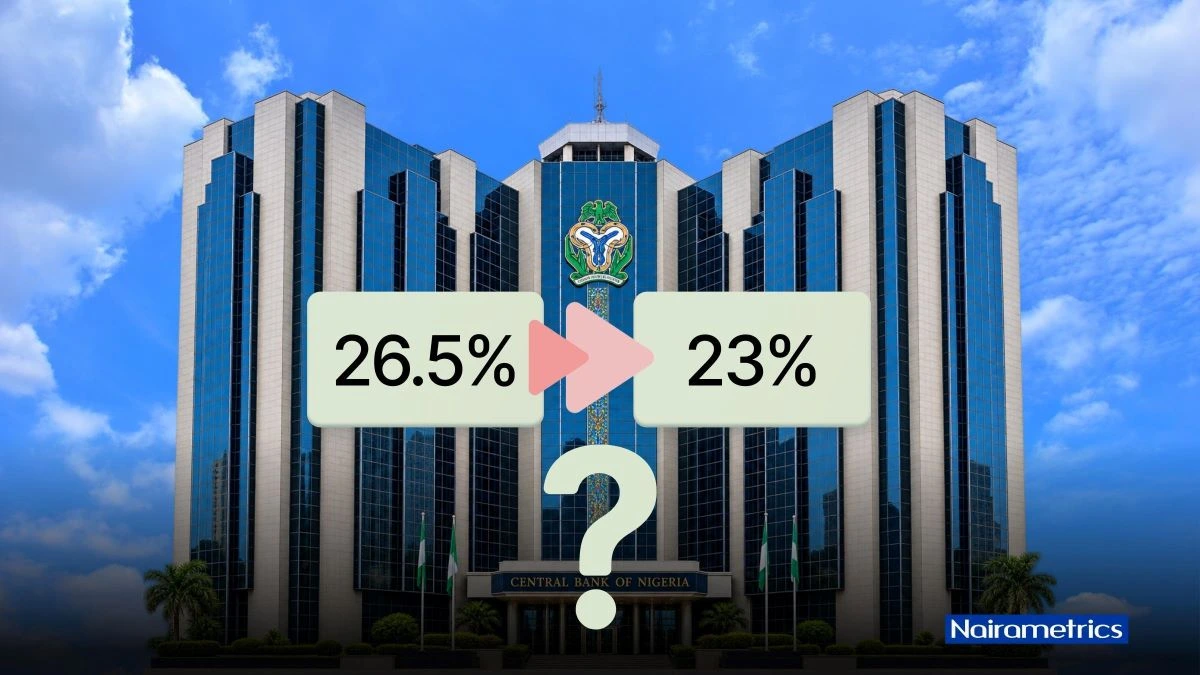
The Central Bank of Nigeria’s decision to cut its Monetary Policy Rate (MPR) to 23% marks a major shift in the country’s interest-rate environment, with implications for bond prices, mutual funds, pension portfolios and investors whose returns are linked to fixed-income and equity markets.
The Monetary Policy Committee (MPC), at its 307th meeting on September 22, 2026, reduced the benchmark rate by 350 basis points from 26.5% to 23%, its first MPR adjustment since February.
The decision comes as Treasury bill yields have already started moving lower, while inflation has continued to moderate and the investment space shifts away from the exceptionally high-yield fixed-income environment of much of 2024 and 2025.
For mutual funds and pension funds, the rate cut could mark the beginning of another portfolio transition cycle, where fixed-income returns may moderate while equities become increasingly relevant to maintaining overall portfolio performance.
Also Read
MPR cut deepens Nigeria’s Yield shift
Even before the MPR was reduced, the fixed-income market had begun pricing a lower interest-rate environment, with Treasury bill yields declining despite strong investor demand for government securities.
At the September 9 Treasury bill auction, the stop rate on the 364-day bill fell to 16.62%, from 16.84% on September 2 and 17.59% on August 12.
- The 364-day Treasury bill rate therefore declined by 97 basis points in less than a month, marking the third consecutive reduction in the one-year Treasury bill rate.
- The shorter tenors also cleared around the mid-16% range, while investor demand remained strong.
- Investors submitted N2.64 trillion in bids against N750 billion offered at the September 9 auction, with the 364-day instrument accounting for 96% of total subscriptions, while The CBN ultimately allotted N1.054 trillion.
Lower rates reshape mutual fund returns
Money-market funds are particularly sensitive to changes in short-term interest rates because a significant portion of their portfolios are invested in Treasury bills, commercial papers and other short-duration fixed-income securities.
- Over the past two years, money-market funds benefited from rising Treasury bill yields, commercial paper rates, and other short-term instruments.
- During a high-rate environment, these funds can reinvest maturing securities at relatively attractive yields, supporting the income generated for investors.
- A fund that already holds a Treasury bill purchased when yields are higher can continue to earn the contracted return until maturity.
FGN Bond funds could benefit from capital appreciation
An implication of lower interest rates is that existing bonds become more valuable. Bond prices generally move inversely to market yields.
- When yields decline, the prices of existing bonds with relatively higher coupon payments become more valuable as their cash flows become more attractive relative to newly issued securities.
- This creates capital gains for mutual funds and pension funds holding existing longer-duration bonds, even as the income available from newly purchased securities declines.
Recent FGN bond auction results provide evidence of the movement in the longer end of the fixed-income market.
- At the September 14 auction, the new 16.79% FGN September 2036 bond cleared at a marginal rate of 16.79%, while the reopened 15.45% FGN June 2038 bond cleared at 16.85%.
- The marginal rate on the 2038 bond was below the 17.79% recorded at the August auction, indicating that yields had also moved lower in the longer-dated segment of the market.
Equity mutual funds may become more attractive
Lower interest rates generally improve the relative attractiveness of equities.
- Equity-focused mutual funds have different return drivers, and the Nigerian equities market has already recorded significant gains in 2026. The NGX All-Share Index gained 2.78% in the week ended September 18, taking its year-to-date return to 60.53%, before crossing the 250,000-point mark on September 21 with a year-to-date gain of 60.76%.
- Equity returns can remain volatile, as reflected in the decline in equity mutual fund net asset value from N241.38 billion in July to N230.50 billion in August.
What does the rate cut mean for pension funds?
The implications for pension funds are broader because Pension Fund Administrators (PFAs) manage diversified portfolios across government securities, equities, money-market instruments and other approved asset classes.
PenCom data showed that approximately N17.40 trillion of pension fund assets were invested in FGN securities as of June 2026.
- For pension portfolios, falling yields can support the market value of existing bonds, particularly longer-duration securities, while creating reinvestment challenges as securities mature.
- Pension funds may have to reinvest proceeds from maturing securities at lower prevailing yields if the downward rate trend continues.
- The same reinvestment challenge applies to mutual funds whose existing high-yield securities eventually mature.
Expert Weigh in
Samuel Oyekanmi, Head, Research & Insights, Norrenberger, said pressure on Treasury bill yields could become more pronounced if the easing cycle continues following the reduction in the MPR to 23%.
- “The reduction in the Monetary Policy Rate to 23% marks a further shift towards a lower interest-rate environment, but its implications for mutual funds and pension returns should be viewed in the context of market expectations,” he said.
According to Oyekanmi, fixed-income markets had already begun pricing in the possibility of rate cuts before the MPC announcement, meaning some of the adjustment in yields may already have occurred.
- “Going forward, the pressure on Treasury bill yields could become more pronounced if the easing cycle continues. This would likely moderate the returns available on new fixed-income investments, particularly for money market funds and pension portfolios with significant exposure to short-term government securities,” he added.
- However, he noted that the impact would not be immediate or uniform across all funds. “Portfolios holding longer-dated bonds could benefit from price appreciation as yields decline, potentially cushioning the effect of lower reinvestment rates in the near term,” he said.
- Ultimately, the rate cut is more likely to translate into a gradual moderation in fixed-income returns than an abrupt decline in fund performance. The extent of the impact will depend on how much of the easing cycle is already reflected in market yields, the pace of subsequent rate cuts, and how effectively fund managers reposition their portfolios.” he emphasized.
Nathanael Disu, Equity Research Analyst, Afrinvest, also highlighted the potential implications for equities.
According to Disu, the CBN’s 350-basis-point rate cut could support demand for equities as investors reassess allocations between fixed-income securities and risk assets.
- “The CBN’s surprise 350bps rate cut is a welcomed development to the equities market as we expect to see more capital inflow into fundamentally sound tickers,” he said.
Disu noted that the NGX recorded a strong performance in 2026, with the market’s year-to-date return around 61%.
He also pointed to Nigeria’s inclusion in the FTSE Russell Frontier Market Index as another factor that could influence market flows, alongside the expected release of first-half earnings by major banks.
Kehinde Jones, Head, Research and Strategy at Anchoria Capital Group, said the 350-basis-point reduction in the MPR, from 26.5% to 23%, represents a significant shift in the interest-rate environment, particularly as inflation continues to moderate and economic activity improves.
- The CBN described the move as a “reset” following the September 2026 MPC meeting, with inflation declining to 15.39% in August 2026 and real GDP growth accelerating to 4.43% in the second quarter of 2026.
- According to Jones, the rate cut could put further downward pressure on fixed-income yields, with the 364-day Treasury bill rate already falling to 16.62% as of September 9, while the latest Open Market Operations (OMO) auction cleared at 18.41%.
- For bond investors, Jones noted that the changing yield environment could create different outcomes depending on whether investors already hold bonds or are deploying fresh capital.
Jones added that the lower-yield environment could also influence portfolio allocation as investors reassess the relative attractiveness of different asset classes.
- “The lower-yield environment could also encourage investors to increase allocations to equities, corporate debt and longer-dated securities,” he said.
On equities, Jones said the lower MPR could support investor interest as market participants look for returns outside traditional fixed-income instruments.
- “The lower MPR could support further investor interest as investors look for better returns outside fixed income,” he said.
He added that lower borrowing costs could support corporate earnings and valuations, particularly for consumer, industrial and oil and gas companies, if the reduction in the policy rate eventually translates into lower lending rates.
However, Jones cautioned that the impact would depend on the speed and extent of monetary-policy transmission.
- “The impact will depend on how quickly the rate cut feed through to lending rates, credit growth and economic activity,” he said.
He also noted that after the strong gains recorded by the equities market, stock selection and valuation would remain important considerations for investors.
What this means for investors
For retail investors, an MPR of 23% does not automatically translate into a 23% investment return.
The more important variables are the direction of Treasury bill yields, bond yields and equity prices, as well as how individual investment portfolios are positioned for the changing rate environment.
- For mutual fund and pension investors, the key issue is therefore not simply where the MPR stands today, but how portfolios are positioned for the rate cycle that follows.
The same 350-basis-point cut can produce very different outcomes for a money-market fund, a bond fund, an equity fund, and a pension portfolio.
And that is why the next phase of Nigeria’s monetary easing cycle may be less about headline interest rates and more about how effectively fund managers navigate the changing relationship between yields, bond prices, equities and inflation.