Follow Us on Google Discover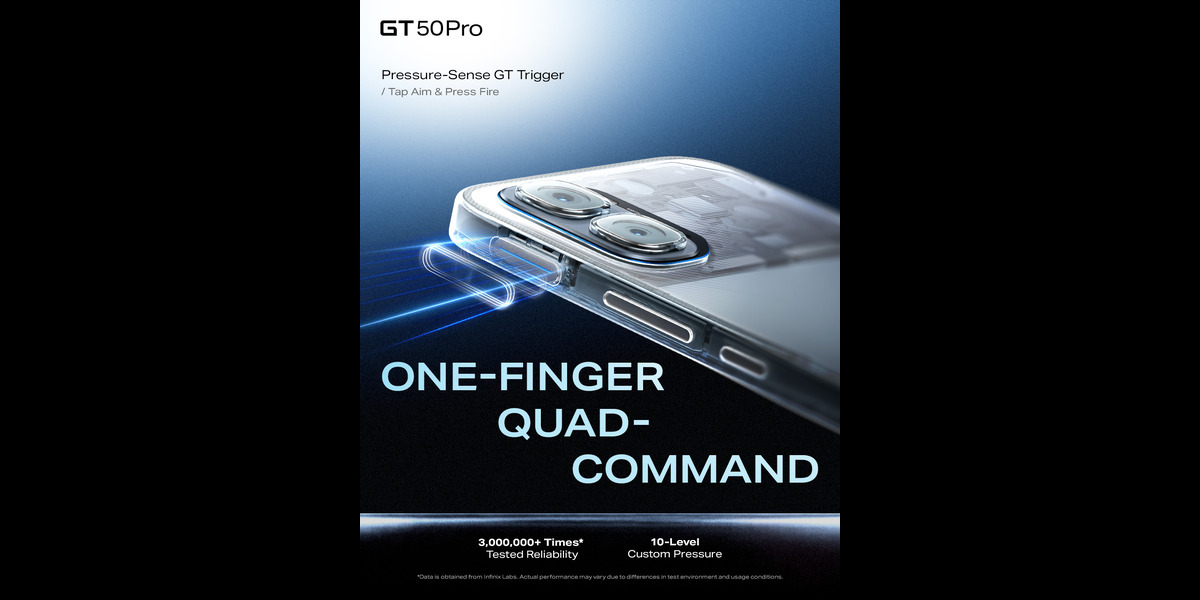
Mobile gaming has moved well beyond casual play. Competitive titles now demand sustained frame rates, responsive controls and hardware that can maintain performance through extended sessions. For players who take ranked matches, tournaments and competitive play seriously, peak performance for the first few minutes is no longer enough. The real test is what happens when the session gets longer and the hardware comes under sustained load.
This is where the Infinix GT 50 Pro takes a different approach. Rather than treating gaming performance as a combination of processor and display specifications, the device is built around three areas that directly affect competitive play: thermal management, frame-rate performance and control response.
At the centre of that approach is the GT 50 Pro’s HydroFlow Liquid Cooling system, paired with support for native 144FPS and the Pressure-Sense GT Trigger.
Cooling Is the Foundation of Sustained Performance
Heat is one of the less visible constraints on mobile gaming performance. As components operate under sustained load, rising temperatures can eventually lead to thermal throttling, reducing performance to keep the device within safe operating conditions. In a competitive game, that can translate into frame drops and inconsistent gameplay at precisely the wrong moment.
Also Read
The GT 50 Pro addresses this with HydroFlow Liquid Cooling, an active cooling architecture designed around the device’s major heat sources rather than simply adding thermal management as an afterthought.
Its system uses a dual-piezoelectric ceramic micro-pump to circulate coolant at up to 6.5ml per minute through precision laser-etched channels. The system’s 6,437mm² diaphragm is designed to provide coverage across the phone’s core heat sources, while the broader cooling architecture includes a 7,700mm² 3D vapour chamber and a total cooling area of 32,700mm².
The significance of these numbers is less about the size of the components individually and more about what they enable: keeping heat under control while the processor and graphics hardware remain under sustained load.
There is even a Pipeline Window on the rear of the phone that allows the movement of coolant through the system to be seen in real time, giving a normally invisible part of smartphone engineering a visible form.
For competitive gaming, that matters because performance is ultimately about consistency. A phone that can maintain its operating conditions over a longer session is more useful to a player than one that delivers high performance only at the beginning of a match.
144FPS Changes the Performance Equation

Cooling provides the foundation, but the GT 50 Pro also targets a higher performance ceiling.
Powered by the MediaTek Dimensity 8400 Ultimate, the device supports native 144FPS across six major gaming titles, including PUBG Mobile, Call of Duty: Mobile, Mobile Legends: Bang Bang, Blood Strike, Standoff 2, Arena Breakout and Free Fire.
The device combines this with MFRC frame interpolation and GPU-integrated frame generation, technologies designed to increase frame output while managing the workload placed on the graphics engine.
For a competitive player, higher frame rates are not simply about making a game look smoother. More frequent frame updates can contribute to smoother motion and more responsive visual feedback, particularly in fast-moving gameplay where players need to track targets, react to movement and make rapid decisions.
The more important consideration, however, is maintaining that performance over time. This is where the relationship between 144FPS and HydroFlow becomes significant. The GT 50 Pro is not simply pursuing a high frame-rate figure; its cooling architecture is designed to help the hardware sustain demanding workloads for longer periods.