Follow Us on Google Discover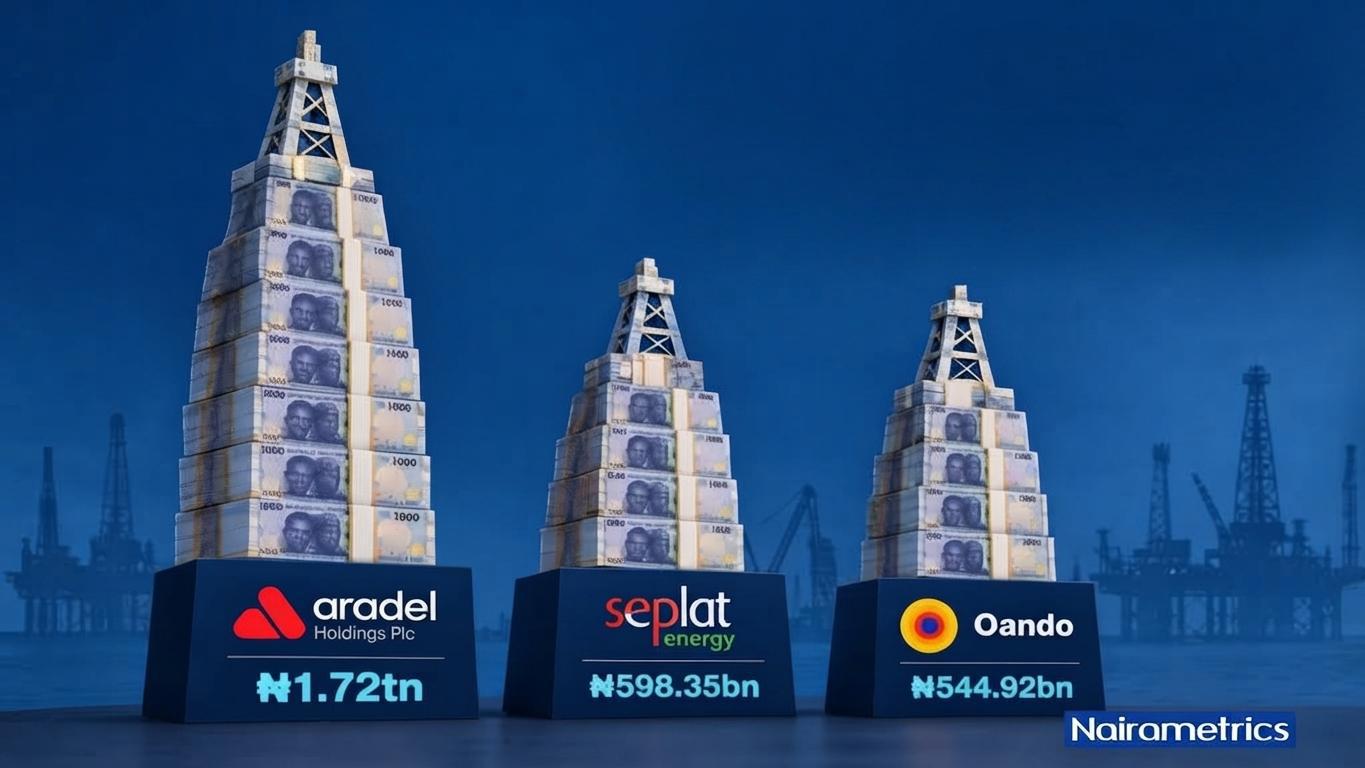
Aradel Holdings, Seplat Energy and Oando Plc built a combined N2.86 trillion cash war chest in the first half of 2026, providing substantial liquidity to support post-acquisition growth and higher production.
Financial statements reviewed by Nairametrics Research show that Aradel, Seplat and Oando ended H1 2026 with cash and cash equivalents of N1.72 trillion, N598.35 billion and N544.92 billion, respectively.
Their combined cash position increased by about N456.34 billion during the first six months of the year, reflecting stronger operating cash generation at Aradel and Seplat and increased financing activity at Oando as the companies move deeper into the investment phase of their expanded upstream portfolios.
What they are saying
Seplat and Oando have indicated that capital expenditure will remain a major priority in the second half of 2026 as they seek to increase production from their expanded asset portfolios. Both companies have outlined investment programmes focused on drilling, well interventions and other short-cycle activities.
Also Read
- “Cash capex run rate is expected to increase over the remaining quarters of 2026,” Seplat stated, citing increased drilling activity and describing full-year capital expenditure as “biased to 2H 2026.”
- Oando said one of its H2 priorities is to “deploy FY2026 capex of $90–100 million into short-cycle activity.”
Seplat expects eight rigs to be active during H2, compared with five in H1, while Oando’s planned expenditure will support new development wells and rig-less activities aimed at increasing and sustaining production.
More Insights
The size of the companies’ cash balances tells only part of the story, as there are significant differences in how the cash was generated and the financial commitments competing for the liquidity. Their investment programmes suggest the N2.86 trillion held at the end of June should not necessarily be viewed as idle cash.
- Aradel had the largest cash position, ending June with about N1.72 trillion. The company generated about $1.05 billion in cash from operations before tax and $737.66 million after tax during H1, allowing it to increase investment while reducing debt.
- It spent $217.45 million purchasing property, plant and equipment, compared with $31.07 million in H1 2025, while also repaying $184.61 million in borrowings, paying $105.85 million in interest and making $39.60 million in lease payments.
A significant portion of Aradel’s investment is going into assets still under development. The company recorded $217.43 million in additions to property, plant and equipment during H1, including about $189.59 million added to assets under development. Despite its investment and financing outflows, dollar-denominated cash and cash equivalents increased by about $197.15 million during the period.
- Seplat generated $985.9 million from operations during H1 but deployed only $109.8 million in cash capital expenditure. It ended June with $433.8 million in unrestricted cash, excluding another $130.8 million in restricted cash. Net debt declined 45% to $370.7 million from $673.3 million at the end of 2025 after the company repaid and cancelled $200 million under its Advanced Payment Facility.
- Oando spent N81.4 billion on capital expenditure during H1 2026, up from N48.3 billion in the corresponding period of 2025. The expenditure was largely directed towards upstream drilling across OMLs 60–63 and its non-operated portfolio as the company seeks additional production from the larger asset base created by its acquisition of Nigerian Agip Oil Company.
Aradel’s investment coincides with a significant increase in the scale of its operations following the consolidation of ND Western Limited and its resulting majority interest in Renaissance Africa Energy Company, with group production averaging 139,500 boepd during H1 2026 compared with 22,400 boepd a year earlier.
What you should know
The recent acquisitions have effectively moved the three indigenous producers into the next phase of their growth cycle.
- While the transactions expanded their reserves, assets and production bases, extracting additional value from those portfolios requires continued investment in drilling, well interventions, infrastructure and asset optimisation.
- Seplat, which entered 2026 with a significantly enlarged operation following its acquisition of Mobil Producing Nigeria Unlimited, maintained full-year working-interest capex guidance of between $360 million and $440 million.
- With only $109.8 million deployed in H1, approximately $250 million to $330 million could still be spent during H2 if expenditure ends within guidance.
This means roughly 69% to 75% of expected 2026 capital expenditure remained to be deployed at the end of June. The heavier H2 programme is expected to support production from new wells, the return of Yoho, the ramp-up of ANOH and completion of the first phase of Oso-BRT.
- Oando plans to deploy between $90 million and $100 million in capital expenditure for the full year. Its programme includes seven development wells and approximately 100 rig-less activities.
- The Idu 6ST well was drilled, completed and brought onstream during H1, while Samabri 4ST was also drilled and completed. At the end of H1, drilling was underway at Samabri 7 and Idu 15, while Idu T, Samabri A and Ogbanbiri were scheduled for H2.
- The rig-less interventions are aimed at restoring shut-in production, sustaining plateau output and mitigating natural field decline.
- The three companies also face different demands on their cash. Seplat increased its FY2026 cash tax guidance to between $600 million and $650 million following higher oil prices and expects underlying dividends related to 2026 business performance of about $270 million.
Oando, meanwhile, had about N2.70 trillion in borrowings at the end of June and plans to complete a N200 billion rights issue and advance a $1.5 billion issuance programme alongside its investment programme.
Production will ultimately be an important measure of the returns from the spending. Aradel maintained full-year production guidance of between 110,000 and 140,000 boepd.
- Seplat maintained guidance of between 135,000 and 155,000 boepd after averaging 139,509 boepd during H1, while Oando maintained guidance of between 40,000 and 50,000 boepd after averaging 42,789 boepd, a 16% year-on-year increase. Beyond 2026, Oando has identified 62 development wells and 55 planned well interventions as part of a pathway towards medium-term production of approximately 100,000 boepd.
- The N2.86 trillion cash position will therefore be an important metric heading into the next earnings cycle, which starts early October.
- Beyond whether the cash pile rises or falls, attention will be on how much of the liquidity is converted into productive capital expenditure, whether those investments translate into additional barrels and how much of the next phase of expansion can be financed from internally generated cash rather than additional borrowing.
Aradel and Seplat have seen their share prices rise by 163% and 177% respectively in the last one year. Oando, on the other hand, is down 29% in the same period as it positions for a new round of capital raise.