Follow Us on Google Discover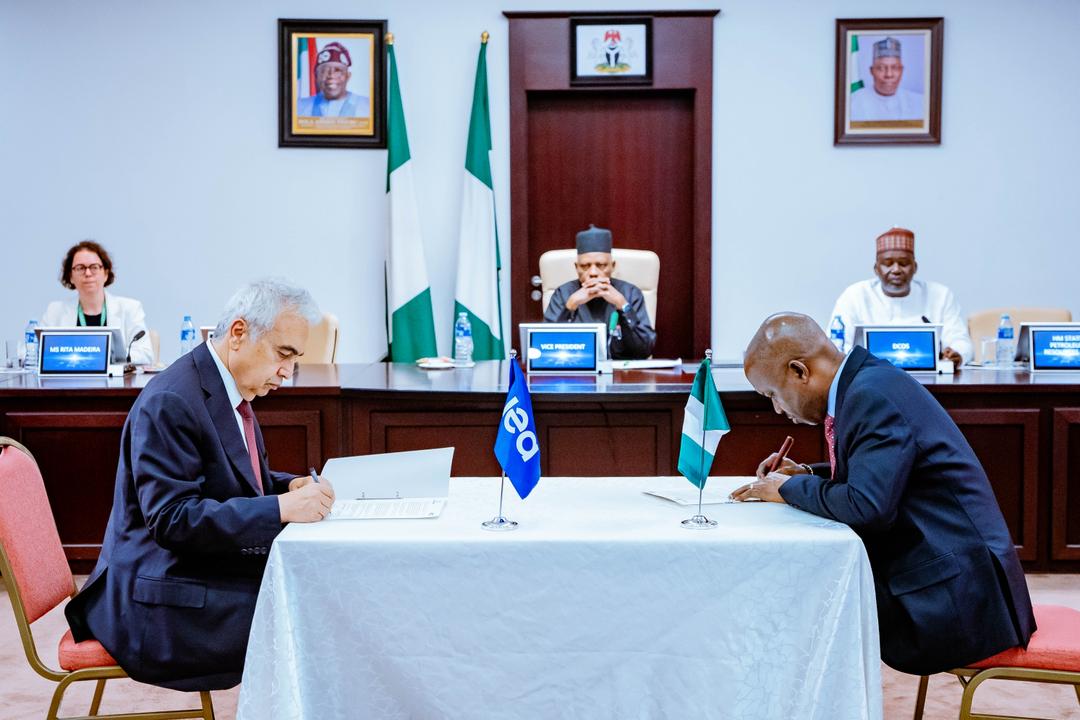
Nigeria and the International Energy Agency (IEA) have signed a Joint Work Programme aimed at improving energy data development and strengthening evidence-based policymaking and investment across the sector.
This is according to a statement signed by Stanley Nkwocha, Senior Special Assistant to the President on Media and Communications (Office of the Vice-President).
The agreement is expected to deepen cooperation between Nigeria and the IEA in the energy sector.
Also, Vice President Kashim Shettima described Nigeria’s formal admission as an IEA Association country as a major milestone, saying the partnership would give the country access to the agency’s technical expertise, institutional knowledge and global energy networks.
Also Read
Shettima spoke on Thursday in Abuja during the signing ceremony attended by Nigerian officials and a delegation from the Paris-based energy organisation.
What they are saying
Shettima said Nigeria’s admission reflected the country’s growing strategic importance in the global energy landscape and the confidence placed in its commitment to energy-sector reforms.
- “Nigeria’s admission as an association country with the IEA is a significant milestone for our country,” Shettima said.
He said the partnership would allow Nigeria to draw on the IEA’s expertise and global experience as the government seeks to advance its energy ambitions.
- The Vice President also highlighted Nigeria’s renewable energy potential and the administration’s efforts to reposition the economy by leveraging the country’s energy resources.
- He assured the IEA of Nigeria’s commitment to working with stakeholders towards a fair and just global energy transition.
IEA Executive Director Fatih Birol said the agency’s work spans major energy technologies and areas, including oil and gas, solar power, nuclear energy, artificial intelligence and electric vehicles.
Birol said Nigeria underwent extensive assessments before its admission was unanimously approved by the IEA Governing Board, which includes major economies such as the United States, Japan, Germany, Italy and the United Kingdom.
- “The IEA will accompany the Nigerian energy sector for the next few years to come for a much better energy future,” Birol said.
He said the agency would provide policy advice and technical assistance in areas including clean cooking, gas markets and capacity development for Nigerian energy professionals.
Minister of State for Petroleum Resources (Oil), Ekperikpe Ekpo, said the Joint Work Programme would provide technical support for the development of reliable energy data to guide decisions across Nigeria’s energy value chain.
According to him, the programme is expected to support economic growth, improve energy security and strengthen the country’s ability to attract investment into the sector.
Ekpo linked Nigeria’s admission to the IEA to reforms undertaken by the Tinubu administration, which he said demonstrated the government’s commitment to transforming the economy and energy industry.
Get up to speed
Nairametrics earlier reported that the IEA executive director had said Nigeria could potentially double investment in its energy sector within the next five years.
The IEA unanimously approved Nigeria’s admission into its Association framework in July 2026.
The agency had earlier noted that Africa’s upstream oil and gas investment fell to $37 billion in 2025 from $68 billion in 2016, with Nigeria and four other major producers accounting for most of the continent’s investment and production.
The agency said Algeria, Angola, Egypt, Nigeria and Libya have dominated the sector in the period under review.
What you should know
Nigeria has recently highlighted reforms aimed at improving investment in its upstream oil and gas sector.
The Nigerian Upstream Petroleum Regulatory Commission (NUPRC) said the reforms have unlocked more than $10 billion in upstream oil and gas investment.
The reforms, according to the regulator, are anchored on the Petroleum Industry Act (PIA), which was signed into law in 2021 to overhaul Nigeria’s oil and gas sector.
Recently, Nairametrics reported that thirty-one companies emerged winners of 37 oil and gas blocks following a competitive bidding process under Nigeria’s 2025 Licensing Round.