
 Follow Us on Google Discover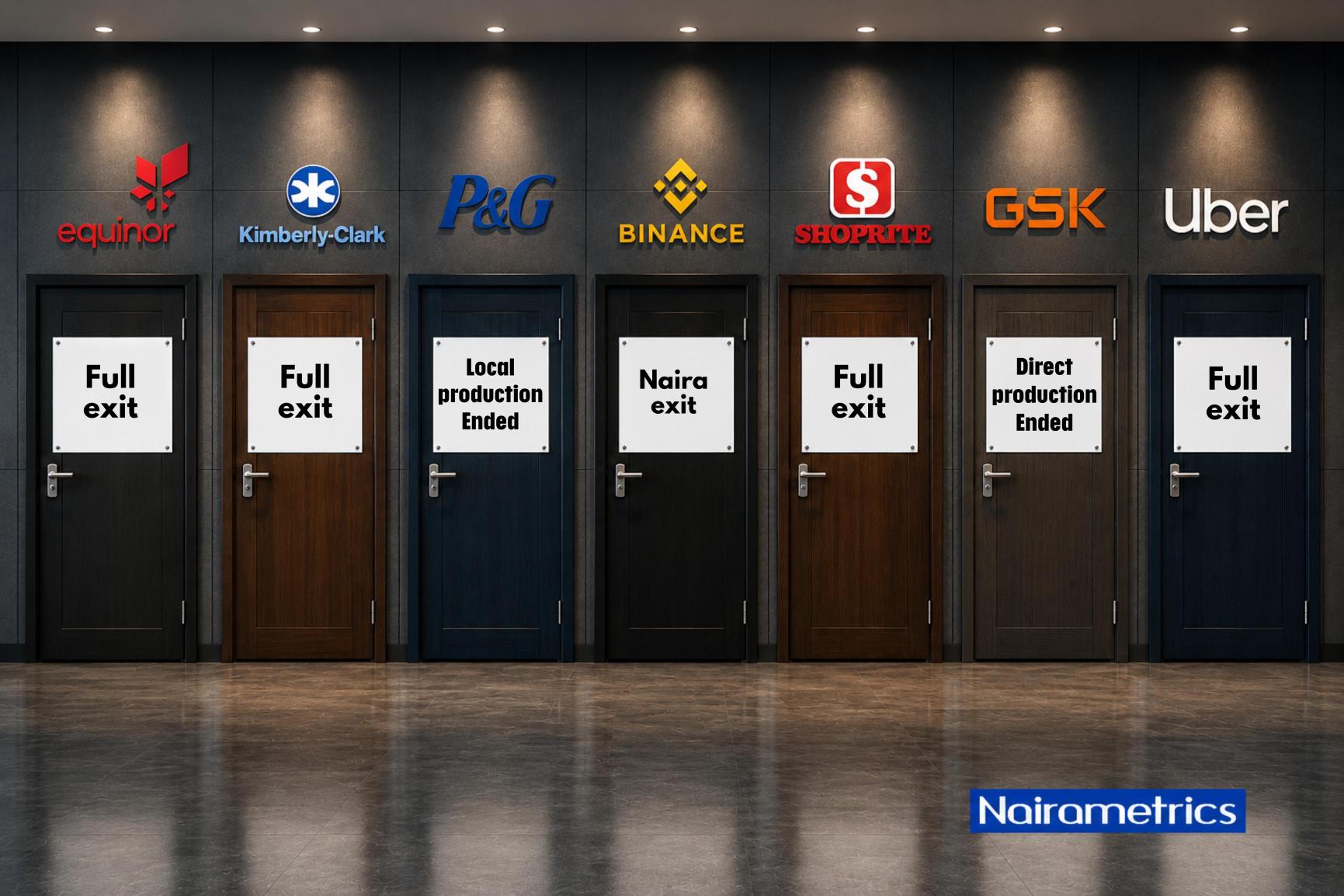
A wave of multinational exits, divestments and business restructuring has reshaped Nigeria’s corporate landscape since President Bola Tinubu assumed office in May 2023.
Several international companies have completely withdrawn from the Nigerian market, while others have stopped local manufacturing, transferred distribution to third parties or sold specific businesses and retained a presence in the country.
The trend has been linked in several cases to foreign exchange shortages, naira volatility, inflation, weak consumer purchasing power and rising operating costs.
Some analysts have noted that this trend exposes the pitfalls of Tinubu’s economic policies.
Also Read
Here are some of the major companies that have either fully exited, ended significant local operations or substantially scaled back their Nigerian businesses since 2023.
1. Equinor — Full exit
Norwegian energy company Equinor, operating since 1992, announced in November 2023 that it would sell its Nigerian business to Chappal Energies.
The transaction was completed on December 6, 2024, after receiving the required approvals, transferring all of Equinor’s Nigerian assets to the Nigerian-owned company.
Equinor said the deal marked its complete exit from Nigeria after more than 30 years in the country. Its assets included interests in OML 128 and the Agbami oil field.
The transaction was valued at up to $1.2 billion, comprising an initial purchase price of $710 million and contingent payments.
2. Kimberly-Clark — Full exit
Kimberly-Clark, the American manufacturer of Huggies and Kotex, announced in May 2024 that it would exit Nigeria after almost 15 years.
The company said it would close its manufacturing facility and commercial office in Lagos and stop manufacturing, marketing and selling Huggies and Kotex products in the country.
It attributed the decision to changes in its global strategic priorities as well as economic developments in Nigeria.
The company’s departure came only about two years after it reopened a $100 million manufacturing facility in Lagos.
3. Procter & Gamble — Local production discontinued
Procter & Gamble announced in December 2023 that it would wind down its on-ground operations in Nigeria and move to an import-only business model.
The company, whose brands include Pampers, Always, Ariel, Oral-B and Gillette, cited the difficulty of operating as a dollar-denominated company in Nigeria and the broader macroeconomic environment.
The decision effectively ended P&G’s local manufacturing operations, although its products continued to be available through imports.
Therefore, P&G is more accurately described as having exited local production rather than completely leaving Nigeria.
4. Binance — Naira market exit
Cryptocurrency exchange Binance discontinued all Nigerian naira services in March 2024 following a regulatory confrontation with the Nigerian government.
The company stopped accepting naira deposits, ended naira withdrawals and delisted naira trading pairs. Remaining naira balances were converted to USDT.
The decision followed increased scrutiny of cryptocurrency exchanges by Nigerian authorities amid concerns over foreign exchange market manipulation and illicit financial flows.
Binance, however, clarified that the move did not mean Nigerian users were completely locked out of the platform. Other Binance services and cryptocurrencies remained accessible.
5. Shoprite
In 2021, South Africa’s Shoprite Holdings sold its 25 Nigerian outlets to Ketron Investment Limited, a subsidiary of Persianas Investment, marking a shift from direct ownership to a franchise model.
However, the locally operated franchise struggled amid worsening macroeconomic conditions, including rising operating costs and declining consumer purchasing power. The challenges led to empty shelves and the closure of outlets in cities such as Ibadan and Ilorin, before the remaining stores were eventually shut down.
The closure brought an end to Shoprite’s nearly two-decade presence in Nigeria, which began in 2005, with the franchise exiting the Nigerian market completely by March 2026.
6. GlaxoSmithKline — Direct commercial operations scaled back
GlaxoSmithKline announced in August 2023 that it would stop selling its pharmaceutical products directly in Nigeria and transition to a third-party distribution model.
The decision affected GSK’s direct commercial operations, with products continuing to reach the Nigerian market through distributors.
The company cited operational difficulties, including challenges around foreign exchange and the cost of doing business.
GSK therefore represents a business-model exit from direct operations, rather than a complete withdrawal of its products from Nigeria. Its current website still lists Nigeria and says the company works with partners to deliver medicines and vaccines to patients.
7. Uber — Full exit in 2026
Uber became the latest major multinational to announce its departure from Nigeria.
The company announced on September 2, 2026 that it would cease its ride-hailing operations in the country after 12 years.
Uber launched in Lagos in 2014 before expanding to other Nigerian cities. The company said the decision followed a review of its business operations, although it did not provide a specific reason for the withdrawal.
The exit comes as Nigeria’s ride-hailing industry faces rising operating costs, fuel expenses, inflation and currency volatility.
Uber also clarified that its decision to leave Nigeria was not connected to the recent directive by the Federal Airports Authority of Nigeria (FAAN) concerning e hailing operations at Nigerian airports.
What this means for Nigeria
The departures and restructuring decisions nonetheless point to a challenging operating environment for multinational companies, particularly those dependent on imported inputs, foreign exchange and local consumer spending.
For manufacturers, naira depreciation and higher production costs have made local production more expensive, while weaker household purchasing power has constrained demand.
At the same time, the exits have created opportunities for Nigerian-owned companies and other investors to acquire assets previously controlled by multinational groups, as seen in Equinor’s sale to Chappal Energies.

We need capable hands to drive the economy towards prosperity. The leadership strategy must change.