Follow Us on Google Discover
A few weeks ago I wrote a piece asking why NGX was still being built for a $200 billion economy when Nigeria wants a $1 trillion one.
BusinessDay and Nairametrics picked it up, which put me on a set in Lagos on August 17, across from Nancy Nnaji on MoneyLine with Nancy on AIT.
Live television exposes where your numbers are soft. Nancy asked sharp questions, and halfway through I realized I was leaning on comparisons I hadn’t stress-tested.
So I asked our team at the Midlo Research Institute (MRI) — Midlothian Angel Network’s research arm — to build the comparison properly: Nigeria’s capital market against South Africa’s and the United States’, through December 2025 and early 2026. Then, almost on cue, FTSE Russell made an announcement that turned this into something with real stakes.
What MRI’s research actually showed
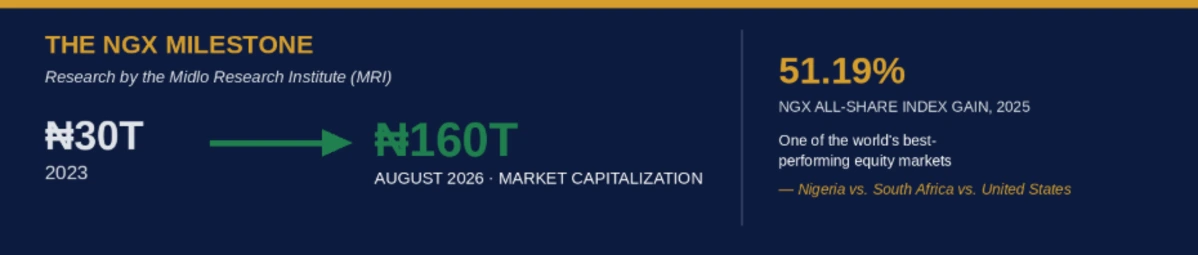
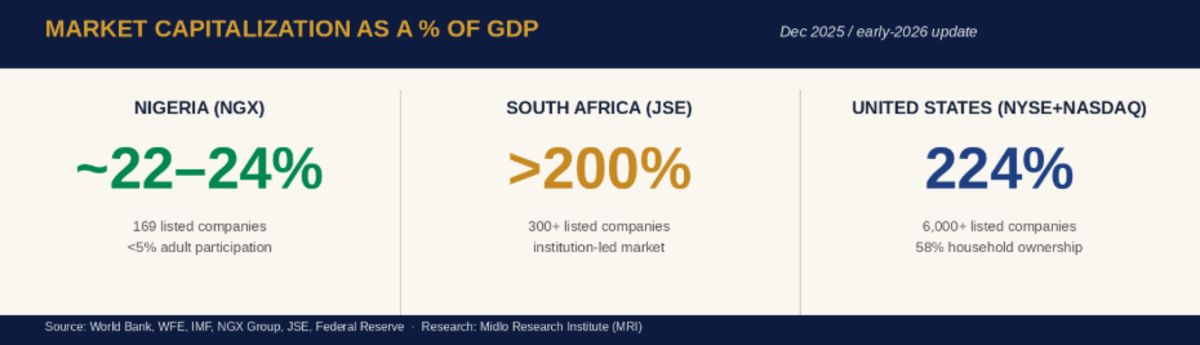
NGX closed out 2025 with equity market capitalization at ₦99.38 trillion — roughly $68.74 billion — after the All-Share Index gained 51.19%, one of the best-performing stock markets on the planet that year. By August 2026, that figure had pushed past ₦160 trillion. Against an economy of roughly $285-291 billion, market capitalization sits at around 22-24% of GDP.
South Africa’s JSE carries a market cap north of $1.3 trillion against a $427 billion economy — over 200% of GDP. The U.S. is starker: NYSE and Nasdaq combined carry more than $75 trillion against a $30.76 trillion economy, 224% as of the end of 2025.
South Africa and the U.S. have built markets worth more than their entire economies; Nigeria’s is worth less than a quarter of hers — not a knock on NGX’s real, earned 2025 growth, but a measure of how much room is left to run.
The same story repeats everywhere else MRI looked: 169 domestic companies listed on NGX against South Africa’s 300-plus and America’s 6,000-plus, and fewer than 5% of Nigerian adults invested in the capital market, against 58% of American households owning stock.
Millions of Nigerians already have bank accounts and use mobile money — inside the financial system, but rarely crossing into owning a piece of a company. A trust-and-access problem more than a liquidity one, and a fixable one.
Then FTSE Russell moved
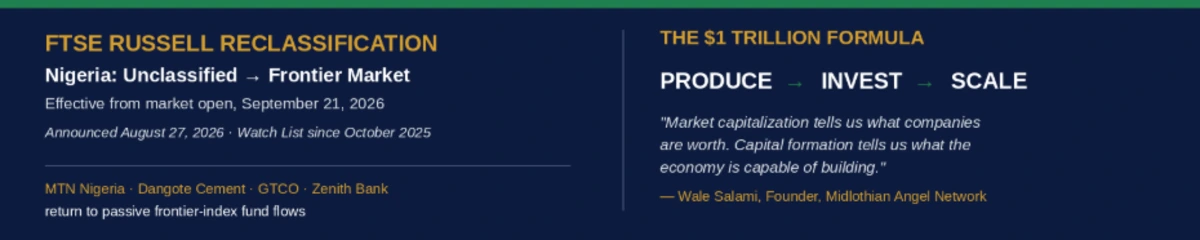
While MRI was finishing this research, FTSE Russell confirmed on August 27, 2026 that Nigeria will be reclassified from Unclassified back to Frontier Market status, effective September 21, 2026. Nigeria was dropped to Unclassified in September 2023 when FX backlogs made repatriation nearly impossible — bad enough that MSCI pulled it from its own Frontier Markets Index in early 2024. What turned it around was sustained, unglamorous reform: the Central Bank cleared the backlog and made repatriation reliable again.
Here’s the framing behind this headline: getting reclassified isn’t a promotion. It’s Nigeria getting back a job it already held before 2023 and lost. FTSE didn’t reward something new — it stopped penalizing a problem Nigeria finally fixed. MTN Nigeria, Dangote Cement, GTCO, and Zenith Bank move back onto portfolios they’d been excluded from for three years. Capital returning, not arriving for the first time.
Read most of the coverage, though, and it’s almost entirely forward-looking: milestone language, opportunity language. Missing is anyone in authority walking the public through what actually broke between 2020 and 2023, in plain terms. Popoola framed the moment as a chance to turn visibility into deeper participation — the right instinct for a CEO managing momentum.
But a country doesn’t build durable trust with global capital only narrating its wins. Three years closed to the world deserves a public accounting, not a party for getting back what it lost.
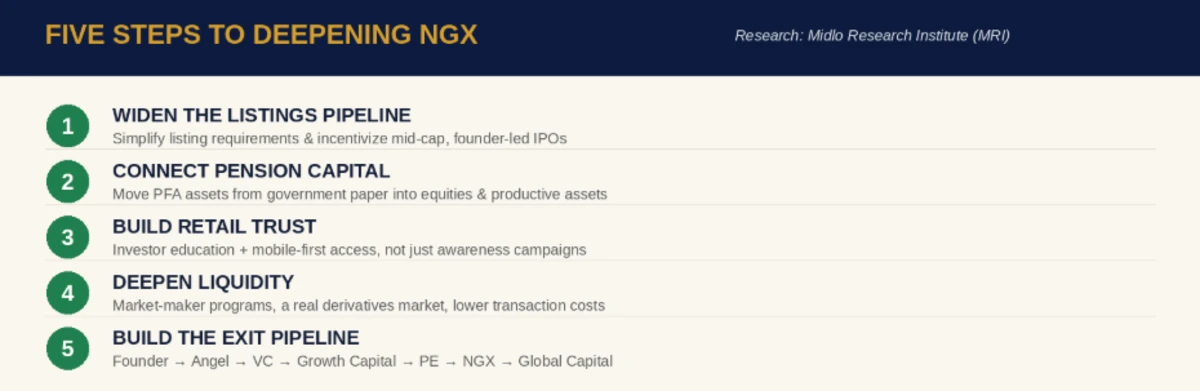
Five steps to actually deepen NGX
Getting the old job back isn’t the same as growing into a bigger one. Based on MRI’s research across all three markets, here’s where I’d start if the goal is closing the gap with South Africa and the U.S. — not just celebrating a reclassification:
1. Widen the listings pipeline. Nigeria has 169 domestic companies listed against South Africa’s 300-plus and America’s 6,000-plus. That gap won’t close through NNPC and a handful of state-linked giants. NGX and regulators need a real on-ramp for mid-sized, family-owned, and founder-led businesses — simplified listing requirements, tax incentives tied to going public, and a visible cohort of companies moving from private to public each year.
2. Connect pension capital to productive assets. Nigeria’s pension industry sits on trillions of naira in assets, much of it parked in government securities rather than equities or productive private investment. South Africa’s institutional investor base is a major reason the JSE carries the depth it does. Nigeria needs PFAs actively allocating into equities, infrastructure funds, and private credit — not just the safest paper available.
3. Build retail trust before chasing retail volume. Fewer than 5% of Nigerian adults invest in the capital market, even though most of them already use mobile money or have a bank account. That’s a trust gap more than an access gap. Closing it means real investor education, mobile-first brokerage onboarding, and visible investor protection — not another awareness campaign that assumes ignorance is the whole problem.
4. Deepen liquidity, not just headline value. Nigeria’s value of shares traded as a share of GDP is a fraction of South Africa’s. A market can grow in market capitalization while staying thin in actual trading activity, and that’s largely what’s happened. Market-maker programs, a functioning derivatives market, and lower transaction costs would all help turn paper gains into a market people can actually move money through.
5. Build the exit pipeline founders are missing. Nigeria has gotten much better at financing startups at the angel and VC stage. What’s still missing is the next leg: growth capital, private equity, and a credible path to NGX for a company that’s reached real scale. Without that pipeline — Founder to Angel to VC to Growth Capital to Private Equity to NGX to Global Capital — the country’s best companies keep looking outside Nigeria for their next raise, and NGX never gets the chance to list them.
None of these five require waiting on FTSE, MSCI, or S&P Dow Jones. They’re domestic homework — the actual difference between a market that’s 22% of GDP and one that’s 200%.
Ten capital-market-ready private companies
Step one — widening the pipeline — isn’t hypothetical. Nigeria already has private companies with the scale and brand recognition to list if the incentives were right:
- 1. Globacom — telecom scale rivaling MTN Nigeria and Airtel Africa.
- 2. Interswitch — payments infrastructure, long rumored as a listing candidate.
- 3. Flutterwave — pan-African fintech unicorn.
- 4. OPay — one of Africa’s most valuable fintech platforms.
- 5. Honeywell Group — conglomerate in flour milling, real estate, energy.
- 6. Sahara Group — major private player in energy trading and power.
- 7. Dufil Prima Foods (Indomie) — dominant consumer staples manufacturer.
- 8. Air Peace — Nigeria’s largest airline, expanding internationally.
- 9. Coscharis Group — conglomerate in automotive, agriculture, logistics.
- 10. Food Concepts (Chicken Republic) — leading QSR chain, regional reach.
A market serious about deepening itself should be courting this tier — not waiting for them to look abroad first.
Produce. Invest. Scale.
The formula I keep coming back to hasn’t changed: produce more, mobilize capital into productive assets, and help Nigerian businesses scale globally from a Nigerian base. FTSE Russell just made part of that easier. What Nigeria does with the five steps above is still unwritten — that’s the part I’ll be watching closest.
If you’re one of the 95% of Nigerian adults not yet in this market, Frontier status doesn’t change your personal calculus much on its own. But it’s a signal that the guardrails — FX repatriation, settlement speed, regulatory credibility — are finally catching up to global norms. That’s the backdrop against which “should I open a brokerage account” starts to look like a different question than it did three years ago.
Wale Salami is a Nigerian-born American angel investor, venture capitalist, faith-driven entrepreneur, and private capital practitioner. He is the Founder of the Midlothian Angel Network, an investment community focused on backing entrepreneurs and expanding access to private capital across Africa and the diaspora. He also leads the Midlo Research Institute (MRI), Midlo Angels’ research arm, which produced the comparative capital markets research featured in this piece.