Follow Us on Google Discover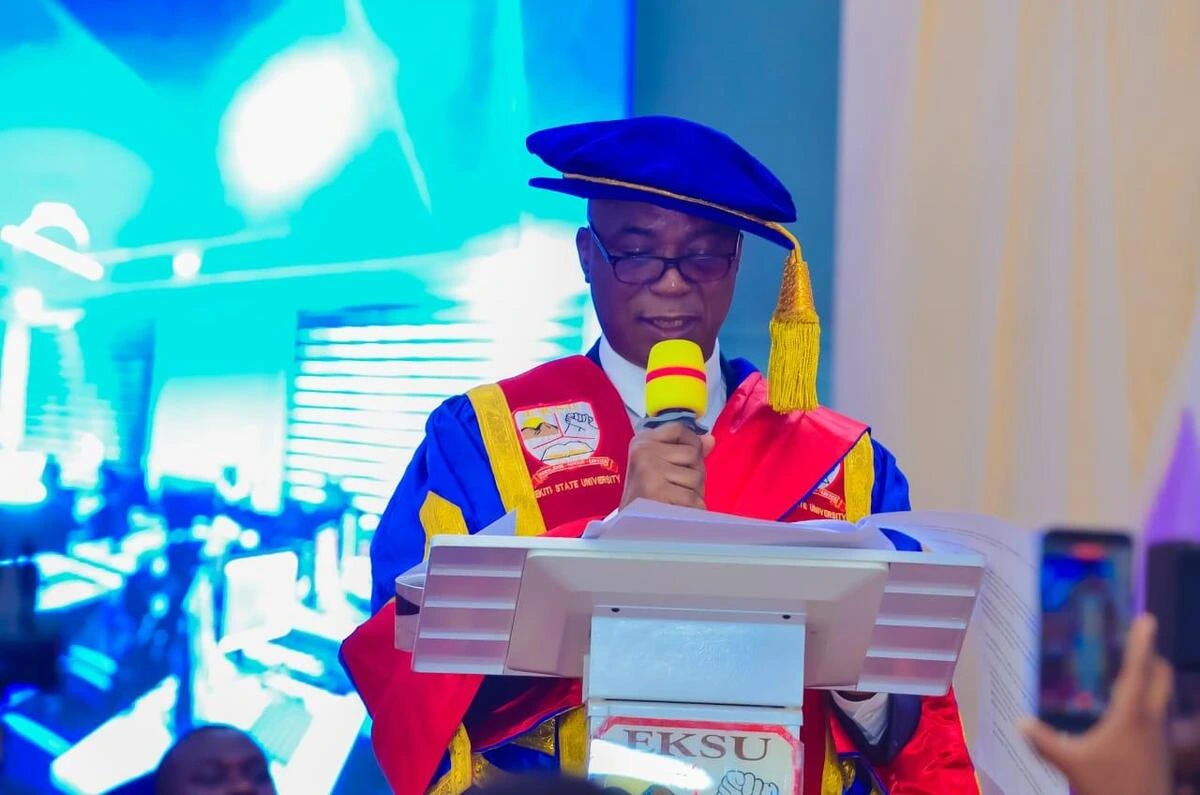
A new generation of financially savvy students is set to emerge from Ekiti State University (EKSU), Ado-Ekiti, as the pioneer cohort of its Professional Diploma Programme — EKSU Financial Markets Training Program (E-FMTP) in Securities Trading and Financial Markets — prepares to graduate before the end of 2026.
The impending graduation marks a major milestone in the university’s drive to move financial education from the confines of lecture halls to the realities of the global financial marketplace.
At the heart of the initiative is the EKSU Trading Room, a state-of-the-art facility established through the vision of the University’s Chancellor, Dr. Tunji Olowolafe, and the financial backing of the Tunji Olowolafe Foundation (TOF).
The eight-month Professional Diploma Programme was approved by the University Senate on February 25, 2026, and the first cohort is now approaching graduation.
”The first cohort of the Diploma Programme will graduate before the end of the year,” Professor Oke Michael Ojo of the Department of Finance disclosed.
This development places EKSU in direct alignment with the vision of President Bola Ahmed Tinubu on building a sustainable economy through improved financial literacy and investment education.
- ”If we can teach this [stock market] in the classroom to our undergraduates, we can build a nation of succession and prosperity,” the President had stated when he hosted the leadership of the Nigerian Xchange Group (NGX) at the State House recently.
Echoing this national objective, Dr. Tunji Olowolafe, a frontline scholar and academician, emphasized that the traditional academic model must urgently evolve to meet the needs of a rapidly transforming global economy.
- ”A large percentage of recent graduates seeking finance roles lack the critical, practical skills demanded by modern capital markets,” Dr. Olowolafe observed.
- “Our vision with the E-FMTP is to pioneer a fundamental paradigm shift in African higher education — moving from rote theoretical learning to real-time execution. By providing students with access to a fully accredited diploma programme, live simulated dealing rooms, and global virtual work experiences, we are not just giving them a degree; we are instilling a professional instinct. We are equipping our youth to command global trading desks from day one, transforming university classrooms into incubators for economic powerhouse leaders. This model must become the blueprint replicated across all Nigerian universities.”
In short, Dr. Olowolafe’s vision for E-FMTP is to turn university classrooms into high-tech trading floors that transform students into market-ready financial powerhouses.
For EKSU, the impending graduation is more than an academic ceremony. It represents the first major test of a bold concept designed to produce graduates who can enter the financial industry with practical market experience rather than certificates alone.
Professor Ojo explained that the Trading Room was deliberately established to bridge the gap between classroom theory and actual financial markets, noting that the curriculum was built deliberately, one building block at a time.
- ”We combined theoretical instruction with practical simulations so students gain a full, hands-on understanding of risk management, investment strategies, and live trading in global markets,” Prof. Ojo said.
Lecturers also recognize the value of E-FMTP — by integrating theoretical concepts with real-time simulations, it serves as a powerful pedagogical tool that elevates instructional delivery.
The Trading Room, supported technically by the CFA Institute, is the first financial dealing and trading room established in any university in Sub-Saharan Africa.
The facility features 20 trading stations equipped with dual monitors, a 75” Smart television screen, an optimized sound system, solar inverter backup, three high-capacity air-conditioning units, and high-speed internet connectivity. Students also wear professional trading vests to replicate the atmosphere of a live dealing room.
The roots of the programme trace back to September 2024, when selected EKSU students traveled to Lagos for a financial literacy programme and study visit to FMDQ Exchange in Victoria Island. The experience inspired the establishment of the EKSU Investment Club (ICESU), which provides students with access to CFA Institute learning resources, career opportunities, internships, examination scholarships, project grants, and investment conferences — forming a foundational block for the university’s broader financial education strategy.
’Graduates Need More Than Certificates’
For Ms. Bomo Anthony, General Manager of TOF, the significance of the project goes far beyond the computers, trading screens, and infrastructure.
- “I’ve watched these students grow, week by week, from learning about shares and bonds to actually placing a trade,” she said. “That’s the moment it stops being a classroom exercise and starts being a career.”
Bomo described the founder’s vision as “indeed in the right direction,” stressing that the initiative equips students for the realities of the modern economy.
- “This investment only pays off if the students protect it and build on it,” she added. “What we’re graduating isn’t just a cohort — it’s a group of young people who already think like professionals.”
As the pioneer students prepare to receive their professional diplomas, EKSU is positioning their graduation as a demonstration of what happens when university education, technology, industry expertise, and private-sector investment converge.
With the pioneer cohort’s success setting the template, TOF and EKSU are already looking ahead: applications for the next cohort will open at the start of the new academic year, extending the Trading Room’s reach to a fresh intake of students — marking the expansion of Dr. Olowolafe’s vision to turn financial education into practical economic power.