Follow Us on Google Discover
The Nigerian Content Development and Monitoring Board (NCDMB) has extended the impact of its human-capacity-development initiatives by sponsoring the second and third phases of the Training-of-Trainers Programme on Information and Communication Technology, Artificial Intelligence and Digital Skills for instructors of the Nigeria Police Force.
The five-day programmes, conducted in Lagos for the South-West and Abuja for the North-Central, are designed to strengthen the Force’s digital-policing capacity and establish a network of competent trainers capable of transferring the acquired knowledge to recruits, cadets and serving officers across police training institutions and commands nationwide.
The initiative underscores NCDMB’s recognition that sustainable economic development depends not only on industrial competence but also on strong, secure and technologically capable national institutions.
Although the Board’s core mandate is rooted in the Nigerian oil and gas industry, its investments in human capital, technology and knowledge transfer continue to generate benefits that extend to other critical sectors of national development.
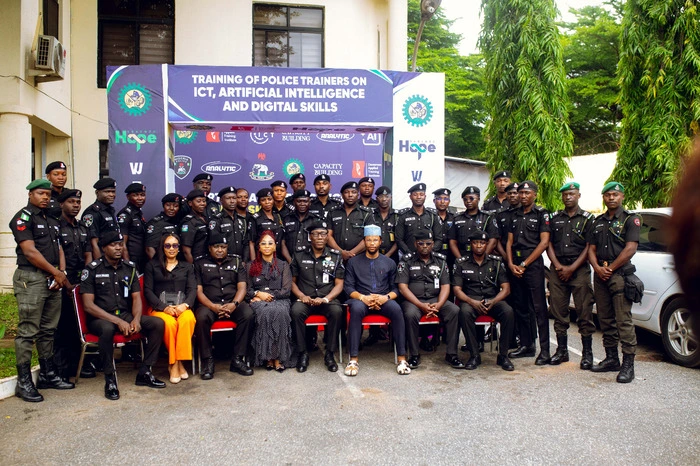
Speaking at the opening ceremony, the Deputy Inspector-General of Police in charge of Training and Development, DIG Isyaku Mohammed, described the programme as an important step towards building a more technologically proficient, intelligence-driven and responsive Police Force capable of addressing emerging and technology-enabled security threats.
He noted that modern policing requires officers who can understand and responsibly apply digital tools in crime prevention, intelligence gathering, investigation, evidence management and public-safety operations.
The Assistant Inspector-General of Police in charge of Training, AIG Uche Ifeanyi, PhD, observed that emerging technologies are providing criminals with increasingly sophisticated tools for perpetrating crime. He said the Inspector-General of Police had consequently prioritised the adoption of technology as an essential component of modern policing.
According to him, the Training Department considered it necessary to equip police personnel with the technological and artificial-intelligence skills required to prevent, detect and investigate conventional and AI-enabled crimes.
“This training is designed to strengthen the capacity of police officers to respond effectively to evolving security threats and protect the public in today’s digital environment,” he said.
Also speaking on behalf of the Deputy Inspector-General of Police, the Commandant of the Police Training College, Ikeja, AIG Omolara Oloruntola, said the changing nature of crime required officers to continuously develop relevant digital competencies.
She explained that the programme was not limited to improving the capabilities of the immediate participants. As a Training-of-Trainers intervention, it would prepare them to return to their respective institutions and commands to train recruits, cadets and serving personnel.
AIG Oloruntola commended NCDMB for sponsoring the programme, describing the collaboration as a significant contribution towards strengthening the Nigeria Police Force through technology-driven training and institutional development.
Representing NCDMB, Mr Uche Malachy described the programme as a strategic investment aligned with the Board’s commitment to human-capacity development under the Nigerian Oil and Gas Industry Content Development Act, 2010.
He emphasised that a secure, digitally skilled and technologically advanced Police Force was essential to safeguarding lives and property, strengthening national security and creating the stable environment required for investment and sustainable economic growth.
NCDMB’s sponsorship demonstrates an increasingly integrated approach to national capacity development. By supporting the development of digital competence within a vital institution such as the Nigeria Police Force, the Board is helping to strengthen the wider ecosystem upon which Nigeria’s industries, businesses and communities depend.
The intervention also reflects the importance of collaboration among regulators, security institutions and indigenous training organisations in addressing emerging national challenges. Through such partnerships, specialised knowledge can be transferred, institutional capabilities strengthened and sustainable pools of skilled personnel created.
The programme is being delivered by Dexterous Applied Training Institute (DATI), an indigenous technical and professional training institution with experience in designing and implementing practical workforce-development programmes across the oil and gas, maritime, engineering, safety and digital-technology sectors.
DATI adopted an application-focused delivery model combining interactive instruction, demonstrations, simulations, case studies, supervised exercises and trainer-development sessions. This approach is intended to ensure that participants move beyond theoretical knowledge to the practical and responsible application of digital tools in policing.
Chief Training Officer of DATI, Dr Scott Onyekachi, said the increasing use of digital platforms, artificial intelligence and other emerging technologies by criminal networks made it imperative for law-enforcement agencies to remain ahead of evolving threats.
He explained that the programme covers AI-assisted investigations, cybersecurity, crime mapping, drone technology, digital-evidence management and digital-record management, while reinforcing ethical policing, data protection, accountability and respect for human rights.
According to him, DATI’s role is not merely to expose participants to technology but to help them develop practical competencies they can demonstrate, apply and transfer to other officers.
“The true measure of the programme’s success will not be the number of certificates issued, but the extent to which the participants apply the knowledge, train others and produce measurable improvements in policing operations,” Onyekachi said.
The Institute’s involvement further highlights the growing capability of Nigerian training organisations to develop and deliver hands-on programmes tailored to the operational requirements of diverse industries and public institutions.
At the conclusion of each phase, participants are expected to possess stronger digital-policing capabilities and the instructional competence required to cascade the training across the Force. The programme is also expected to improve the use of technology in investigations, intelligence analysis, records administration, digital-evidence handling and other areas of police operations.
Through this initiative, NCDMB is reinforcing the principle that investment in people remains central to institutional effectiveness and national progress. Its partnership with the Nigeria Police Force and DATI demonstrates how targeted human-capacity development can strengthen public institutions, support national security and contribute to the enabling environment required for economic prosperity.