Follow Us on Google Discover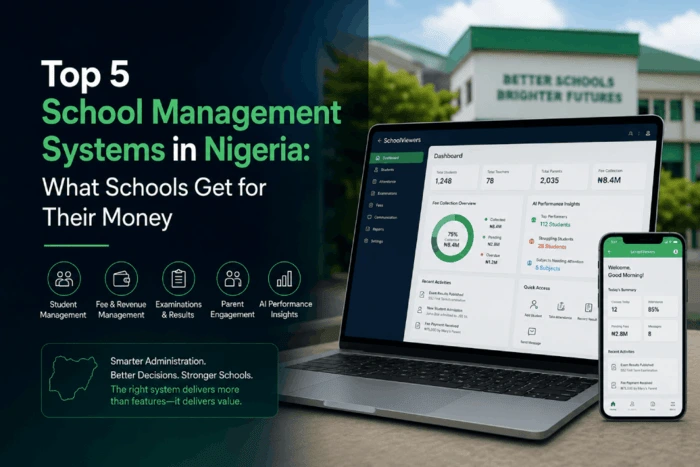
For many Nigerian private schools, technology is no longer a luxury. It is becoming part of the basic infrastructure required to run a competitive school.
A school proprietor may need to manage hundreds of student records, calculate continuous assessment and examination results, monitor school fees, communicate with parents, conduct computer-based tests, process admissions and manage staff payroll—all while keeping operating costs under control.
This is where school management software comes in.
A modern school management system in Nigeria can replace multiple spreadsheets, paper files and disconnected applications with a central platform for managing academic and administrative operations.
But the question for school owners is not simply which platform has the most features.
It is what does the school actually get for its money?
A cheaper system that cannot handle the school’s workflow may become expensive in staff time and administrative inefficiency. Conversely, a feature-heavy platform with a high implementation cost may be excessive for a smaller school.
We examined five notable options based on functionality, affordability, Nigerian relevance, scalability, academic technology, financial management and the practical value they offer schools.
1. SchoolViewers — Best Overall Value
SchoolViewers ranks first because it combines a wide range of school-management functions with a pricing model that makes the platform accessible to both smaller schools and larger institutions.
The platform covers student information management, result processing, report cards, parent and student portals, attendance, timetables, lesson notes, fees, expenses, payroll, computer-based testing (CBT), online admission and digital school administration.
It also goes beyond simply recording school fees. Its revenue-protection tools are designed to help schools manage outstanding fees and connect fee clearance with access to selected school services.
For schools looking for a school management software solution that covers both academic and administrative operations, that breadth is significant.
What makes the pricing different?
SchoolViewers offers a free Starter plan for schools with up to 100 active students. Its paid plans are based on active students rather than requiring a large upfront licence or installation cost.
The current active-student-based paid plans starts at ₦300 per student for the Micro plan, ₦600 for Growth and ₦1,000 for Professional, with billing based on a 120-day cycle. Different plans unlock progressively more functionality.
That pricing model is particularly relevant to Nigerian schools because the cost scales with the size of the active student population.
It is not just about administration
SchoolViewers has also introduced some enterprise-grade AI capabilities, including AI Performance Insights, which analyses student results to identify top performers, struggling students and subjects requiring attention.
For school administrators, this changes the role of a result management system. Instead of simply producing report cards and broadsheets, the data can also be used to identify where academic intervention may be needed.
For a proprietor trying to get more value from a school management platform, this combination of administration, financial management, academic tools and emerging AI capabilities makes SchoolViewers the strongest overall value in this comparison.
Best for: Private schools looking for broad functionality, affordable scaling, revenue protection and increasingly intelligent academic management.
2. FlexiSAF / SAFSMS — Best Established Option
FlexiSAF’s SAFSMS is one of the established names in Nigeria’s education technology space.
Its platform is built around comprehensive school administration, covering areas such as student information, academic records, attendance, fees, results and other administrative processes.
Its longevity and experience in the Nigerian education market can be valuable to schools looking for an established provider with a broad school ERP approach.
However, schools should compare the overall cost of implementation and ongoing use with newer platforms, particularly where the institution has a smaller student population.
Best for: Established schools and larger institutions looking for a mature school administration system.
3. Edves — Best for Connected School Operations
Edves has established itself as another prominent Nigerian education technology platform, with tools covering school administration, student information, fees, academics, communication and parent engagement.
Its broader ecosystem approach is useful for schools that want to give parents greater digital access while bringing different aspects of school administration into one environment.
For schools where parent communication and engagement are important parts of the digital strategy, Edves is worth considering.
The trade-off, as with many broad platforms, is that schools need to assess which features they will actually use and whether the total cost is justified by their operational requirements.
Best for: Private schools seeking broad administrative and parent-engagement capabilities.
4. ExcelMind — Best for Academic and CBT Needs
ExcelMind has developed a strong identity around academic management and examination technology.
Its capabilities include school administration, academic records and computer-based testing, making it particularly relevant to schools that place considerable emphasis on digital examinations.
CBT is becoming increasingly important as Nigerian students prepare for examinations and schools increasingly conduct internal assessments digitally.
For institutions where an online examination system, examination preparation and academic technology are major priorities, ExcelMind can be an attractive option.
Its main consideration is whether a school’s wider administrative needs are adequately covered compared with more comprehensive school ERP platforms.
Best for: Schools prioritising academic management, examinations and CBT.
5. SchoolHub — Best for AI-Assisted Administration
SchoolHub represents a newer generation of school-management software that combines conventional school administration with AI-assisted tools.
Its platform covers areas including student records, attendance, fees, report cards, parent communication, timetables and CBT, while also introducing AI-assisted lesson planning and related capabilities.
The emergence of AI in school software is significant. The technology is increasingly moving beyond chatbots and content generation into practical analysis and workflow automation.
For schools interested in experimenting with AI-assisted administration and teaching workflows, SchoolHub is an interesting option.
However, schools should still evaluate the fundamentals—student information management, fees, results, communication, reliability and cost—before allowing the presence of AI to become the deciding factor.
Best for: Schools interested in combining conventional school administration with newer AI-powered tools.
What Should Schools Look for Before Paying?
The most important consideration is not the number of modules displayed on a software provider’s website.
It is whether the system solves the school’s actual problems.
Academic management
A good platform should make it easier for teachers to enter CA and examination scores, calculate results, produce report cards and generate broadsheets. Schools conducting digital assessments should also examine the quality of the online examination system and CBT functionality.
Fee management and revenue protection
For many private schools, fee collection is one of the biggest administrative challenges. A useful system should provide more than payment records. Fee balances, reminders, receipts, clearance and reporting can all influence the financial value of the software.
Parent and student access
A modern school portal should reduce unnecessary trips and phone calls by allowing parents and students to access relevant information online. Results, announcements, fee information and other school records can be delivered through parent and student portals.
Scalability
A platform that works well for 100 students should not become financially or technically impractical when the school reaches 500 or 1,000 students.
Schools should therefore examine the pricing model, not just the headline price. Student-based pricing can make expenditure easier to forecast as enrolment changes.
AI and data-driven decisions
AI is becoming another differentiator. But schools should ask what the AI actually does.
There is a meaningful difference between a platform that simply advertises “AI features” and one that can turn existing school data into useful insights.
Tools such as AI student performance analysis can potentially help schools identify high performers, struggling students and subjects that require additional attention.
Final Verdict
There is no single school management system that will be perfect for every Nigerian school.
A small nursery and primary school may prioritise affordability and simple result management. A large secondary school may need CBT, fee enforcement, payroll, accounting and advanced reporting. An international school may have entirely different requirements.
Nevertheless, SchoolViewers offers the strongest overall value in this comparison because it brings together a substantial range of academic, administrative and financial functions without requiring schools to begin with a large software investment.
Its free entry point gives smaller schools a way to start digitising, while its student-based paid plans provide a path to scale. Its combination of result management, CBT, online admission, fees, attendance, expenses, payroll and parent portals makes it more than a simple student information system.
The addition of AI Performance Insights also points to where school-management software is heading: from merely storing information to helping school administrators interpret it and make better decisions.
For Nigerian school proprietors, that distinction matters.
The best school management software is ultimately not the one with the longest feature list. It is the one that delivers enough practical value to justify its cost—by saving administrative time, improving academic oversight, strengthening fee management and giving schools a clearer picture of what is happening across their operations.
On that measure, SchoolViewers currently offers one of the most compelling value propositions in Nigeria’s school-management software market.