Follow Us on Google Discover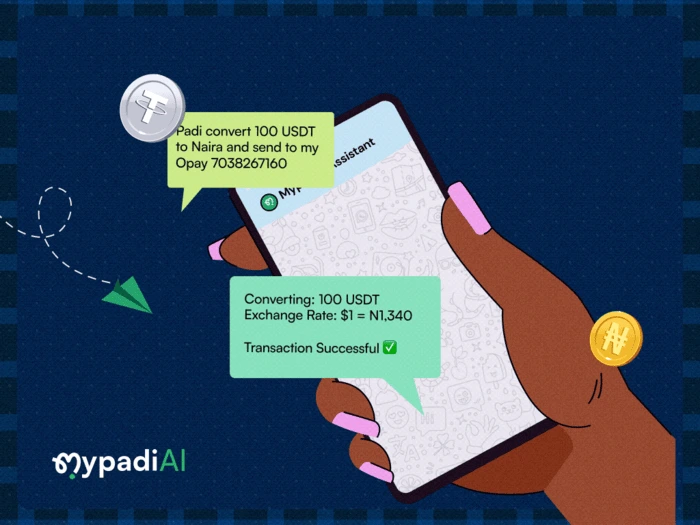
Nigeria is home to one of the largest peer-to-peer cryptocurrency markets in the world, and more than half of its active crypto investors are under the age of thirty.
This massive scale has outpaced the infrastructure built to serve it responsibly, and the gap between it has left behind is exactly where MyPadi AI has planted itself.
Launched in May 2026, MyPadi AI is a WhatsApp based AI platform that converts Bitcoin, Ethereum, and Tether USDT into Naira and South African Rand through ordinary chat commands, with funds settling straight into a user’s bank account.
In a market this size, a platform that closes the gap between owning crypto and actually spending it is not a small feature. It is infrastructure, and Nigeria’s crypto economy has been waiting for someone to build it properly.
The cost of the gap MyPadi AI is closing
Nigeria’s crypto boom has largely been driven by peer-to-peer trading, because for years it remained the fastest way to move value in and out of digital assets.
That speed came at a price. Vendors disappeared mid transaction. Payment screenshots were faked convincingly enough to fool experienced traders. Rates shifted without warning between agreement and settlement, and every one of these frictions carried a real financial cost that fell hardest on the young, first time users who make up the bulk of the market.
That same friction shows up differently for businesses. A merchant accepting crypto payments from customers abroad is exposed to market volatility for as long as that payment sits unconverted, which means a good sale can quietly lose value before it ever reaches a bank account.
For a platform built around instant conversion, that is not a convenience, it is basic risk management, and it is precisely the kind of problem that turns a product into infrastructure rather than a nice to have.
There is a time cost too, one that rarely shows up in market reports but compounds across a market this size. Waiting on a vendor to respond, confirming a rate, and verifying a payment can stretch a transaction that should take minutes into an ordeal that eats an entire evening. MyPadi AI collapses that entire process into a single chat, which is exactly why it has moved so quickly from launch to being talked about as a category defining platform.
Trust has always been the largest barrier to broader crypto adoption in Nigeria, and MyPadi AI’s architecture treats that barrier as the actual product to solve. The platform runs on WhatsApp’s end to end encryption, requires PIN verification for every transaction, and layers in multi factor authentication, transaction validation protocols, secure API integrations, and blockchain level verification workflows. None of these measures are unique in isolation.
What sets MyPadi AI apart is removing the counterparty risk entirely, rather than simply making it easier to spot a bad one, which is a fundamentally different way of solving the same problem the rest of the market has spent years managing rather than eliminating.
Nigeria’s approach to digital assets has moved considerably in recent years, from early caution around bank involvement in crypto transactions toward a coordinated framework for licensing and monitoring virtual asset service providers.
In August 2026, the Central Bank of Nigeria opened applications for the second cohort of its regulatory sandbox, with a dedicated track for on and off ramp companies, payment processors, and wallet service providers, a clear signal that this category is now firmly on the regulator’s radar rather than sitting in a grey area.
Platforms that treat compliance as a foundation rather than an afterthought are the ones best positioned as that framework matures, and MyPadi AI’s security first design puts it squarely in that category.
Encryption, PIN verification, and validation protocols are not the kind of features a company retrofits under regulatory pressure, they are the kind a company builds in from day one when it expects to still be operating five years from now.
For anyone tracking capital flows into African fintech, MyPadi AI represents a thesis that has already proven itself elsewhere on the continent: the biggest wins in financial inclusion come from removing friction inside behaviour people already have, not from asking them to adopt new ones.
Messaging based finance has already reshaped mobile money markets across East Africa, and MyPadi AI is proving that the same principle applies to crypto conversion in West Africa’s largest economy.
That comparison is worth sitting with. Mobile money did not win in East Africa because it offered more features than a bank account, it won because it met people inside a habit they already had, on a device they already carried, without asking them to change how they lived their financial lives.
MyPadi AI is running the same playbook against a much newer asset class, and doing it inside an app that already sits at the centre of how Nigerians communicate, work, and transact. Investors and policymakers watching Nigeria’s fintech sector should be watching this one closely, because the problem it solves is large enough, and painful enough, to make MyPadi AI one of the more consequential fintech stories to come out of Nigeria this year. YouTube video