Follow Us on Google Discover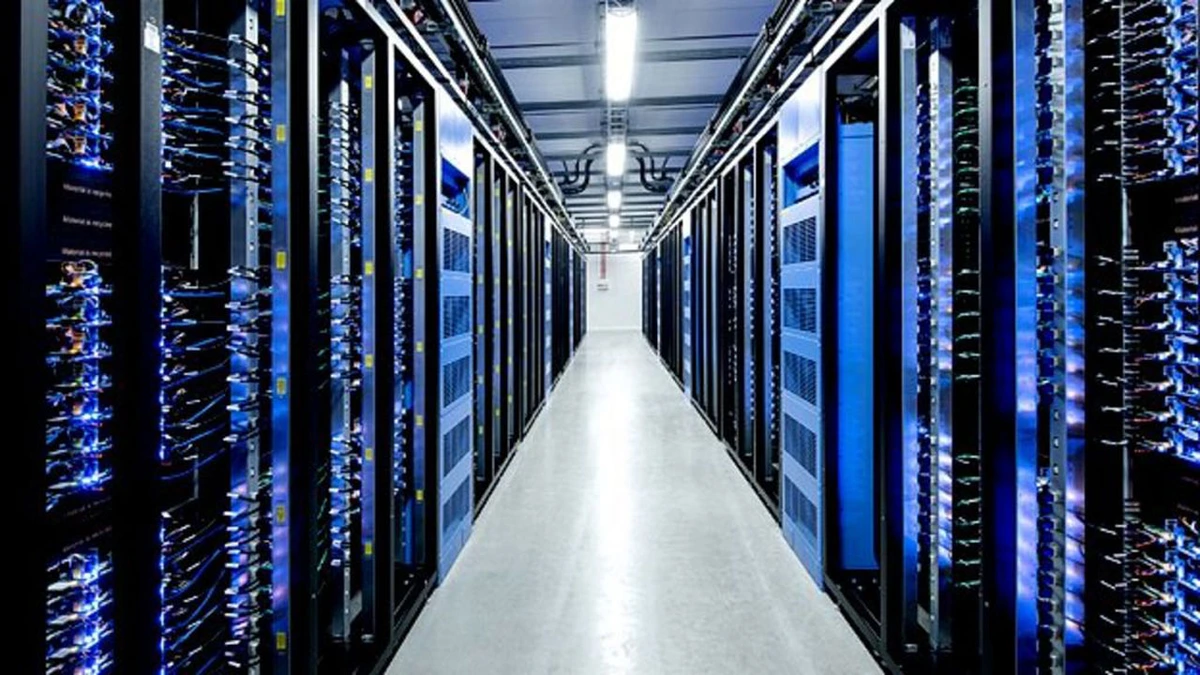
Artificial intelligence may be powered by algorithms, but it runs on physical infrastructure.
Every AI model, cloud service, chatbot, and digital platform depends on data centers — facilities packed with servers, networking equipment, cooling systems, and a reliable supply of electricity.
Sub-Saharan Africa, however, remains a small player in that infrastructure race.
According to the International Monetary Fund’s (IMF) 2026 paper, Unlocking the Potential: AI in Sub-Saharan Africa, the region hosts only about 160 data center facilities, accounting for roughly 5.5% of global installations despite representing a far larger share of the world’s population and one of its fastest-growing workforces.
Also Read
The region’s footprint is also highly concentrated.
Nearly half of Sub-Saharan Africa’s data centers are located in just three countries: South Africa, Nigeria, and Kenya, while much of the rest of the continent has only a handful of facilities, underscoring how uneven Africa’s AI infrastructure remains.
In this article, Nairametrics ranks the countries with most data centers in Sub-Saharan Africa based on the IMF report.
15: Zambia — 3 facilities
Zambia rounds out the top 15 with 3 facilities. The Southern African nation has the smallest footprint among the 15 individual countries named in the report’s chart.
It sits just below the four-facility tier and does not feature in the report’s discussion of major data-centre financing flows.
14: DR Congo — 4 facilities
The Democratic Republic of the Congo has four data centre facilities. Like Zambia, it does not feature prominently in the report’s data-centre financing discussion.
Instead, much of the continent’s newer AI infrastructure investment — including initiatives involving Microsoft, NVIDIA, Huawei, Tencent, and the IFC — remains concentrated in a narrower set of countries.
13: Uganda — 4 facilities
Uganda also records four data centre facilities, tying with Democratic Republic of the Congo.
Like the DR Congo, the report gives Uganda little coverage in its discussion of infrastructure financing.
Recent AI-related investment across Sub-Saharan Africa has largely flowed to a limited group of markets, leaving Uganda among the countries with smaller compute capacity.
This paints a picture of the uneven distribution of AI infrastructure development across the region.
12: Botswana — 5 facilities
Botswana ranks 12th on this list with five data centre facilities. The country provides a useful contrast in the IMF report’s broader discussion of energy readiness for AI adoption.
Its electricity system is heavily fossil-fuel based, with renewables accounting for only about 1.3% of installed generation capacity which is the lowest share cited in the paper’s regional renewable-energy figures.
This contrasts sharply with more renewable-heavy power systems such as Ethiopia’s hydropower-dominated grid and Kenya’s geothermal-led electricity mix, highlighting the uneven energy foundations that African countries will need to build on as AI infrastructure expands.
11: Ethiopia — 6 facilities
Ethiopia has six data centre facilities, according to the IMF. It is named as a recipient of a US$100 million commitment from the International Finance Corporation to expand data centers operated by the Raxio Group across Sub-Saharan Africa.
Ethiopia stands out for its energy profile: the report shows it among the most hydropower-dependent grids in the region, with 96.9% renewable installed capacity.
It is also cited as an early adopter of AI in public health systems, having digitized and modernized its health emergency information systems.
10: Mozambique — 6 facilities
Mozambique also has six data centre facilities, tying with Ethiopia. It appears in the report mainly as a recipient of the same IFC-backed Raxio Group expansion.
This highlights how much of the continent’s mid-tier data-centre growth is currently driven by a handful of pan-African infrastructure operators and development-finance partners rather than purely domestic private investment.
9: Côte d’Ivoire — 6 facilities
Côte d’Ivoire also has six data centre facilities.
Like Mozambique, it is included in the IFC’s US$100 million commitment to expand Raxio Group data centers.
Its presence on the list again underscores the role of regional operators and development finance in driving mid-tier capacity growth.
8: Senegal — 7 facilities
Senegal’s digital economy is better known in the report for agritech than for data centers.
It is home to Tolbi, a machine-learning-powered irrigation platform credited with cutting water use by up to 60 percent.
That kind of application-layer innovation illustrates a broader theme in the paper: countries don’t need a large compute footprint to generate real AI-driven productivity gains, particularly in agriculture, where “targeted AI applications operate primarily through information and decision gaps rather than task substitution.”
7: Ghana — 8 facilities
Ghana, sitting at number 6 with 8 facilities, is not among the region’s largest data-centre markets.
However, it features in the report as an early mover on practical AI applications.
The paper cites tablet-based AI assessment tools piloted in its education system and notes Ghana alongside Rwanda as an example of AI-enabled drone deliveries of medical supplies.
6: Angola — 10 facilities
Angola has 10 data centre facilities.
It is included in the IFC-backed Raxio Group expansion, one of the main financing flows the report cites for new data-centre capacity in Sub-Saharan Africa.
Like much of the region, it still faces the broader constraint of unreliable power: firms across Sub-Saharan Africa report average outage-related losses of 8.4 percent of annual sales, well above the global average.
5: Mauritius — 10 facilities
Mauritius is tied with Angola with 10 data centre facilities.
The report groups it with Kenya, Rwanda, the Seychelles and South Africa as one of a small set of Sub-Saharan African economies that have developed comparatively advanced ICT sectors through targeted investment and sustained policy effort.
Even these better-positioned countries, the paper notes, still face a steep climb relative to global frontier cases.
4: Tanzania — 11 facilities
Tanzania’s most notable appearance in the report is on the education side: Shule Direct, an AI-assisted assessment tool used by teachers to target remediation.
The tool is cited as an example of how low-connectivity delivery channels can extend AI-enabled learning support into underserved classrooms.
Tanzania’s position just outside the continent’s top three data center markets fits a wider pattern visible across the report’s country-level data.
Kenya has drawn the region’s marquee AI infrastructure investment in East Africa, while neighboring markets like Tanzania have built up complementary but smaller-scale capacity.
3: Kenya — 19 facilities
Kenya occupies the number 3 position and it is the report’s most consistently cited AI success story.
It anchors the Microsoft/G42 partnership, a US$1 billion, 100-megawatt green data center campus near Naivasha powered directly by geothermal energy. The report holds this up as proof that “data center demand can make large-scale renewable projects financially viable in locations where dispersed household demand alone could not justify the investment.”
With over 90 percent of its electricity already coming from renewables, Kenya is positioning its geothermal endowment as a strategic advantage for attracting green compute infrastructure.
Kenya also appears throughout the paper’s non-infrastructure chapters:
- As the home of M-Pesa, the mobile money system credited with pioneering financial inclusion across the region;
- As one of five countries the report singles out for building comparatively advanced ICT sectors despite the region’s overall low ranking on the IMF’s AI Preparedness Index;
- As home to the Agricultural Observatory Platform serving over 700,000 farmers with satellite-based advisory data; and as the site of a large-scale clinical study in which AI-based decision support cut diagnostic errors by 16 percent across nearly 40,000 patient visits.
Its Data Protection Act (2019) is also cited as a rare example of “measurable progress” on enforcement in a region where regulatory capacity is otherwise described as uneven.
2: Nigeria — 25 facilities
Nigeria is Africa’s second-largest data center market by facility count and one of the four countries, alongside Egypt, Kenya, and South Africa, that together absorbed roughly 84 percent of the continent’s US$2.2 billion in venture capital funding in 2024.
It’s also a target market in the Cassava Technologies–NVIDIA partnership, a US$700 million deal to deploy 12,000 GPUs across facilities in Nigeria, South Africa, Kenya, Egypt, and Morocco.
But Nigeria also illustrates the infrastructure strain behind the growth.
The report finds that 86 percent of Nigerian firms report owning or sharing a backup generator, the highest rate among the three countries with the largest data center presence, reflecting persistent grid unreliability.
Nigeria’s electricity subsidies amounted to about 0.2% of GDP in 2022, while petroleum subsidies reached 0.8% of GDP.
The report argues more broadly that countries with subsidized energy systems could face rising fiscal pressures as AI-driven electricity demand increases, particularly where additional generation depends on higher-cost fuel-based power.
On the innovation side, Nigeria is also home to some of the report’s most cited education successes: a six-week AI chatbot tutoring program in Nigerian secondary schools produced learning gains equivalent to roughly two years of schooling, and platforms like uLesson and WhatsApp-based maternal health chatbots are highlighted as scalable, low-bandwidth AI applications.
1: South Africa — 62 facilities
South Africa is, by a wide margin, Sub-Saharan Africa’s data center capital with 62 facilities.
This is more than double Nigeria’s facility count and more than triple Kenya’s, and well ahead of every other named country in this report.
It is one of the five countries in the Cassava Technologies–NVIDIA GPU deployment deal, one of the four leading recipients of the region’s venture capital, and one of the handful of countries the report identifies as having developed comparatively advanced ICT sectors through sustained institutional investment.
South Africa also illustrates one of the report’s central themes: that AI leadership will depend not only on digital infrastructure but also on reliable electricity systems.
Electricity subsidies there exceeded 1 percent of GDP in 2022 – the highest among the top three data center markets, and 63 percent of surveyed firms report owning or sharing a backup generator due to grid unreliability, a legacy of the country’s well-documented power crisis.
The report’s broader argument is that this tension is not unique to South Africa but previews a continent-wide challenge: as AI-related electricity demand scales, “where these adjustments lag, part of the projected productivity gains from AI-related capital deepening may be offset by higher operating costs and fiscal pressures.”