Follow Us on Google Discover
Nigeria’s investment landscape has undergone a fundamental shift over the past six years, forcing investors to rethink long-held assumptions about wealth preservation.
In this part three of the Comercio Partners report: ‘10 Years of Money Market and Living Costs’, the company examines how persistent inflation, currency depreciation and changing market dynamics reshaped the performance of major asset classes between 2020 and 2025.
It explores why traditional safe havens such as Treasury bills and cash failed to preserve purchasing power, how selective equities and property emerged as more effective inflation hedges, and why investors who adapted early outperformed those who relied on pre 2020 investment strategies.
What Changed in the Markets?
Three Market Phases, Three Different Rules
Also Read
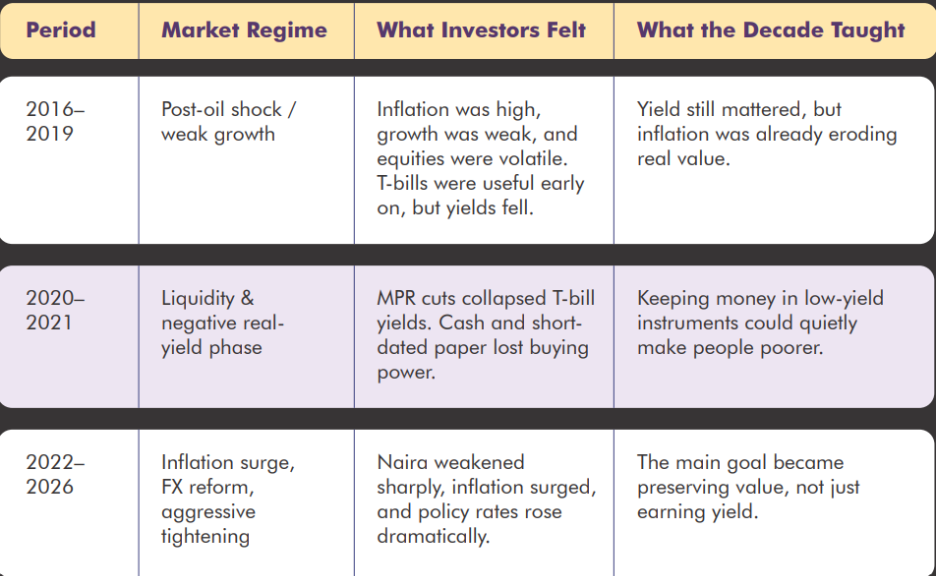
The progression across these phases is the decade’s central market lesson: investors who adapted their framework early, from yield-seeking to value-preservation, made decisions that held up. Those who stayed anchored to pre-2020 assumptions, that T-bills were safe, that a positive market return was a real gain, that naira-denominated cash was neutral, were systematically poorer in real terms.
Fixed Income: The Illusion of Safety
Fixed income feels safe because the naira amount never moves. But that safety is often an illusion. But in a high-inflation economy, this certainty is deceptive. What matters is not the asset’s return in naira, but whether that return beats inflation. For Nigerian fixed income, the honest answer from 2020 to 2025 was: it did not.
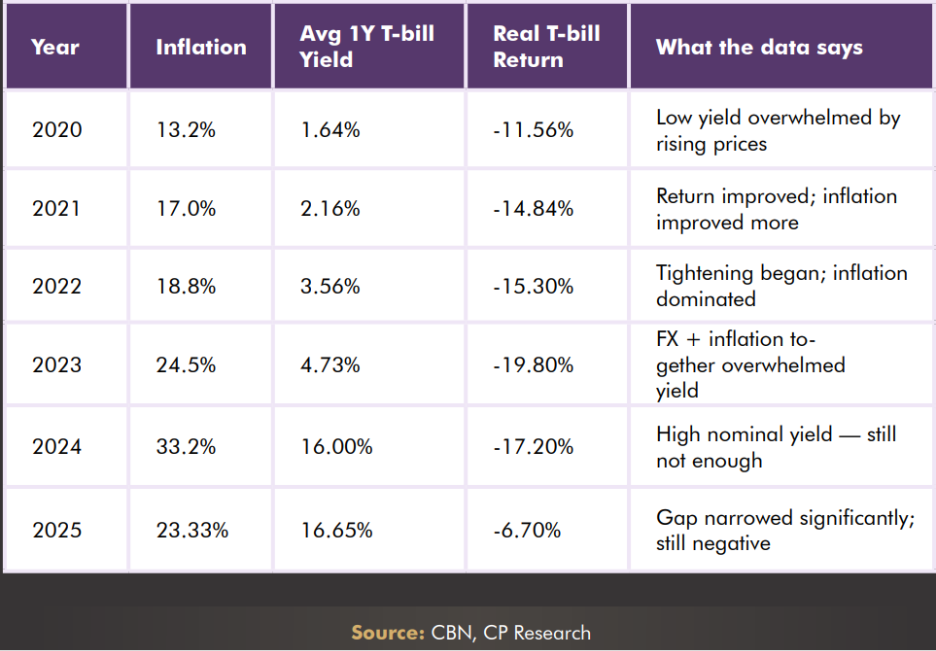
Six consecutive years of negative real T-bill returns. An investor who parked ₦1 million in Treasury bills in 2020 and rolled them annually would have watched the nominal number grow, while the purchasing power of that pile quietly eroded by roughly half in real terms. This is not to say that fixed income was useless. It remained valuable for liquidity management, cash flow matching, and short-term parking of funds. In 2024, yields were also attractive to foreign portfolio investors on a nominal and currency-stabilised basis. But as a tool for preserving wealth against inflation, it consistently failed. Investors looking for real protection had to go elsewhere, and most eventually did.
Equities: Useful — But Only When Returns Beat Inflation
Equities became the decade’s most complex and most rewarding asset class, but not uniformly so. The headline index numbers mask a critical distinction: a positive market return is not automatically a real gain. You need to beat inflation in the same year. The table below tells the full story.
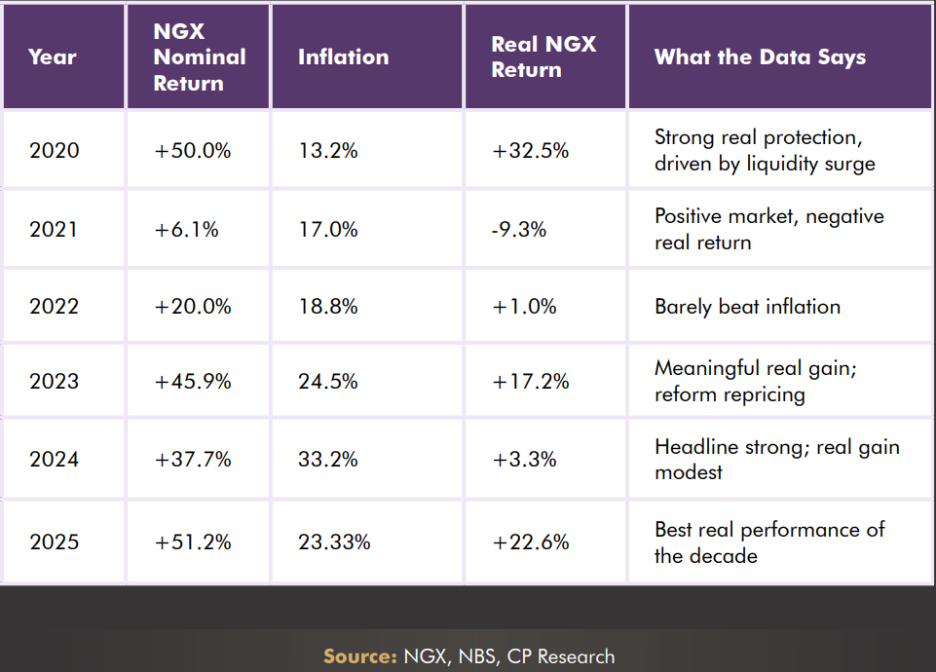
The pattern is consistent: equities served as an inflation hedge in years when companies could raise prices faster than costs rose. They underperformed in years when inflation was broad and severe, making it difficult for even good businesses to outrun erosion. The investor who understood this distinction and chose companies with genuine repricing power did materially better than those simply tracking the index.
Which Equities Held Up and Why
The market did not reward every company equally. Five characteristics separated the winners from the rest:
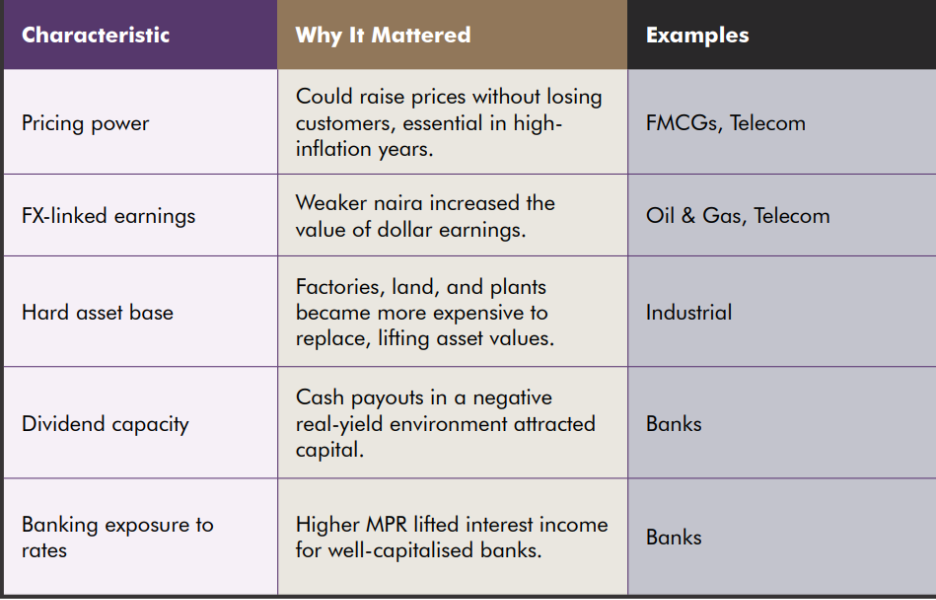
The common thread: these companies had something fixed-income instruments fundamentally lack, the ability to reprice. When the naira fell, their revenues rose. When costs increased, they had a market position to pass on. When assets inflated, their balance sheets expanded. The decade rewarded businesses with a comparative advantage deep enough to withstand the erosion.
Property: Protection for Owners, a Wall for Everyone Else
Property became the decade’s most intuitive inflation hedge and its most exclusionary one. The logic was simple: construction costs are dollar linked. When the naira fell, replacing an existing building became more expensive. Therefore, existing buildings became more valuable. Scarcity in cities like Lagos compounded this; the housing deficit did not narrow, so upward pressure on demand kept prices and rents rising even as household income lagged.
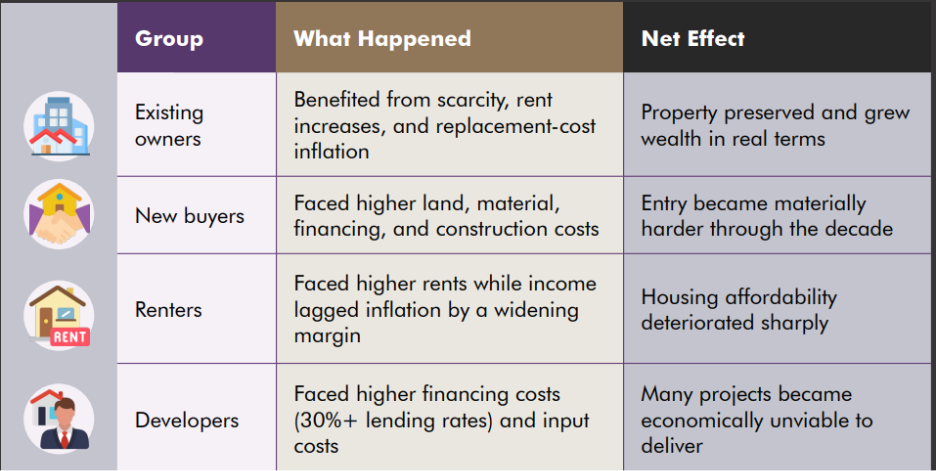
The property story is therefore not a story of an asset class that uniformly creates wealth. It is a story of incumbency advantage: those already inside the system benefited, while those trying to enter faced progressively higher barriers. This dynamic replicated across equities and property, making it part of why the decade felt contradictory. Aggregate asset prices rose. Aggregate household welfare declined. Both were simultaneously true.
Cash: Comfortable Illusion, Quiet Erosion
Cash is the asset class that requires the least explanation and the most caution. The naira in a bank account does not decrease visibly. But when inflation runs at 25–35%, as it did from 2022 to 2024, holding cash means losing purchasing power at precisely that rate invisibly, month by month. For much of the decade, savings rates at commercial banks were well below inflation. The gap was not narrow. In some years, a household holding ₦1 million in a standard savings account would have seen its real purchasing power fall by 15–20% in a single year. The money was still there. It just couldn’t buy the same things
If you keep ₦100,000 and prices rise 30%, the money is still ₦100,000, but it buys roughly what ₦77,000 bought before. The loss is invisible on the bank statement. It shows up at the checkout.
The rational response, which many Nigerian investors eventually made, was to reduce exposure to idle cash and shift toward assets with repricing characteristics. This behavioural shift, from passive saving to active wealth-building, is the decade’s defining investment trend.