Follow Us on Google Discover
There’s a bill many Nigerians pay every month that never shows up on a bank statement as a single line. It shows up as a transfer to a parent, a sibling’s school fees, an “urgent” request from an uncle, a friend who’s stuck.
A new report from Cowrywise explores the longterm cost of this bill, and for the first time, provides a way to measure it.
What is Black Tax?
Black Tax is the regular or occasional financial support an income earner gives to parents, siblings, relatives, or community members, simply because they’re seen as the one who’s “made it.” It’s rarely written into a budget. It’s rarely questioned. And according to Cowrywise’s research, it may be one of the biggest and least discussed financial commitments many Nigerians will ever carry.
“In many Nigerian homes, the first person to make it doesn’t just change their own life,” the report notes. “They become a financial bridge for everyone else.”
Also Read
Why this is heavier now than it used to be
Black Tax isn’t new — it’s arguably as old as the extended family system itself. But the economic backdrop it plays out against has shifted. Rising cost of living, and stagnant salaries mean the same family obligations that felt manageable five years ago now consume a larger share of take-home pay. A transfer of ₦50,000 hits differently in an economy where rent, transport, and feeding have all moved up. Cowrywise’s report arrives at a moment when more Nigerians than ever are doing this math in their heads — this just gives it a name and a number.
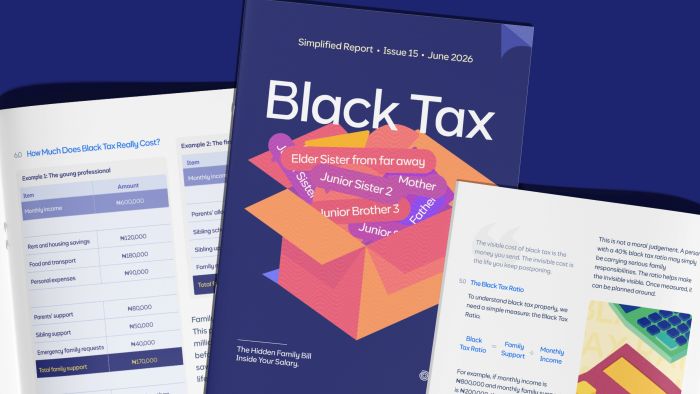
The formula: how much of your income is actually yours?
The report introduces a simple diagnostic: the Black Tax Ratio.
Black Tax Ratio = Monthly Family Support ÷ Monthly Income × 100
Take someone earning ₦600,000 a month who sends ₦170,000 to family and covers other “billings.” Their ratio is 170,000 ÷ 600,000 × 100 = 28% — more than a quarter of their income, before rent, feeding, or their own savings are accounted for.
Here’s how the report classifies the results:
| Ratio | What it means |
|---|---|
| 0% – 10% | Light family support |
| 10% – 25% | Manageable, but should be budgeted |
| 25% – 40% | Heavy family responsibility |
| 40% – 60% | Financially stressful |
| 60%+ | Potentially unsustainable without more income or support |
How the report models it
Cowrywise’s report walks through two illustrative examples to show how the ratio plays out at different income levels:
Example 1: The young professional
| Item | Amount |
|---|---|
| Monthly income | ₦600,000 |
| Rent and housing savings | ₦120,000 |
| Food and transport | ₦180,000 |
| Personal expenses | ₦90,000 |
| Parents’ support | ₦80,000 |
| Sibling support | ₦50,000 |
| Emergency family requests | ₦40,000 |
| Total family support | ₦170,000 |
Family support here works out to a 28% ratio, and once rent, food, transport, and personal expenses are accounted for, it leaves less than ₦60,000 (10% of income) for investments.
Example 2: The firstborn with siblings in school
| Item | Amount |
|---|---|
| Monthly income | ₦1,000,000 |
| Parents’ allowance | ₦150,000 |
| Sibling school fees savings | ₦120,000 |
| Sibling upkeep | ₦80,000 |
| Family medical support | ₦50,000 |
| Total family support | ₦400,000 |
Family support equals 40% of income. This person isn’t really living on ₦1 million, they’re living on ₦600,000, before personal bills, rent, food, savings, investments, transport, and lifestyle expenses are even factored in.
What this looks like for real Nigerians
Beyond the report’s own modeling, we spoke to three Nigerians who broke down exactly what this looks like for them:
- A 34-year-old senior IT manager earning ₦900,000 monthly sends roughly ₦340,000 to family — a 38% ratio, landing squarely in “heavy responsibility.“
- A 34-year-old business owner earning an average of ₦10 million monthly supports a sister’s allowance, a father’s allowance, cousins in school, and more — totalling ₦920,000. That’s just a 9.2% ratio.
- A 30-year-old finance professional earning ₦800,000 monthly covers his girlfriend’s brother’s school fees, wedding planning, and family and friend requests — totalling ₦500,000. That’s a 62.5% ratio — more than half his income, to people he isn’t even married to yet.
The gap between the first two real cases is striking: the business owner earns roughly ten times more than the IT manager, but carries a lighter load. Income alone doesn’t determine how heavy Black Tax feels, structure does. The third case pushes that point further: it isn’t only family obligation driving this. Romantic relationships, and the expectations attached to them, can carry the same financial weight as blood ties, often before any formal commitment exists.
The cost that doesn’t show up immediately
The report also quantifies what recurring family support costs over time. ₦50,000 a month, an amount that might not feel significant in isolation, adds up to ₦3,000,000 over five years. At ₦100,000 a month, that figure doubles to ₦6,000,000. These numbers represent delayed investments, postponed certifications, and stalled business plans for the people carrying them.
Is Black Tax always a bad thing?
No — and the report is careful to make that distinction. For many families, this kind of support is the reason younger siblings finish school, parents access healthcare, and households survive difficult seasons. The issue isn’t the support itself. It’s when it becomes unplanned, has no upper limit, and starts competing with the giver’s own future.
The report distinguishes between two things that often wear the same name:
- Support that builds independence — school fees, medical bills, a business investment with a clear plan — reduces how much a family member needs help over time.
- Support that creates dependency — open-ended requests with no structure or accountability — tends to grow as the giver’s income grows, with no corresponding reduction in need.
Three questions to ask before your next family request
The report offers a practical starting point for anyone trying to bring structure to this without cutting family off:
- Is this essential, or is it avoidable? Medical bills and school fees sit differently than repeated lifestyle requests or poor planning.
- Is this a one-time ask, or will it recur? A single emergency is different from a request that quietly becomes monthly.
- Does saying yes still leave room for your own savings, investments, and emergency fund? If the answer is consistently no, the arrangement isn’t sustainable — regardless of how much love is behind it.
What the report recommends
Rather than telling readers to stop supporting family, Cowrywise’s framework focuses on structure: setting a fixed monthly amount instead of reacting to requests as they arise, building an emergency fund and investment plan alongside family support rather than after it, and having direct conversations, before marriage, and before major financial decisions, about what obligations already exist and what will continue.
As the report puts it: “Give, but do not disappear.”
What’s your Black Tax Ratio? Read the full Black Tax report, and calculate your own ratio, at cowrywise.com/simplified.