Follow Us on Google Discover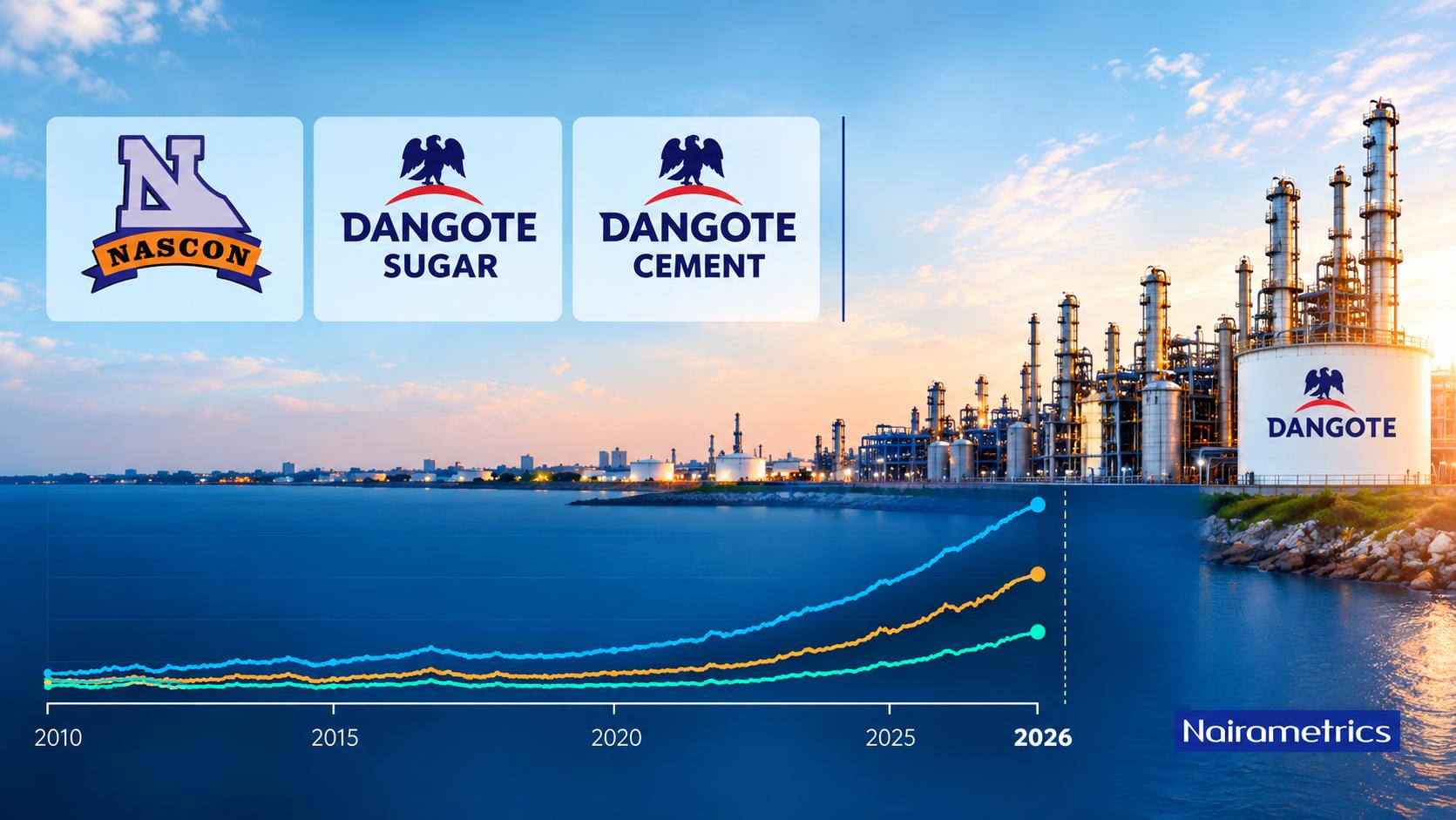
Dangote Petroleum Refinery’s N2.15 trillion public offer at N525 per share opened on Monday, September 14, 2026, raising an important question for investors: what happens after the offer and eventual listing?
The offer prospectus provides some indication of what investors can expect post-listing, while brokerage firms and analysts have also made projections about where the stock could trade.
But the Dangote Group already has a long history on the Nigerian equities market, and that provides another useful perspective.
NASCON Allied Industries, Dangote Sugar Refinery and Dangote Cement have all traded on the Nigerian Exchange for well over a decade. Their performances show substantial gains for long-term shareholders but also extended periods when their share prices traded below or only marginally above their original reference prices.
Also Read
As of September 16, 2026, NASCON was up about 627% from its 2007 offer price, equivalent to an annualised price gain of approximately 10.8%. Dangote Sugar had gained about 291%, or about 7.2% annually, while Dangote Cement was about 666% above its 2010 admission price, equivalent to approximately 13.7% annually.
These calculations measure share-price appreciation only and exclude dividends and bonus shares.
NASCON: From N22 to N160, or about 10.8% annually
NASCON’s share price has risen from the N22 offer price in June 2007 to N160 as of September 16, 2026, representing a simple price gain of about 627%.
Spread across roughly 19 years, that translates to a compound annual growth rate of approximately 10.8%, excluding dividends and bonus shares.
But much of the appreciation came relatively recently.
- NASCON was originally listed on the Nigerian Stock Exchange in October 1992. In June 2007, Dangote Industries offered 400 million NASCON shares to investors at N22 each.
- The timing proved difficult. Nigeria’s stock market crashed the following year, with the NSE All-Share Index losing about 45.8% in 2008.
- NASCON ended that year at N5.87, about 73% below the offer price.
Five years after the offer, the shares were still at N7.87, about 64% below the offer price, despite the company remaining profitable.
Even ten years later, NASCON closed 2017 at N18.14, still about 17.5% below the N22 offer price. This was despite revenue rising to N27 billion and profit after tax more than doubling to N5.3 billion that year.
- The major rerating came much later. NASCON finally moved decisively above N22 in 2023 as Nigerian equities began a stronger bull run. By September 16, 2026, it had reached N160.
- The rally coincided with significantly stronger earnings. Profit after tax more than doubled to N33.5 billion in 2025, while H1 2026 profit rose another 25.7% to N19.6 billion.
For an investor who bought at N22 in 2007, the eventual gain has been substantial. But it required a holding period of more than 19 years to produce the 627% headline appreciation.
Dangote Sugar: N18 to N70.45, or about 7.2% annually
Dangote Sugar Refinery followed a similar path. The company came to the market through an IPO structured as an offer for sale and was listed on March 8, 2007, with 10 billion shares and an initial market capitalisation of about N180 billion.
At the time, it was Nigeria’s largest IPO, attracting considerable investor interest in an era before social media amplified the frenzy surrounding major public offers.
Its N18 offer price initially looked attractive. By the end of March 2007, the shares had risen more than 55% to N29.46 and ended the year more than 73% above the offer price.
Then came the 2008 crash.
Dangote Sugar ended 2008 at N14.94, about 17% below its offer price. By 2012, five years after listing, it had fallen further to N5.78 — approximately 68% below the original price.
- By 2017, ten years after listing, the stock had recovered to N19.27, only modestly above its N18 offer price, despite profit after tax jumping from N14.3 billion to N39.3 billion that year.
- The stock remained relatively range-bound for several more years. Between 2017 and 2022, its highest price was around N22, meaning an investor focused solely on capital appreciation had seen relatively little return over roughly 15 years.
- The major rerating began in 2023, when the stock crossed N50.
- Remarkably, the shares remained elevated even as severe foreign-exchange and finance-cost pressures pushed the company to losses of N192.6 billion in 2024 and N64.1 billion in 2025.
The turnaround in earnings became clearer in 2026, with H1 profit after tax rebounding to N41.5 billion from a N24.3 billion loss a year earlier.
By September 16, 2026, Dangote Sugar had reached N70.45, representing a gain of about 291% from its N18 offer price and an annualised share-price return of approximately 7.2%.
Dangote Cement: N135 to N1,034, or about 13.7% annually
Dangote Cement has delivered the strongest annualised share-price performance of the three.
The company was listed by introduction on October 26, 2010, following its merger with the already-listed Benue Cement Company.
- About 15.5 billion shares were admitted at N135 each, giving Dangote Cement a market capitalisation of approximately N2.1 trillion and making it Nigeria’s largest listed company at the time.
- The stock initially struggled. By the end of 2011, it was trading around N100, approximately 26% below its admission price.
- Five years after listing, the shares had recovered to N163.01, about 21% above the admission price, supported by the company’s rapid expansion across Africa.
Yet even ten years after listing, Dangote Cement traded at about N152 in October 2020 — only around 13% above its N135 admission price.
Between its 2010 listing and 2022, the highest price reached by the stock was about N280 in September 2021.
The bigger rerating came afterwards as earnings expanded sharply.
- By 2025, revenue had risen to N4.31 trillion, while profit after tax more than doubled to N1.01 trillion. In H1 2026, revenue increased 21.4% to N2.51 trillion and profit after tax rose 22.7% to N638.5 billion.
- By September 16, 2026, Dangote Cement had reached N1,034, representing a gain of about 666% from its N135 admission price.
Over the nearly 16 years since admission, that translates to an annualised share-price gain of approximately 13.7%, excluding dividends.
What this means for Dangote Refinery investors
The histories of NASCON, Dangote Sugar and Dangote Cement reveal an important pattern: strong brands, large businesses and considerable investor enthusiasm at the point of entry did not guarantee immediate or uninterrupted share-price appreciation.
- The stocks were also heavily influenced by conditions outside the companies themselves. The 2008 market crash devastated the early performance of NASCON and Dangote Sugar, while recessions, currency depreciation, inflation and periods of weak investor appetite affected valuations over subsequent years.
- Conversely, some of their strongest gains have occurred during the major rerating of Nigerian equities in recent years, alongside significant growth in nominal revenues and earnings.
Dangote Petroleum Refinery is, of course, a different business entering the market under different circumstances. Its N525 offer price, earnings trajectory, free float, refining margins, crude supply, foreign-exchange exposure and eventual valuation will ultimately determine how investors price the company.
The history of other Dangote-related stocks therefore cannot predict where Dangote Refinery will trade.