Follow Us on Google Discover
The Nigerian banking industry demonstrated remarkable resilience in 2025, navigating regulatory changes and macroeconomic headwinds while continuing to attract investor confidence.
A major highlight of the year was the recapitalization exercise initiated by the Central Bank of Nigeria (CBN).
According to the CBN and confirmed by the Securities and Exchange Commission (SEC), 33 out of the country’s 37 banks raised a combined N4.65 trillion to meet the new minimum capital requirements, with approximately 72.6% of the funds sourced domestically.
During the year, the CBN also brought an end to all COVID-19-related regulatory forbearance and waivers. Banks were consequently required to fully recognize distressed assets, discontinue loan restructuring concessions, and regularize breaches of their Single Obligor Limits (SOL). This development led several institutions to increase provisions for non-performing loans, putting pressure on earnings.
Also Read
Consequently, aggregate profit after tax (PAT) for the ten commercial banks under review declined by 11.9% year-on-year to N4.26 trillion. Despite the moderation in industry earnings, a number of banks delivered impressive performances across key indicators such as profitability, operational efficiency, balance sheet growth, capital adequacy, and customer acquisition.
This article ranks the best-performing Nigerian commercial banks in 2025 based solely on their audited financial results.
Industry View
Despite a challenging operating environment, the banking industry remained fundamentally resilient, although some prudential indicators weakened. According to CBN data, industry capital adequacy ratio (CAR) closed the year at 10.4%, within the regulatory thresholds for national and regional banking licences, but below the requirements for international banking operations.
Asset quality also deteriorated, with the industry’s non-performing loan (NPL) ratio rising to 8.12%, significantly above the regulatory benchmark of 5%. Likewise, return on equity (ROE) declined sharply to 19.1% from 40.03% recorded in the previous year, reflecting the impact of higher impairment charges following the withdrawal of regulatory forbearance.
Nonetheless, the ten banks considered in this analysis expanded their combined asset base by 14% to N196.8 trillion, while shareholders’ funds rose by 24% to N24.3 trillion. Despite increasing competition from digital and challenger banks, the institutions collectively attracted an additional N22.3 trillion in customer deposits and created N3.65 trillion in new loans, reaffirming the sector’s central role in financial intermediation.
Ranking methodology
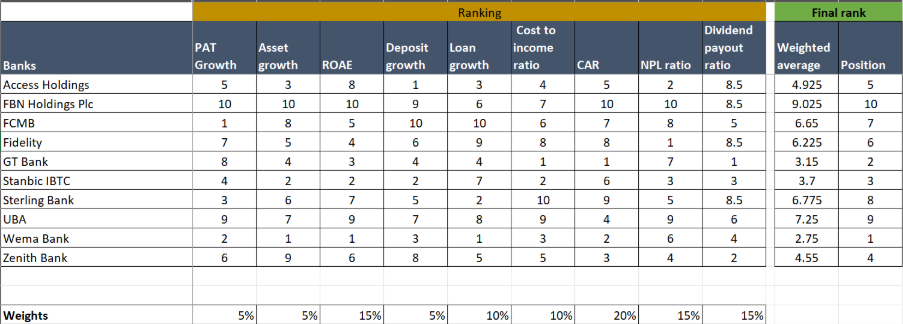
The ranking is based exclusively on audited financial statements, annual reports, and investor presentations of ten indigenous conventional commercial banks listed on the Nigerian Exchange (NGX).
To provide a balanced assessment, the banks were evaluated across nine metrics spanning profitability, efficiency, solvency, growth, and shareholder returns. These indicators include: Profit after tax (PAT) growth; Asset growth; Return on average equity (ROAE); Customer deposit growth; Loan growth; Cost-to-income ratio; Non-performing loan ratio; Capital adequacy ratio; and Dividend payout ratio.
A weighted scoring methodology was adopted, with each metric assigned relative importance to arrive at the final rankings.
Here are the best-performing banks, judging by their numbers:
Leading banks by PAT growth
Analysis shows that the 10 banks recorded an aggregated 12% decline in PAT to N4.26 trillion, with massive declines from FBN Holdings and UBA Group, weighing on profit growth.
FCMB, Wema, and Sterling Bank led the list of PAT growth in 2025, compared to the previous year.
- First position – FCMB (141%)
- Second position – Wema Bank (+125%)
- Third position – Sterling Bank (+75%)
- Fourth position – Stanbic IBTC (69%)
- Fifth position – Access Holdings (+16%)
Upshots: Meanwhile, Zenith recorded the highest profit of N1.04 trillion during the period, although a marginal increase compared to the previous year. Sterling Bank recorded the lowest PAT compared to the other banks.
Leading banks by total asset growth
The ten banks under consideration grew their total assets by 14% from N173 trillion recorded as of December 2024 to N196.8 trillion as of the end of 2025. Wema, Stanbic IBTC, and Access Holdings recorded the highest asset growth.
- First position – Wema Bank (+41.2%)
- Second position – Stanbic IBTC (+24.7%)
- Third position – Access Holdings (+24.2%)
- Fourth position – Fidelity Bank (+18.6%)
- Fifth position – Sterling Bank (+10.4%)
Upshots: Access Holdings retains the bank with the highest balance sheet, with total assets of N51.6 trillion, accounting for 26% of the total books of the 10 banks under consideration.
Leading Banks by ROE
On average, the banks saw a massive decline in ROE compared to the previous year. Average ROE for the 10 banks dropped to 24% in 2025 from 31.7% and 26% recorded in 2024 and 2023, respectively. This was a result of declining profitability due to the halt of regulatory forbearance.
However, Wema Bank, Stanbic IBTC, and GTCO led the list of banks with the highest return on equity in the review period.
- First position – Wema Bank (44.4%)
- Second position – Stanbic IBTC (42.4%)
- Third position – GTCO (28.3%)
- Fourth position – Fidelity (24.4%)
- Fifth position – FCMB (23.4%)
Upshots: In terms of the most improved bank based on ROE, FCMB led the chart, having increased its ratio from 12.7% in 2024 to 23.4% in 2025.
Leading Banks by Deposit Growth
Customer deposits to banks rose by 25% year-on-year in 2025 to N111.88 trillion compared to N89.6 trillion recorded as of the beginning of the year. Access Holdings recorded the fastest growth in deposit mobilization, followed by Stanbic IBTC.
- First position – Access Holdings (+53.4%)
- Second position – Stanbic IBTC (+45.3%)
- Third position – Wema Bank (30.3%)
- Fourth position – GTCO (+25.3%)
- Fifth position – Sterling Bank (+18.5%)
Upshots: Access Holdings also led the list in terms of largest deposits, with N34.6 trillion, having grown its books from N22.5 trillion in the previous year.
Leading Banks by Loan Growth
The ten commercial banks increased their net customer loans by N3.6 trillion in the review year, to close at N55.01 trillion, representing an increase of 7.1%. This is significantly lower than the N14.8 trillion it gave out as net loan in the previous year.
Despite a cautious approach to credit creation, Wema Bank, Sterling Bank, and Access Holdings led the rankings by loan growth.
- First position – Wema Bank (+44.7%)
- Second position – Sterling Bank (+28.02%)
- Third position – Access Holdings (+16.1%)
- Fourth position – GTCO (+12.4%)
- Fifth position – Zenith Bank (+4.9%)
Upshots: In terms of the largest loan books, Access Holdings leads with N13.34 trillion, followed by Zenith Bank with N10.4 trillion.
Leading Banks by Cost-to-Income Ratio
Cost-to-income ratio for the considered banks rose slightly to 49.9% from 49.3% recorded in the previous year. GTCO recorded the lowest cost optimization ratio at 28%, followed by Stanbic IBTC at 37%. Meanwhile, Sterling Bank recorded the highest CIR.
- First position – GTCO (28%)
- Second position – Stanbic IBTC (37%)
- Third position – Wema Bank (47%)
- Fourth position – Access Holdings (52%)
- Fifth position – Zenith Bank (53%)
Upshots: Despite the elevated cost ratio, it is worth noting that Sterling Bank and Wema Bank saw their CIR drop by 10.5% and 9%, respectively, in contrast to the previous year.
Leading Banks by Capital Adequacy Ratio
Most of the banks maintained a relatively healthy capital adequacy ratio by the end of the year, with the average CAR closing the year at 22.06%, slightly lower than the 22.63% recorded in the previous year.
GTCO recorded the highest CAR at 43.82%, while FBN Holdings recorded the lowest following a significant slump.
- First position – GTCO (43.8%)
- Second position – Wema Bank (28.1%)
- Third position – Zenith Bank (25.3%)
- Fourth position – UBA (23.2%)
- Fifth position – Access Holdings (21%)
Upshots: Following the capital raise endeavour, several of the banks were able to meet the new minimum capital threshold as stated by the CBN; however, the CAR for the banks varied, with FBN having a CAR of 10.95%, a decline from 17.32% in the previous year.
Leading Banks by NPL Ratio
The NPL ratio of the ten banks remained elevated slightly above the prudential limit of 5%; however, with varying performances across the board.
Fidelity Bank recorded the lowest NPL ratio as of the end of the year, with 2.4%, followed by Access Holdings with 2.82%.
- First position – Fidelity Bank (2.4%)
- Second position – Access Holdings (2.8%)
- Third position – Stanbic IBTC (3.4%)
- Fourth position – Zenith Bank (3.8%)
- Fifth position – Sterling Bank (4.7%)
Upshots: Out of the ten banks, seven of them were able to reduce their non-performing loan ratio from the previous year, while the remaining three banks saw an increase. UBA’s NPL ratio increased by 2.1% points, FBN Holdings by 1.8%, and Access Holdings by 0.04%.
Leading Banks by Dividend Payout Ratio
Due to the muted profitability of some of the banks in 2025, only six banks declared dividends to their shareholders for the financial year. However, some of the banks increased their dividend payments.
GTCO, Zenith Bank, and Stanbic IBTC led the list by dividend payout ratio.
- First position – GTCO (50.2%)
- Second position – Zenith Bank (39.5%)
- Third position – Stanbic IBTC (27.5%)
- Fourth position – Wema Bank (17.5%)
- Fifth position – FCMB (8.8%)
Upshots: While some of the banks could not declare dividends in 2025 due to the need to account for impaired loans, there is a possibility for them to declare interim dividends in H1 2026, in a bid to calm market sentiments.
Bottom Line
The 2025 financial year was one of transition for Nigerian banks. The end of regulatory forbearance, tighter prudential requirements, and the ongoing recapitalization exercise placed pressure on profitability and asset quality.
Yet, the sector demonstrated remarkable resilience, with most banks strengthening their capital positions, expanding balance sheets, and continuing to attract deposits despite a more competitive landscape.
While size remains an important factor, the rankings show that sustainable performance is increasingly being driven by a combination of profitability, efficiency, balance sheet strength, and prudent risk management.
As the recapitalization exercise concludes and macroeconomic conditions gradually stabilize, banks that combine strong capital buffers with disciplined execution and superior customer experience are likely to be best positioned to deliver long-term value to shareholders and customers alike.