Follow Us on Google Discover

Nigerian banks increased lending to traders in the first half of 2026, while manufacturers saw a sharp drop in outstanding bank credit.
This is according to Nairametrics Research’s analysis of sectoral credit data published by the Central Bank of Nigeria (CBN).
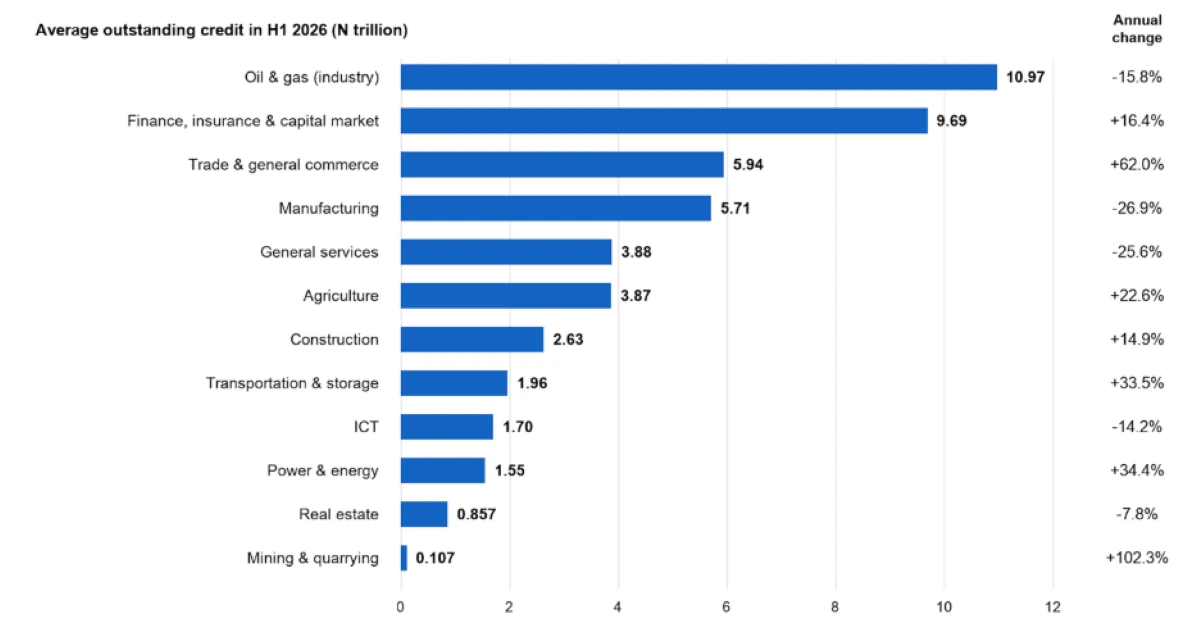
Average credit to trade and general commerce rose 62% compared with the same period last year.
Manufacturing credit, meanwhile, fell by about 27%, showing that the increase in lending did not reach all parts of the economy equally.
Also Read
Traders attract more bank credit
Trade and general commerce recorded the biggest increase in the value of outstanding credit among the sectors that attracted more bank financing. Average credit to the sector reached N5.94 trillion in H1 2026, up 62.04% from N3.66 trillion in H1 2025, the strongest year-on-year growth in absolute naira terms among the growing sectors.
The figures measure outstanding loan balances being the amount borrowers owed banks on average during the period, rather than the value of fresh loans banks approved.
Other sectors also recorded increases:
- Financial services remained the second-largest recipient of bank credit after the industrial oil and gas sector.
- Agriculture attracted more credit, alongside construction, power and energy.
- Transportation and storage also recorded growth, showing that the gains extended beyond trading and financial activities.
Overall, 12 of the 17 sectors tracked recorded increases, while five saw declines.
However, average outstanding credit across the economy was only slightly higher than a year earlier. This means the stronger growth recorded in trade and several other sectors came alongside substantial reductions elsewhere, rather than a broad surge in lending to businesses.
Manufacturers face a different picture
Manufacturing moved in the opposite direction, with average outstanding credit falling 26.94% to N5.71 trillion in H1 2026 from N7.81 trillion in H1 2025. The decline left the sector behind trade and general commerce in the distribution of bank credit. As recently as H1 2022, manufacturing accounted for 16.43% of total outstanding bank credit; by H1 2026 that share had fallen to 9.58%.
For readers, the contrast is straightforward: traders accounted for a larger portion of banks’ outstanding loans, while manufacturers accounted for less. The figures alone do not explain whether that reflected banks’ lending decisions, weaker borrowing demand, loan repayments or a combination of factors.
The decline also extended to other sectors:
- Industrial oil and gas remained the largest recipient of bank credit, but its outstanding balance fell.
- General services recorded a substantial contraction.
- Information and communication technology, as well as real estate, also received less credit than a year earlier.
Manufacturing’s decline follows earlier warnings about access to financing. Nairametrics previously reported that the Manufacturers Association of Nigeria raised concerns about a N1.92 trillion fall in manufacturing credit during 2025.
The latest figures show that the pressure on manufacturing credit continued into the first half of 2026.
Will lower rates change lending?
The next question is whether lower interest rates will help businesses access more affordable bank loans. The CBN reduced its benchmark Monetary Policy Rate to 23% in September 2026, after the period covered by these figures.
That timing matters because the first-half data cannot show whether the September decision has changed lending conditions. A reduction in the benchmark rate also does not immediately establish that businesses can borrow more cheaply.
The developments to watch include:
- Whether banks reduce the interest rates they charge businesses on loans.
- Whether lending to the manufacturing sector begins to recover in subsequent CBN reports.
- Whether credit growth extends to more sectors, particularly those that recorded declines in the first half of the year.
MAN Director-General Segun Ajayi-Kadir previously told Nairametrics that prime lending rates around 30% could continue to limit manufacturers’ access to affordable financing, despite the benchmark rate reduction.