Follow Us on Google Discover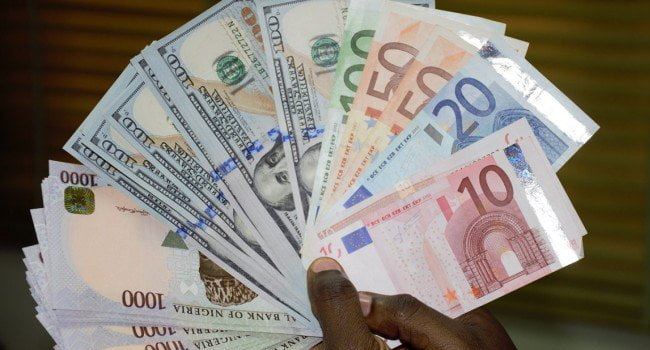
The naira experienced a slight depreciation against the major European currency this week, with the CBN’s latest data indicating it settled at N1576/€1, up from N1569/€1 last week.
The EUR/NGN exchange rate peaked near N1,774/€1 in January 2026 before dropping back to the multi-month low of around N1,555/€1.
Recent market activity suggests this support level at N1550/€1 has been absorbed by the CBN and dollar-euro liquidity providers.
The EUR/NGN key support is stationed at N1550/€1; latest market action showed this level has been absorbed by the CBN and by dollar-euro liquidity suppliers.
Also Read
The area under N1,550/€1 provides a technical clearance all the way to the N1,500/€1 resistance line.
NGN Bulls need a closing below N1,500/€1 resistance line to extend a multi-month bull phase.
A relatively tight monetary stance, with the MPR held between 26.50% and 27.50%, and rising yields on treasury bills at 16%, should attract foreign portfolio investors. Additionally, Nigeria’s reserves, exceeding $51 billion by mid-2026, are expected to provide ample liquidity to clear FX backlogs and protect against speculative attacks.
Although Nigeria’s headline inflation remains elevated at 15-16%, significantly above the Eurozone’s ~2%, this persistent gap continues to exert a long-term downward pressure on the naira.
Euro remains flat against the Greenback amid ongoing Middle East tensions
Meanwhile, the euro closed the week roughly unchanged against the US dollar, settling slightly above $1.14. Market sentiment highlighted caution amid limited macroeconomic data and ongoing Middle East tensions.
- The core issues remain unresolved since the June agreement between Washington and Tehran outlined in a 14-point MoU aiming for a 60-day ceasefire
- The US insists Iran halt all nuclear development, while Iran seeks control over the Strait of Hormuz, with no clear path to resolution. The conflict extends beyond Iran and the US, involving Israel and Lebanon, with longstanding tensions persisting.
- Recent cross-strait attacks and US President Trump’s comments about ending the MoU have heightened concerns about escalation, but not enough to trigger panic. These developments have temporarily pressured the US dollar. Oil prices serve as a barometer of market sentiment; currently, WTI trades near $71.50, unchanged from last week. Despite ongoing fears, market reactions have been muted, thanks to stable transit through the Strait of Hormuz and steady oil prices.
In Europe, economic data presents mixed signals. The Eurozone’s Sentix Investor Confidence Index improved from -13.4 in June to -3.1 in July.
- Retail sales in May grew modestly by 0.2%, the slowest since March, but still positive. Meanwhile, the Producer Price Index rose to 5.9% YoY from 5.0%, surpassing expectations of 5.7%. Overall, sluggish growth paired with persistent inflation might define the near-term economic outlook.
- The PPI increase has yet to influence the EUR, but further inflationary pressure in June could impact the currency, especially if July’s data shows sustained high inflation despite easing geopolitical tensions.
Recent technical analysis indicated that the EUR/USD pair continues to be dominated by bears.
The euro has struggled to break above its longer-term moving averages, with the 20-day SMA at 1.1439 acting as resistance. The 20-day SMA slopes downward relative to the 100-day at 1.1604 and 200-day at 1.1646 SMAs, signalling a bearish trend. It has yet to confirm a reversal of the downtrend, while recent price action remains below the midpoints of key resistance levels.