Follow Us on Google Discover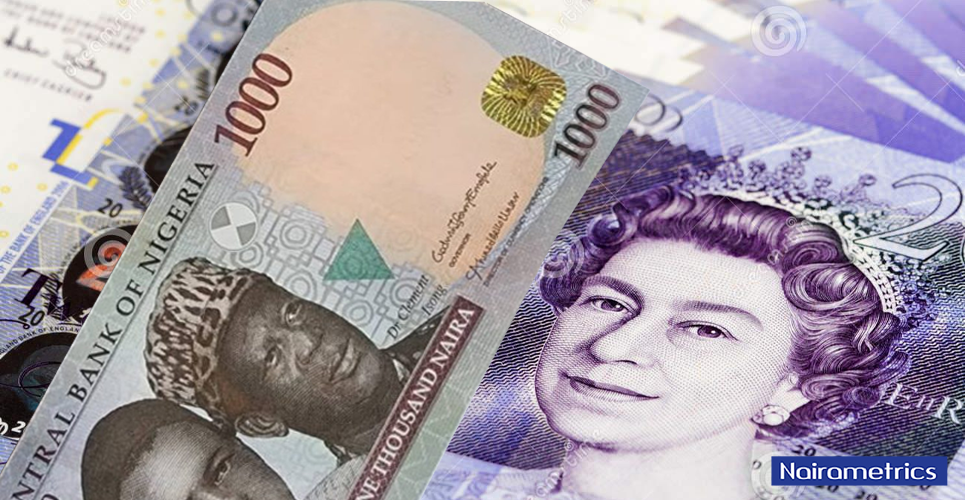
The British pound sterling traded at N1,827/£1 against the naira at the start of the midweek session in the Nigerian foreign exchange market, with black market rates fluctuating slightly higher based on local liquidity.
The pair recently retreated slightly from tests below the N1,832£1, indicating relative stability in the NAFEM (official) market.
GBP/NGN has been consolidating within a narrow band between N1,825/£1 and N1,840/£1
The CBN still periodically injects foreign exchange into the interbank market to control extreme volatility and clear backlogs to attract portfolio flows and absorb excess Naira liquidity.
Also Read
High-yield offerings on OMO bills and Nigerian Treasury Bills (NTBs) are intended to stabilize the currency against major peers like the greenback and British pound.
Local food and energy inflation keep real yields under pressure, despite short-term consolidation, sustaining long-term upward pressure on the exchange rate.
The immediate resistance level is seen between N1,845/£1 and 1,850/£1. The pair opens the floor for further upside to the multi-month high zone, where the resistance is placed between N1,880/£1 and 1,900/£1. The immediate cost level support remains between N1,815/£1 and N1,825/£1, while the main structural floor, supported by the medium-term average trend, is positioned at N1,780/£1 -N1,800/£1.
In London, against a backdrop of persistent UK core inflation, which is putting services-based wages under pressure, the BoE maintains its gradualist policy for rate cuts, with UK yields relatively insulated relative to those for most frontier currencies like the naira.
Latest market activity showed the British Sterling received steady international bids as the recent UK services PMI reveals relatively moderate growth and is preventing outright sterling selloffs.
US Dollar Grips the British Pound Sterling at Mid-Week Session
The British pound loses ground to the dollar at about 1.3355 in the London trading session on Wednesday.
- The American dollar gains ground against the British pound amidst fresh geopolitical tensions following the US’s renewed strikes on Iran. The escalation of the Middle East conflict strengthened the dollar; rekindling inflation concerns and reducing risk appetite.
- According to Reuters, “After three tankers were struck by projectiles in the Strait of Hormuz, the US military unleashed a new wave of strikes against Iran on Tuesday and revoked a license allowing the country to sell oil.” Mohammad Bagher Ghalibaf, Iran’s chief negotiator, responded by accusing the US of violating key provisions of the memorandum of understanding (MoU) signed to bring about a ceasefire.
- In the meantime, the Iranian Islamic Revolutionary Guards Corps (IRGC) reported on Wednesday that it had “targeted 85 US military sites in Bahrain and Kuwait following the US ceasefire breach” and that it had shot down a US MQ9 drone in the southern region of the country.
Consequently, the minutes of the Federal Reserve’s (Fed) June meeting will be released later today. After three tankers were attacked in the Strait of Hormuz on Tuesday, Washington launched a fresh round of strikes against Tehran and revoked a license that permitted the nation to sell oil, according to Reuters.
Geopolitical concerns have increased, bolstering the US dollar’s value as a safe-haven investment. The stability of the peace agreement, which reappeared after Iran attacked ships passing through the Strait of Hormuz, is a source of concern for markets. Yields were rising globally due to concerns over the inflation outlook. The official contest to succeed departing Prime Minister Keir Starmer will start on July 9. Andy Burnham, the front-runner, is expected to win.
Andy Burnham calmed the jitters by re-emphasizing adherence to existing fiscal rules, such as running the day-to-day budget with a surplus and aiming to get the debt ratio down, causing renewed interest in UK bonds and sterling price action. Burnham’s decision to opt for continuity – by clinging to Rachel Reeves’ fiscal framework – has shaved much of the political risk premium off Sterling’s valuation and averted a rout.
The Cable has retreated into consolidation with the Federal Reserve meeting minutes set for release, while the US dollar is holding firm. Major overhead resistance is $1.34, which coincides almost perfectly with its 200-day Simple Moving Average. Several cable upward corrections failed here, but bulls should see an eventual break above $1.34 after an upward structural retest of $1.352.