Follow Us on Google Discover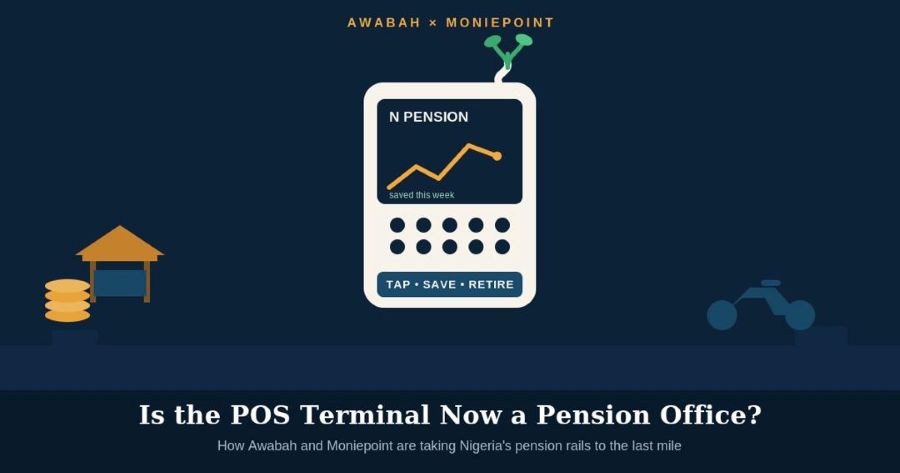
Nigeria has never lacked ambition in pension policy. The 2014 pension reform theoretically opened the Contributory Pension Scheme to informal workers, and the Micro Pension Plan followed in 2019 to formalize that access.
Five years on, fewer than 100,000 people had signed up, a rounding error against the more than 75 million Nigerians, over 93% of the workforce, who operate informally and mostly retire with nothing.
The gap was never really about product design. It was distribution. Pension Fund Administrators built their systems around salaried workers with bank accounts and HR departments to deduct contributions automatically.
Nobody built a channel that reached a market woman in Mile 12 or an okada rider in Kano on their own terms, in cash, in small amounts, without paperwork, at a location they already trust.
Also Read
That is the gap the new partnership between Awabah and TeamApt (Moniepoint’s CBNlicensed switching and processing subsidiary) aims to fill. In February 2026, Awabah became PenCom’s first Accredited Pension Agent, a new license category that shifts the regulator’s posture from “build it, and they will come” to actively pushing pensions into markets, motor parks and workshops through trusted intermediaries. TeamApt’s contribution is the rails: the same Moniepoint POS terminals traders already use to send money or collect payment can now enroll a contributor and set up recurring direct debits, with contributions starting from as little as ₦500 and flexible enough to run weekly rather than monthly.
Why the rails matter more than the pensions
The interesting part of this deal isn’t the pension product itself; Awabah has offered Personal-pensions, bundled with health, accident, and life cover, for a while. It’s that the enrolment and collection mechanism is being outsourced entirely to infrastructure that already has scale and trust. Moniepoint’s agent network reaches an estimated 4 million active businesses each month and processes hundreds of billions of dollars in transaction value annually, spanning every local government area in the country. That is a distribution footprint no PFA could replicate on its own, and it is precisely the kind of last-mile density that Nigeria’s financial inclusion numbers have struggled to convert into real inclusion: formal inclusion sits around 64%, but inclusion among the informal segment specifically has been stuck near 10%, because most products were never built around how informal earners actually manage cash flow.
The bigger implication: pensions as a proof of concept
If enrolling for a pension can be reduced to a few taps at a POS terminal someone already visits weekly, the same rails can plausibly carry other underpenetrated products: micro-insurance, micro-credit, targeted savings, investments, without requiring a new agent network, a new trust relationship, or a new device. Awabah’s bundling of health and life cover into the pension product already hints at this. The model effectively treats agent banking infrastructure as shared public-good rails that any accredited financial service can plug into, rather than requiring every product owner to build their own last-mile network from scratch. That is a more scalable path to inclusion than product-by-product distribution efforts have managed so far.
The caveat is uptake, not access
None of this guarantees success. Access has rarely been Nigeria’s binding constraint on informal-sector savings; income volatility, low trust in long-horizon financial commitments, and weak understanding of pension mechanics have mattered just as much. Awabah has set a target of 2 million enrolments in 2026 — a number that will say more about whether this model works than the partnership announcement itself. What the deal does establish is a more honest theory of the problem: that reaching the last mile at scale requires renting trust and reach that already exist, rather than asking millions of informal workers to come to a system built for people with pay slips.