Follow Us on Google Discover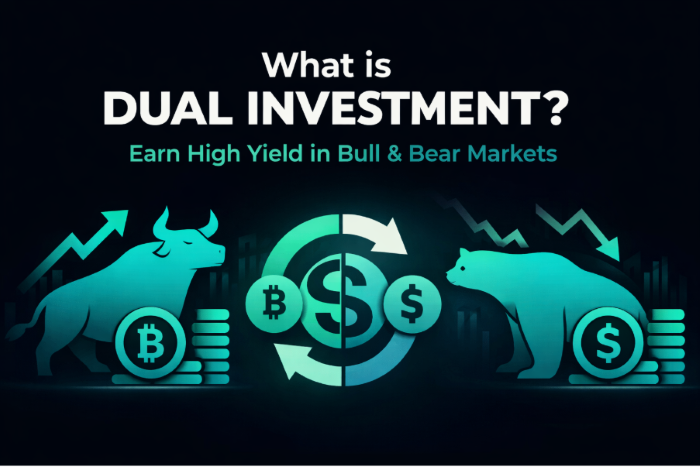
In crypto, the hardest part isn’t finding volatility—it’s turning volatility into a repeatable plan. Many traders either hold spot and hope for direction, or overtrade and bleed fees and emotions.
A structured approach sits in the middle: define the price you’d like to sell or buy at, and let the product handle execution. That’s where CoinEx Dual Investment fits.
Dual investment is a structured product that generates yield while setting a conditional “sell high” or “buy low” outcome. Instead of relying on a single market direction, it packages a rule‑based payoff:
If the market reaches (or fails to reach) a target level by settlement, your principal plus yield is returned in one of two assets. The trade‑off is simple—you accept potential opportunity cost in exchange for yield and automation.
Also Read
What is Dual Investment?
It’s commonly described as a “two‑outcome” yield product. You deposit one asset (e.g., USDT or BTC), select a target price and a tenor, and earn yield over the term. At settlement, the outcome depends on whether the market price ends above or below the target (the condition varies by direction, such as “Buy Low” or “Sell High”). The key idea: you’re expressing a preference—“I’m happy to buy this coin if price drops to X” or “I’m happy to sell if price rises to Y.”
This structure works in both bull and bear regimes. In a bull phase, “Sell High” turns a take‑profit plan into a yield‑generating position. In a bear phase, “Buy Low” turns a disciplined dip‑buying plan into a yield‑generating position. In choppy, range‑bound markets, it monetises sideways movement more effectively than simply waiting.
How it works: “Sell high” or “Buy low” automatically.
Think of it as a conditional limit order with interest. Choose the pair and direction (e.g., deposit BTC to sell into USDT at a higher target, or deposit USDT to buy BTC at a lower target). Select a target price and settlement date. Over the holding period, yield accrues at the stated rate, and at settlement you receive principal + yield in one of the two assets based on the condition relative to the target.
Simplified example: BTC at $60,000, deposit 1 BTC into a “Sell High” product with target $65,000. If settlement is at or above $65,000, you may receive USDT (effectively sold at target) plus yield. If below, you may receive BTC back plus yield—you didn’t sell, but still earned yield for the period. Mirror logic for “Buy Low”: deposit USDT with target $55,000. If settlement at or below $55,000, you may receive BTC plus yield (you bought lower). If above, you receive USDT back plus yield (you didn’t buy, but got paid for waiting).
Why traders use it in bull and bear markets.
Dual investment is most effective when you already have a price bias and don’t want to babysit the market. In bullish conditions, a “Sell High” setup automates take‑profit while earning yield as you wait. In bearish conditions, “Buy Low” lets you define a comfortable entry price, and you earn yield even if the market never dips to that level—reducing regret: if price falls, you get the asset at your chosen level; if it rises, you still earned yield instead of sitting idle.
Range‑bound or volatile markets are where this structure can truly shine. When price oscillates, limit‑order‑style strategies become repeatedly relevant, and the yield component compensates for waiting time. For many portfolios, this is a cleaner “rules‑first” alternative to frequent discretionary trading.
The real risk: opportunity cost (vs. outright holding).
The most important risk isn’t liquidation or leverage—it’s opportunity cost. Because the payoff is conditional, you may miss upside if the market rallies far beyond your target in a “Sell High” product (you sold near the target and no longer hold the asset for the continued run). Similarly, in a “Buy Low” product, if the market never falls to your target and instead rallies, you keep your original asset (e.g., USDT) and miss the gains you would have had by buying earlier.
This is why dual investment must match your intent. If you’d be unhappy selling at or near your target during a breakout rally, your target is too conservative. If you’d be unhappy buying during a sharp drawdown, your “Buy Low” target may not reflect true risk tolerance. Set targets you’d accept even in emotionally charged conditions. Also remember that outcomes may return a different asset than you deposited—that “currency switch” is by design. Plan portfolio liquidity accordingly and avoid allocating funds you must keep in a specific coin at a specific time.
When CoinEx Dual Investment makes sense.
- The strategy fit is clearer than the product mechanics. It’s most useful when:
- You want a systematic “sell high” take‑profit without constant chart monitoring.
- You want disciplined “buy low” entries and prefer earning yield while waiting.
- You expect a range‑bound or highly volatile market and want a rules‑based approach.
- You can tolerate receiving settlement in either of two assets.
- You understand that the main trade‑off is opportunity cost versus simple spot holding.
Practical tips for setting targets like a professional.
Anchor targets to levels you’d already use for limit orders—prior support/resistance, recent swing highs/lows, or a volatility‑based distance (e.g., beyond typical daily noise). The goal isn’t to “predict” the market, but to express a price you’d accept for executing your plan.
Position sizing matters as much as the target. Over‑allocating can make even a reasonable settlement feel like a mistake because it dominates your portfolio outcome. Consider splitting capital across multiple tenors or targets to avoid all‑or‑nothing timing—this laddering approach makes dual investment behave like a series of planned entries/exits rather than a single bet.
Finally, treat the stated yield as compensation for constraints. Higher yield often correlates with a higher probability of settlement converting into the other asset, or with more aggressive targets. Align parameters with your real objective—accumulation, distribution, or simply earning yield in a sideways regime.
Brief note on responsibility
Dual investment is not “free yield.” It’s a structured payoff that exchanges flexibility for yield and automation. Read the terms on CoinEx, understand how settlement is determined, and only allocate what fits your time horizon and risk tolerance. This article is for information only and does not constitute financial advice.