Follow Us on Google Discover
Fabmac Glass, a Nigerian architectural glass and partitioning company, has launched EuroFrame, a European-grade semi-frameless partition system designed to fix the acoustic leakage, sagging hardware and structural problems that show up in standard frameless glass offices after a few months of heavy use.
The launch comes as more Nigerian and West African businesses move away from solid drywall toward open, light-filled workspaces. The look is in demand, but the execution often disappoints: generic frameless installations tend to drift out of alignment, doors begin to sag, seals peel, and what was meant to be a private boardroom turns into a “goldfish bowl” where conversations carry straight through the glass.
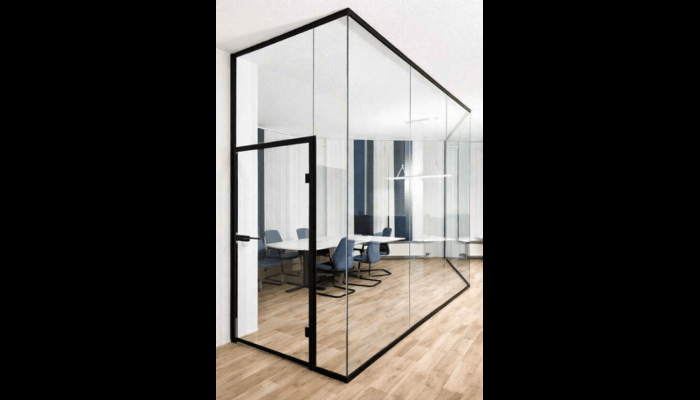
EuroFrame is Fabmac’s answer to that gap. The system pairs the minimal, near-frameless look clients want with slim aluminium profiles that hold panels in precise alignment over years of daily door swings. Its EuroFrame and door seals compress the air and dust gaps around each panel, delivering a solid closing sound and a measured 30dB of sound reduction — enough to keep boardroom conversations where they belong.
“Modern workplaces deserve more than ordinary glass partitions. EuroFrame combines the elegance of minimal design with the structural strength, acoustic performance and reliability businesses need for long-term value.” — Olayiwola Tosin, Founder and Technical Officer, Fabmac Glass
Also Read

The corporate office has quietly changed its job description. It is no longer just somewhere to put desks and chairs; it has become part of how a company presents itself — to staff, to clients, and to itself.
Walk through the newer office towers in Lagos or Abuja and the shift is hard to miss. The solid block walls and beige drywall of the last decade are giving way to glass: open floors, long sightlines, meeting rooms you can see into but, ideally, not hear through. It is an aesthetic borrowed from tech campuses abroad, and across Nigerian business districts it has become shorthand for a company that has arrived.
What the polished photographs rarely show is how often these installations disappoint the people who paid for them.
The frameless trap
For years, achieving that clean, frameless look in a Nigerian office came down to two unappealing options. A business could import a complete European system at premium cost, or hand the job to local fitters who joined toughened glass panels with poor-quality hardware and hoped it held.
The second route photographs beautifully on handover day. The trouble tends to start months later. Under daily commercial use, panels drift out of alignment. The hardware holding the glass together starts to fall off. Doors begin to sag under their own weight. Seals lift at the edges. And because little is actually sealing the gaps between panels, sound passes through — so the confidential meeting in the glass boardroom becomes, in practice, an open one. For an executive floor, a law firm or a bank, that is not a finish problem. It defeats the purpose of the room.
That gap is what Fabmac Glass, an indigenous glass and partitioning company, has spent the last few years trying to close. According to founder and technical officer Olayiwola Tosin, the same complaints kept surfacing from clients who had been burned by exactly this kind of installation. The company’s response is a system it calls EuroFrame, which it markets as a semi-frameless partition built for the wear, traffic and climate of African commercial buildings.
A frame to fake the frameless
The idea behind it is almost counter-intuitive: to get a frameless look that survives years of use, you add a slim frame.
The less visible part is acoustic. Fabmac says a two-part sealing arrangement around the fixed framing and the doors closes off the air gaps that let sound leak, and rates the result at around 30 decibels of reduction — the difference, in practice, between a boardroom that feels private and one that does not. The range extends to switchable “smart” glass that turns from clear to opaque at the touch of a button, for rooms that need privacy on demand. These are the company’s own performance figures; like most fit-out claims, their real test is how the glass behaves three or four years in.
The case for building it locally
Fabmac’s pitch rests less on adjectives than on volume. The company says it has delivered more than 130,000 square feet of commercial partitioning across Nigeria — in financial institutions, technology hubs and corporate head offices, spaces where a failed partition is noticed quickly.
Its sharper argument is about logistics. By fabricating locally and installing with its own trained teams, the firm says it sidesteps the import delays and spare-part shortages that have long made premium fit-outs slow and risky in Nigeria, and backs each project with a three-year warranty supported by parts held in the country. It is a meaningful distinction in a market where “imported” has often meant “irreplaceable when it breaks” — though, as with the durability claims, the warranty’s worth is something only time and a few service calls will prove.
Tosin frames the ambition regionally. “Our vision is to become West Africa’s most trusted provider of premium architectural glass and partition systems,” he says, pointing to plans to expand the product line and increase local manufacturing.
Whether Fabmac becomes that or not, the underlying bet is one a growing number of Nigerian builders are making: that world-class commercial space can be designed, made and serviced at home rather than shipped in. On the evidence of the glass going up across Lagos and Abuja, the market is increasingly willing to test the proposition.
Completing more than 130,000 square feet of office partition projects across Nigeria, working with financial institutions, technology hubs and corporate offices. EuroFrame builds on that track record. It is modular — available in four standard configurations and as stand-alone doors — and can be finished to suit different brands and budgets, from Crittall-style and French-grid decorative bars to reeded films and a remote-controlled switchable smart-glass film that turns clear glass opaque at the touch of a button.
Every installation is handled by Fabmac’s trained installers, runs through a quality-control checklist before handover, and is backed by a three-year warranty with local spare-parts support — a deliberate move to cut import delays and maintenance headaches that have long frustrated premium office fit-outs in Nigeria. Standard projects can be delivered in as little as 15 days.
Corporate organisations, project managers and interior designers can book an on-site assessment at Fabmac’s Ikeja facility at 7 Asiata Solarin Crescent, request a quote by emailing [email protected] or calling +234 806 155 3551, or review the full system in the EuroFrame catalogue.
About Fabmac Glass
Fabmac Glass is a Nigerian provider of architectural glass and partitioning solutions for commercial and residential projects. From its base in Ikeja, Lagos, the company designs, fabricates and installs high-performance glass systems, with a focus on durability, acoustic performance and finish quality that meets international standards.