Follow Us on Google Discover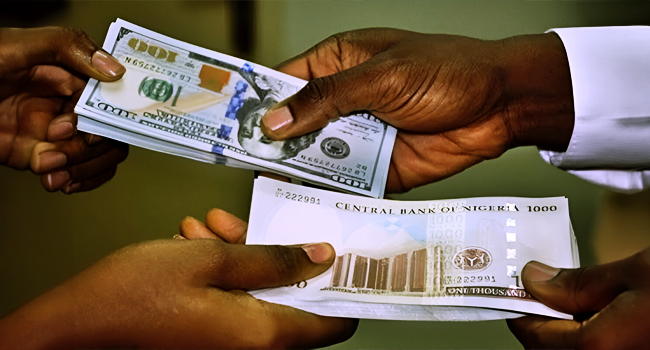
The naira weakened slightly against the United States dollar at the close of trading on Friday, settling at N1,365/$ in the official foreign exchange market after a largely stable performance throughout the week.
Data from the Central Bank of Nigeria’s (CBN) website showed that the local currency depreciated from N1,359.75/$ recorded on Thursday, ending a week characterised by limited volatility and improving investor confidence.
Despite the marginal decline, the naira maintained a stronger position compared to previous weeks, supported by rising external reserves and ongoing reforms in the foreign exchange market.
Also, the data shows that Nigeria’s external reserves increased from $49.80 billion at the beginning of the week to $50.04 billion by June 4.
Also Read
What the data is saying
The naira traded within a relatively narrow range during the week, reflecting stable market conditions and sustained liquidity in the official foreign exchange market.
- The currency opened the week at N1,366/$ on June 1 before appreciating to N1,360.22/$ on June 2.
- It traded at N1,360/$ on June 3 and strengthened further to N1,359.75/$ on June 4 before easing on Friday.
- The currency remained stronger than the previous week’s levels of N1,372/$ on May 29, N1,374/$ on May 26, and N1,377/$ on May 25.
The relatively tight trading range suggests that recent policy measures have helped reduce the sharp fluctuations previously experienced in the foreign exchange market.
More Insights
The naira’s performance coincided with another week of growth in Nigeria’s external reserves, providing additional support for market stability and investor sentiment.
- The reserves grew by approximately $237.3 million within four days.
- Higher reserve levels improve the Central Bank of Nigeria’s ability to support the foreign exchange market and meet external obligations.
The recent stability also follows a series of reforms introduced by the Central Bank of Nigeria to improve transparency, deepen liquidity, and strengthen confidence in the country’s foreign exchange market.
What you should know
Nigeria’s foreign exchange market has undergone significant reforms aimed at improving liquidity and restoring investor confidence.
- Nigeria’s gross external reserves rose to $49.96 billion as of June 3, 2026.
- The reserves increased by more than $155 million within 24 hours from $49.80 billion recorded the previous day.
Nairametrics previously reported that reserves declined from above $50.08 billion on March 12 to $49.61 billion by March 23, 2026.
- Earlier data showed external reserves gained approximately $1.22 billion during May 2026.
- The CBN recently introduced the Fourth Edition of its Foreign Exchange Manual to strengthen market governance and improve operational efficiency.
The revised FX framework introduced several regulatory changes, including an increase in the allowable advance payment for imports from 15% to 30%, a move aimed at improving trade transactions and easing access to foreign exchange for businesses.