Follow Us on Google Discover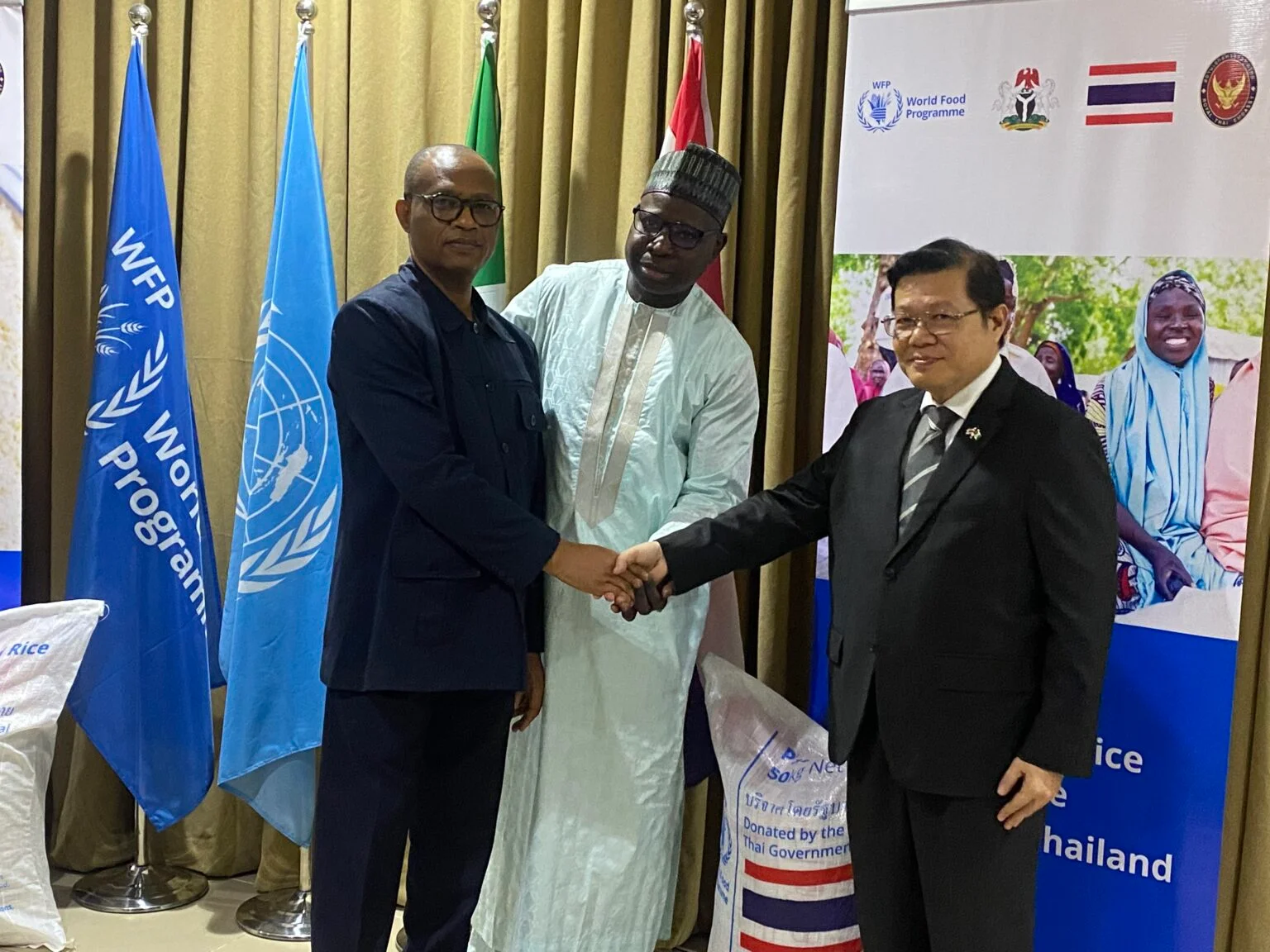
Thailand has donated 12 metric tonnes of rice valued at $22,000 to support communities affected by food insecurity in Nigeria, as humanitarian agencies warn of worsening hunger conditions across the country.
The donation was announced on Thursday in Abuja by the Ambassador of Thailand to Nigeria, Mr. Thirapath Mongkolnavin, during the presentation of the rice to the World Food Programme (WFP) for distribution to vulnerable populations, particularly in the North-East.
Thailand is regarded as the world’s sixth-largest rice producer, with annual production estimated at about 34.3 million metric tonnes.
What they are saying
Speaking at the event, Mongkolnavin said the donation was in response to the humanitarian challenges affecting hundreds of thousands of people in Borno, Adamawa and Yobe (BAY) states.
Also Read
- He said, “In response to this crisis, Thailand is pleased to contribute 12 metric tonnes of Thai rice valued at 22,000 dollars through the WFP to support communities affected by food insecurity.”
The ambassador also highlighted Thailand’s previous humanitarian support to Nigeria, noting that the country had earlier provided financial assistance through international relief channels.
- “Earlier, the Royal Thai Government provided financial assistance of 10,000 dollars through the Nigeria Humanitarian Fund, managed by the United Nations Office for the Coordination of Humanitarian Affairs (UNOCHA), to support humanitarian efforts in the BAY states,” he said.
Also speaking, the Permanent Secretary of the Federal Ministry of Humanitarian Affairs and Poverty Reduction, Mr. Olubunmi Olusanya, described the donation as a reflection of global solidarity in addressing hunger and poverty.
- “As we celebrate this gesture today, let us reaffirm our collective commitment to building partnerships that advance sustainable development, reduce poverty and ensure that no one is left behind,” he said,
More insights
Nigeria continues to grapple with a worsening food security crisis driven by conflict, economic pressures and climate-related disruptions.
- According to PwC, as many as 34.7 million Nigerians could face acute food insecurity in 2026, highlighting the growing scale of the humanitarian challenge.
- Similarly, the United Nations Food and Agriculture Organization (FAO) projects that about 34.7 million Nigerians may experience severe food insecurity during the June-August 2026 lean season, based on findings from its October 2025 Cadre Harmonisé analysis.
Experts attribute the crisis to a combination of factors, including persistent insecurity in food-producing regions, farmer-herder clashes across the Middle Belt, widespread banditry in parts of the North-West, and climate change-induced events such as flooding and droughts that have disrupted agricultural production.
These challenges have significantly reduced food output, displaced farming communities and increased pressure on already fragile food supply chains.
What you should know
Although Nigeria is one of Africa’s largest consumers of rice, consuming an estimated 7.6 million metric tonnes annually, the country continues to face a production shortfall of between two million and three million metric tonnes each year, which is largely bridged through imports.
The supply gap, combined with foreign exchange pressures, transportation costs, inflation and other economic challenges, has contributed to a sharp increase in rice prices in recent years.
- A market survey conducted by Nairametrics during the first week of May 2026 showed that the price of a 50kg bag of rice ranged between N53,000 and N82,000, depending on location, transportation costs, supply chain efficiency and regional demand.
The rice donation will be implemented by the WFP in partnership with the Federal Government and targeted at newly arrived residents of Internally Displaced Persons (IDP) camps in North-East Nigeria.