Follow Us on Google Discover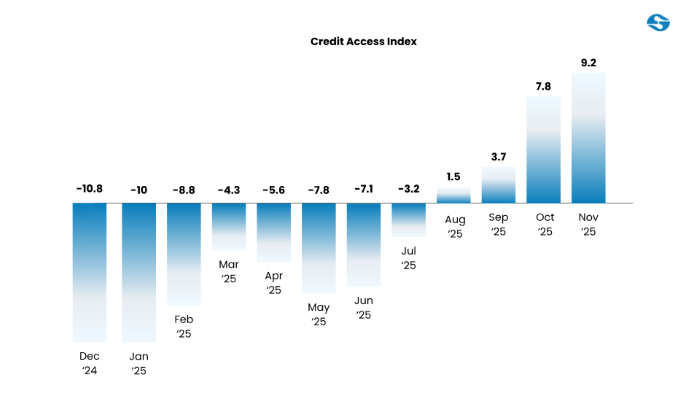
Nigeria’s Credit Access Index has moved into positive territory after more than a year of negative readings.
This marks a gradual shift away from the prolonged period of tight lending conditions that defined much of 2024 and the first half of 2025.
According to Credit Direct’s 2025 Nigeria Credit Landscape Report, the index measures how willing financial institutions are to extend credit to businesses.
It rose to 9.2 points in November 2025, up from -10.8 in 2024. Over the same period, the Financial Conditions Index, which reflects the broader cost and availability of funding, moved from -2.7 to 21.1. Together, these indicators suggest that lenders are gradually re-engaging with the real economy after a prolonged period of tight credit conditions.
Also Read
The improvement built gradually through the year in alignment with macroeconomic easing. The index moved choppily through the first half of 2025 in negative territory before crossing into positive readings in the third quarter and rising every month after that, reaching its strongest level of the cycle in November.
Several macroeconomic factors underpin the broader outlook, including relative stability in the Naira, easing inflationary pressures, stronger GDP growth, and improved foreign exchange supply. The report also points to improving cashflow structures in manufacturing, logistics, ICT, and oil-linked value chains, which it expects to drive demand for medium to long-term credit. At the same time, recent adjustments by the Central Bank of Nigeria to its asymmetric policy corridor, including a lower Standing Deposit Facility rate and a higher Standing Lending Facility rate, are designed to encourage more lending into the productive economy.
For businesses, the most immediate change is that longer-term financing is becoming more accessible again. The report notes that demand for medium to long-term credit is expected to strengthen into 2026 as companies return to investment planning. This outlook is supported by the Central Bank’s business sentiment projections, which indicate that the Business Sentiment Index is expected to rise from 37.5 in December 2025 to 52.5 over the next six months. Broader growth expectations remain positive, with the IMF and World Bank projecting GDP growth between 4.2% and 4.4% in 2026, while the Central Bank’s forecast sits slightly higher at 4.49%.
Even so, the recovery is uneven across the economy. Lenders remain cautious as they assess policy direction and broader macroeconomic stability, while borrowing costs remain relatively high even as access improves, continuing to shape how much risk businesses are willing to take on.
At the same time, structural constraints continue to slow the pace at which improved credit conditions translate into real economic activity. Insecurity, unreliable power supply, high subnational taxation, and uncertainty around tax reforms all influence whether improved credit indicators lead to actual loan disbursements and investment decisions.
Taken together, the data points to a recovery that is real but uneven. After a year in which many businesses were focused primarily on whether financing was available at all, the conversation is beginning to shift. It is moving from access alone to questions of pricing and structure. For lenders and borrowers alike, that shift opens a more deliberate phase in which credit becomes available again, but is increasingly shaped by the terms that determine who can scale and who remains constrained.
The full Nigeria Credit Landscape Report 2025 is available for download from Credit Direct: https://www.creditdirect.ng/2025-credit-report
About Credit Direct
Credit Direct is building Africa’s leading embedded finance business by integrating credit into the supply chains and payment flows of partners, unlocking financial success for individuals and businesses. The company also provides retail investment solutions, expanding its role from access to credit to broader financial growth and wealth-building. Credit Direct has served millions of customers nationwide, including those historically underserved by traditional banking. Credit Direct is a wholly owned subsidiary of First City Monument Bank (FCMB) Group Plc.