Follow Us on Google Discover
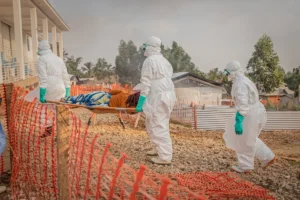
Uganda has closed its border with the Democratic Republic of the Congo as authorities intensify efforts to contain the spread of Ebola following a sharp rise in suspected infections linked to the outbreak in eastern Congo.
The closure was announced by Uganda’s National Task Force on Ebola Response, which said the decision was taken amid growing concerns over cross-border transmission between the two neighboring countries, which share extensive border communities and trade routes in East and Central Africa.
The development comes after Uganda recorded its first Ebola case less than two weeks ago involving a Congolese patient who crossed into the country seeking medical treatment.
The patient later died in intensive care in Kampala on May 14 after developing bleeding-related symptoms associated with the virus.
Also Read
What they are saying
Under the new border measures, Ugandan authorities said only authorised Ebola response personnel, humanitarian workers, cargo and food transport operators, and security officials will be permitted to cross between the two countries.
All approved travelers will be subjected to strict health screenings, documentation procedures, and continuous monitoring at designated border entry points.
- The government also directed anyone returning from Congo to undergo mandatory 21-day self-isolation under the supervision of health authorities and district surveillance teams.
- Schools in border communities will remain open but must comply with health ministry protocols, including compulsory temperature screening for students arriving from Congo.
- District officials have also been instructed to strictly enforce Ebola prevention guidelines, while media organizations are expected to devote daily prime-time programming to public sensitization campaigns on the outbreak.
According to Tedros Adhanom Ghebreyesus, Director-General of the World Health Organization, as of May 25, Congo had confirmed 101 Ebola cases and 10 deaths, although the actual scale of the outbreak is believed to be significantly larger.
He noted that more than 900 suspected infections and 220 suspected deaths had already been reported in Congo, pushing the broader number of reported and suspected cases close to 1,000.
Tedros also disclosed that Uganda recently confirmed two additional Ebola infections among healthcare workers, bringing the country’s total confirmed cases to seven, including one death.
More insights
The current outbreak involves the Bundibugyo strain of the Ebola virus, a relatively rare variant first identified in Uganda in 2007.
- Health authorities and international agencies have warned that there is presently no approved vaccine or specific treatment for the strain, raising concerns over the speed of transmission across Central Africa.
- The outbreak has already resulted in at least 220 suspected deaths in Congo, while health officials continue tracing hundreds of suspected infections across affected communities.
The World Health Organization earlier declared the outbreak a Public Health Emergency of International Concern, citing the growing regional risk posed by cross-border movement and weak healthcare systems in affected areas.
What you should know
African governments and international partners have secured nearly $500 million in pledges and commitments to strengthen Ebola response efforts across affected and high-risk countries in Central and East Africa.
- Part of the funding package includes about $160 million pledged by the World Bank for Congo’s response operations, $82 million from the United States, and roughly $57 million from European partners to support surveillance, treatment, and containment measures.
- Last week, Tom Fletcher, the United Nations Under-Secretary-General for Humanitarian Affairs and Emergency Relief Coordinator, announced on X that the United Nations Office for the Coordination of Humanitarian Affairs had released up to $60 million from its emergency response fund to support efforts aimed at containing the outbreak.
The emergency funding was announced days after the WHO declared the Ebola outbreak a global public health emergency, warning that the Bundibugyo strain currently spreading across parts of Central Africa lacks an approved vaccine or targeted treatment.