Follow Us on Google Discover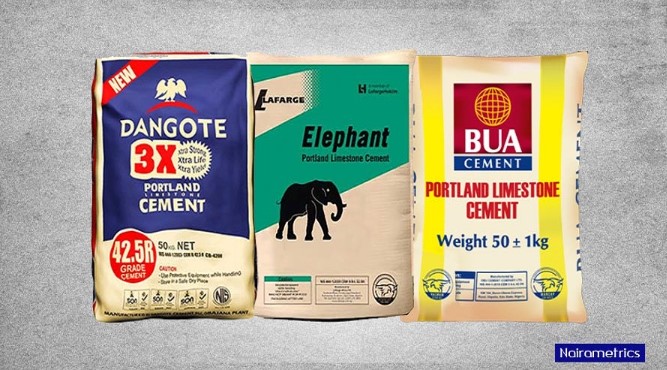
Nigeria’s three biggest cement producers; Dangote Cement, BUA Cement and Lafarge Africa delivered strong profitability expansion in their Q1 2026 results.
Combined net profit margin for the three companies rose from about 22% in Q1 2025 to nearly 32% in Q1 2026, meaning the companies retained almost 32 kobo as profit for every N1 of revenue generated during the quarter, compared with about 22 kobo in the same period of 2025.
The performance is particularly notable because Q1 2026 margins were stronger than the sector’s full-year 2025 margins, suggesting the cement makers entered 2026 with stronger pricing power and operational efficiency.
BUA Cement recorded the highest net profit margin among the three at 49.69%, ahead of Lafarge Africa’s 29.25% and Dangote Cement’s 26.80%.
The margin expansion came despite rising operating expenses linked to higher crude oil prices and energy costs following the US/Israel-Iran conflict.
Dangote Cement’s haulage expenses rose to N135.82 billion from N124.48 billion in Q1 2025, while Lafarge Africa and BUA Cement also recorded higher distribution costs.
Yet the companies still widened margins, suggesting they successfully passed part of the higher energy and logistics costs to consumers through pricing, while maintaining cost discipline.
For investors, the stronger margins could translate into higher earnings per share, improved dividend-paying capacity, stronger valuations, and potentially better shareholder returns if sustained through the rest of 2026.
Lafarge Africa (WAPCO)
Among the three cement manufacturers, Lafarge Africa currently leads in share price appreciation.
As of May 20, 2026, the stock traded at N342, up from N134.50 at the start of the year, representing a 154% year-to-date gain and just about 3% below its 52-week high.
At this price, investors are paying about N17 for every N1 of trailing earnings, implying a P/E ratio of about 17x. While this may appear elevated, Lafarge’s earnings growth makes the valuation more compelling.
EPS rose from N3.17 in 2021 to N16.96 in 2025, representing a five-year CAGR of about 52%. This puts its PEG ratio at around 0.33x, suggesting the stock may still be undervalued relative to earnings growth.
The momentum has continued in 2026, with Q1 EPS rising to N6.08, already about 36% of full-year 2025 EPS.
Lafarge also raised its dividend from N1.20 in 2024 to N10 per share in 2025, backed by EPS of N16.96.
BUA Cement
BUA Cement is following Lafarge Africa closely in terms of share price appreciation, with the stock gaining about 132% year-to-date.
The share price has risen from N178.50 at the start of the year to N414 as of May 20, 2026, placing it about 10% below its 52-week high of N460.
At the current market price, investors are paying over N31 for every N1 of trailing earnings, implying a price-to-earnings ratio of about 31x, significantly higher than Lafarge Africa’s valuation multiple.
- While this may appear expensive on the surface, BUA Cement’s earnings growth profile partly explains the premium valuation.
Over the past five years, the company compounded earnings at an annual growth rate of about 41%, while return on equity stood at about 68%, reflecting strong profitability and efficient use of shareholder capital.
The momentum strengthened further in Q1 2026. Earnings per share rose by about 118% year-on-year to N5.22, already accounting for nearly half of its full-year 2025 EPS of N10.51.
- Part of the strong bottom-line growth was supported by an FX gain of about N13 billion compared with an FX loss in Q1 2025.
- However, the company’s core operations also remained strong. Revenue increased by over 22% to N355 billion, while gross profit rose by more than 45% to N202 billion.
- Gross margin expanded sharply to nearly 57% from about 48% in Q1 2025, suggesting that BUA Cement might have passed higher energy and logistics costs to consumers while maintaining operational efficiency.
The stock’s rally therefore appears fundamentally supported by strong earnings growth, expanding margins and improving shareholder returns.
Dangote Cement
The company’s share price has climbed from N609 at the beginning of the year to N1,180, representing a 94% year-to-date gain and pushing its market capitalization close to N20 trillion, making it the most capitalized stock on the NGX.
At the current market price, investors are paying about N18 for every N1 of trailing 12-month earnings, lower than BUA Cement’s valuation multiple.
Although Dangote Cement’s five-year earnings CAGR of about 29.6% trails Lafarge Africa and BUA Cement, its PEG ratio of about 0.60 still suggests the stock may be reasonably undervalued relative to earnings growth.
The company’s earnings momentum also strengthened in Q1 2026. Earnings per share rose by about 56% year-on-year to N19.14, already accounting for nearly one-third of its full-year 2025 EPS of N59.86.
A major support factor was the sharp reduction in finance costs, which declined to N98.25 billion from N129.38 billion in Q1 2025 following a significant reduction in total debt to about N745 billion from N1.16 trillion as of December 2025.
The result suggests Dangote Cement’s rally is being supported by improving fundamentals, stronger pricing power, lower leverage and expanding profitability.
On dividend, Dangote Cement is a strong dividend paying company. For at least over a decade, it has been consistent in paying dividends. In 2025, it increased its dividend per share to N45 from N30 in 2024, from earnings per share of N59.86.
Overall, the Q1 2026 results suggest Nigeria’s major cement manufacturers entered the year with stronger pricing power, wider margins and improved earnings quality despite rising energy and logistics costs.
Among the three, BUA Cement leads in profitability expansion; Lafarge Africa leads in share price appreciation and earnings acceleration, while Dangote Cement continues to dominate in scale, market capitalization and balance sheet strength.
If current earnings momentum is sustained through the remaining quarters of 2026, the sector could deliver another strong year of shareholder returns, supported by earnings growth, dividend expansion, and further share price gains.