

Private participation in Africa’s airport sector is expanding, but remains structurally limited compared to global aviation markets.
Most airports across the continent are still state-owned, with private capital entering primarily through concessions, public-private partnerships (PPPs), and long-term infrastructure leases rather than outright ownership.
This model has attracted a growing pool of investors ranging from pension funds and infrastructure managers to construction conglomerates and global airport operators.


The small presence of private operators comes against the backdrop of a continent that accounts for only about 2–3% of global air traffic despite its population size. Africa’s aviation industry is constrained by high operating costs, limited intra-regional connectivity, and uneven infrastructure quality, even as passenger demand continues to rise steadily.
As governments seek to modernize transport infrastructure without overburdening public finances, airport concessions have become a key policy tool. The result is a fragmented but gradually evolving ecosystem where state ownership remains dominant, but operational control and capital deployment are increasingly shared with private investors.
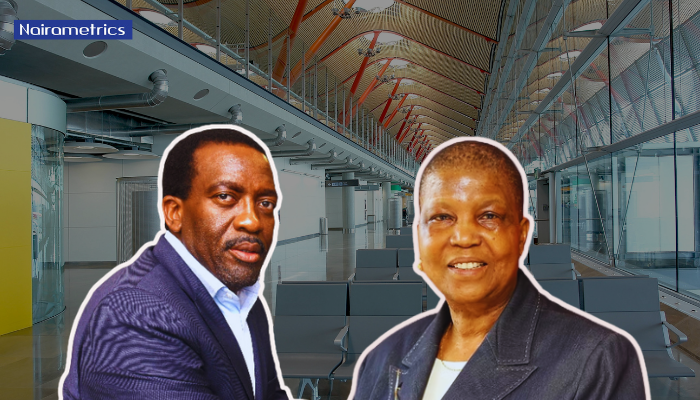
Owners of Lanseria International Airport (FALA), South Africa
Founders- Tshepo Mahloele and Salukazi Dakile-Hlongwane
Tshepo Mahloele and Salukazi Dakile-Hlongwane are key shareholders in Lanseria International Airport, one of Africa’s few fully privately owned commercial airports, through their respective investment platforms Harith General Partners and Nozala Investments, alongside the Government Employees Pension Fund (GEPF) via the Public Investment Corporation (PIC).
- Mahloele leads Harith General Partners, a Pan-African infrastructure fund manager with about $3 billion in assets under management. The firm invests across transport, energy, and telecommunications through vehicles such as the Pan-African Infrastructure Development Fund (PAIDF).
- As part of a recent restructuring, PAIDF’s stake in Lanseria was transferred to Harith Infraco Limited, a dedicated infrastructure holding company established by Harith to consolidate and directly manage its asset-level investments. The move reflects a shift toward tighter operational oversight and streamlined ownership structures within Harith’s portfolio.
Dakile-Hlongwane is the founder and chair of Nozala Investments, a women-led investment holding company established in 1996 to advance economic participation for black women in South Africa. The firm plays a central role in Lanseria’s empowerment ownership structure.
Lanseria International Airport operates as a privately owned alternative to Johannesburg’s main hub, serving domestic and regional traffic. Its current ownership framework dates back to a 2013 transaction involving PIC (on behalf of GEPF), PAIDF (managed by Harith), and a Nozala-led consortium.
A 2024 ownership realignment increased GEPF’s stake and repositioned Harith’s investment under Harith Infraco, signalling continued institutional backing and positioning the airport for expansion, including a planned cargo precinct aimed at strengthening its role as a regional aviation and logistics hub.







What about Asaba International airport, Asaba Delta State. It was concessioned to a private group of investors some years ago. Asaba is amongst the too 10 busiest airport in Nigeria