

Private participation in Africa’s airport sector is expanding, but remains structurally limited compared to global aviation markets.
Most airports across the continent are still state-owned, with private capital entering primarily through concessions, public-private partnerships (PPPs), and long-term infrastructure leases rather than outright ownership.
This model has attracted a growing pool of investors ranging from pension funds and infrastructure managers to construction conglomerates and global airport operators.


The small presence of private operators comes against the backdrop of a continent that accounts for only about 2–3% of global air traffic despite its population size. Africa’s aviation industry is constrained by high operating costs, limited intra-regional connectivity, and uneven infrastructure quality, even as passenger demand continues to rise steadily.
As governments seek to modernize transport infrastructure without overburdening public finances, airport concessions have become a key policy tool. The result is a fragmented but gradually evolving ecosystem where state ownership remains dominant, but operational control and capital deployment are increasingly shared with private investors.
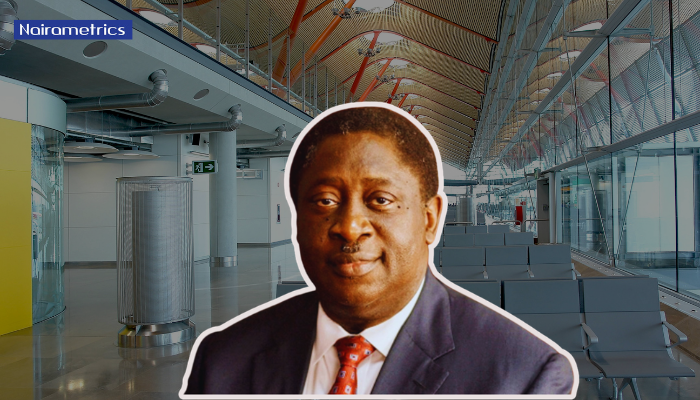
Managers of Murtala Muhammed Airport Terminal 2
Bolanle Olawale Babalakin- Founder of Bi-Courtney Aviation Services Ltd
Bolanle Olawale Babalakin is a Nigerian lawyer and businessman who has played recurring advisory and committee roles in public policy, legal reform, and higher education governance.
He is Chairman of the Bi-Courtney Group, a diversified conglomerate with interests in aviation infrastructure, construction, and real estate.
Its flagship subsidiary, Bi-Courtney Aviation Services Limited (BASL), was incorporated to develop and operate airport infrastructure under public-private partnership arrangements. In 2003, BASL was granted a 36-year concession by the Federal Government of Nigeria under a Design-Build-Operate-Transfer (DBOT) structure to deliver the Murtala Muhammed Airport Terminal 2 (MMA2).
The MMA2 project includes a domestic passenger terminal, aircraft apron, multi-level car park, and associated commercial facilities. It is widely regarded as Nigeria’s first major privately developed airport terminal and a benchmark for airport concessioning in West Africa.
In 2005, he was appointed by President Olusegun Obasanjo to the National Political Reform Conference, where he served on the Legal Reforms Committee and chaired the Constitution Drafting Sub-Committee.
The assignment placed him among key participants in Nigeria’s constitutional review process at the time.
He has also served in advisory and technical capacities to successive administrations, including as Honorary Adviser to President Umaru Musa Yar’Adua alongside Alhaji Rilwanu Lukman.
In the legal sector, he has held committee roles within the Nigerian Bar Association, including chairing the Real Estate and Construction Law Committee under the Section on Business Law and the Government Practice Committee under the Section on Legal Practice.
Babalakin has been extensively involved in Nigeria’s tertiary education governance and labour relations framework. He served as Pro-Chancellor and Chairman of Council of the University of Maiduguri between 2009 and 2013 and currently holds the same position at the University of Lagos.







What about Asaba International airport, Asaba Delta State. It was concessioned to a private group of investors some years ago. Asaba is amongst the too 10 busiest airport in Nigeria