Follow Us on Google Discover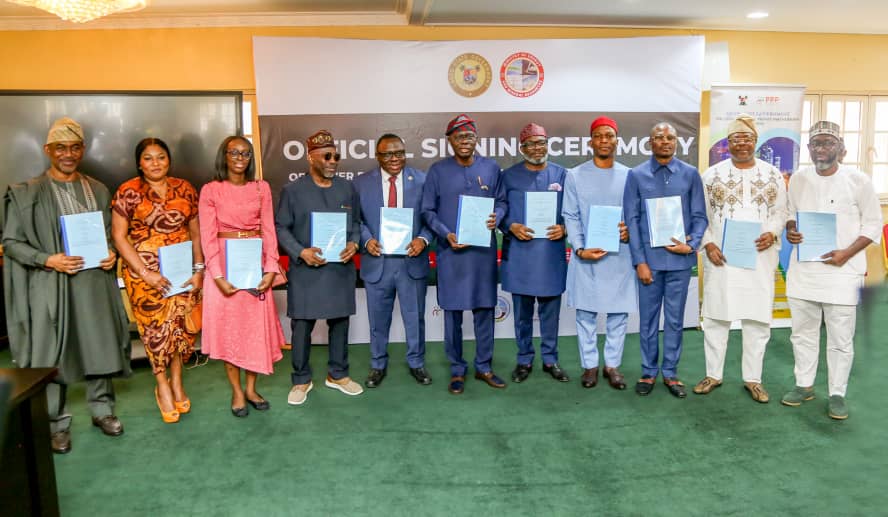
The Lagos State Government has signed Power Purchase Agreements (PPAs) and concession arrangements with three independent power producers (IPPs) as part of efforts to expand electricity generation capacity to between 200MW and 400MW within the next few years.
The agreements were formalised at Lagos House, Marina, and involved Mainland Power Limited, Fenchurch Power Limited, in partnership with Aggregate Utilities Limited, and Viathan Engineering Limited.
According to the state government, the transactions cover three of the four IPPs deployed under its embedded power generation programme and are aimed at strengthening Lagos’ push toward a more stable and self-sustaining electricity market.
Governor Babajide Olusola Sanwo-Olu, who presided over the signing ceremony, described the development as a key milestone in the state’s broader energy reform agenda.
Also Read
What they are saying
Sanwo-Olu said the agreements reflect Lagos’ commitment to improving power supply for homes, businesses, and public infrastructure.
- “These partnerships represent our determination to power homes, industries and critical infrastructure with reliability and efficiency.”
- “We are laying a strong foundation for a future where Lagos has the capacity and independence required for sustainable development.”
The Commissioner for Energy and Mineral Resources, Biodun Ogunleye, explained that the new agreements were restructured to align with Lagos’ evolving electricity market framework.
- “From a current capacity of less than 60MW, we see these plants scale up to over 200-400MW in 2-3 years without draining the treasury but competing in the marketplace to provide sustainable energy to our citizens,” he stated.
Get up to speed
Lagos State has in recent years pursued embedded generation projects to reduce dependence on the national grid and improve electricity reliability across key economic corridors.
- The state has deployed multiple IPPs to serve industrial, commercial, and residential clusters.
- Previous power arrangements included legacy models such as “take-or-pay” contracts.
- Lagos has been repositioning its electricity market to attract more private sector participation.
More Insights
Ogunleye said the new framework removes legacy contractual structures and introduces a more performance-driven payment model.
- The state has eliminated “take-or-pay” and “deemed energy” provisions, which previously required payment for unused electricity.
- Payments will now be tied strictly to metered energy delivered at designated supply points.
- Dual power supply systems are being introduced for critical infrastructure to improve reliability.
He added that the reforms are designed to improve transparency, cost efficiency, and accountability in the electricity value chain.
The government said the reforms are expected to significantly scale up generation capacity from less than 60MW currently to as much as 400MW over the next two to three years, driven largely by private sector investment.
- Mainland Power continues to serve parts of Ikeja, Oshodi, Anthony, and key public facilities such as LASUTH.
- The Akute IPP is being rehabilitated after several years of inactivity to support expanded water infrastructure and surrounding communities.
- The Viathan-linked plants on Lagos Island will continue powering key government and commercial assets through hybrid systems.
What you should know
Earlier, Odu’a Investment Company Limited, in partnership with Elektron Energy Development Strategies Limited, announced plans to build a 50-megawatt (MW) gas-fired Independent Power Plant (IPP) at the Ogba Industrial Estate in Ikeja, Lagos, to improve electricity supply for businesses in the area.
The independent power project is part of a broader shift enabled by regulatory changes, as Lagos is among the 15 states in Nigeria that have established their own electricity regulatory frameworks.
In December 2024, the Nigerian Electricity Regulatory Commission transferred oversight of the electricity market in Lagos to the Lagos State Electricity Regulatory Commission.