
 Follow Us on Google Discover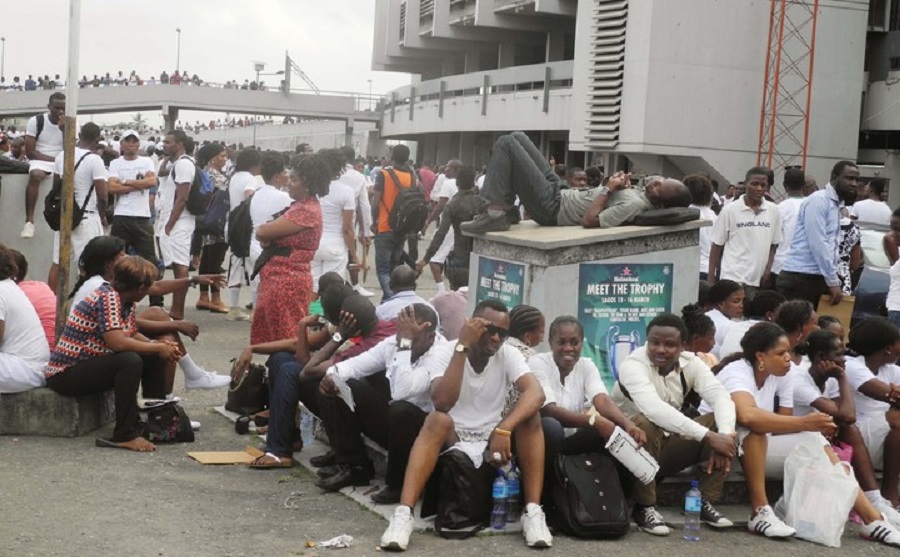
Stand at the Oshodi bus stop in Lagos for ten minutes, and you will count, without trying, at least eighty-five people who are technically working.
Among others, you see the woman selling cold shelled groundnuts from a tray balanced on her head, the man hawking phone chargers so new they are still in Chinese-language packaging, the teenage boy weaving through traffic with a tower of chin-chin that defies both gravity and NAFDAC regulations, and a graduate in a faded foreign university hoodie, conducting an informal survey of which danfo will leave first.
Everyone is doing something.
The street hums with the controlled chaos of a nation that has never had the luxury of sitting still. And yet, for several years running, the National Bureau of Statistics (NBS) told us that one in three Nigerians of working age could not find a job. How?!
Nigeria presents one of the most striking labour market paradoxes in the developing world: a country of visible, relentless economic activity in which, by official count, one in three working-age Nigerians was unemployed as recently as 2020.
The paradox is not an accident. It is the product of how employment is defined, measured, and reported, and understanding it is essential for anyone seeking to diagnose Nigeria’s economic challenges honestly.
This article distils the core argument for policymakers, economists, and development practitioners who need the key points rapidly and without the groundnut seller anecdotes, however entertaining those anecdotes might be.
The Statistical Turning Point
In the fourth quarter of 2020, Nigeria’s National Bureau of Statistics (NBS), according to its Q4 2020 Unemployment Report, recorded an unemployment rate of 33.3%, equivalent to 23.18 million people.
This represented a sharp increase from 27.1% in the second quarter of the same year, largely driven by the economic disruptions caused by the COVID-19 pandemic, and marked the highest unemployment level in at least 13 years.
The combined unemployment and underemployment rate (a measurement of the proportion of people in the labour force who are employed but not fully utilized in terms of their skills, time, or earning capacity) reached 56.1%, meaning more than half the labour force was in acute labour market distress.
However, in 2023, the NBS adopted the standard methodology of International Labour Organisation (ILO), and Nigeria’s headline unemployment rate fell to approximately 4.1%. This dramatic change was not the result of a sudden economic transformation.
It was the result of a definitional shift in which, under the ILO framework, any person who worked for at least one hour in the survey reference week is classified as employed.
Curiously, Nigeria seemingly only adopted the ILO framework, formally established in 1982 at the 13th International Conference of Labour Statisticians (ICLS), to “manage” the unemployment numbers going forward. Under Nigeria’s old framework, the threshold was 20 hours per week, capturing the inadequacy of work rather than merely its presence. Both definitions are internally consistent.
They answer different questions about the labour market, and conflating them produces confusion about the scale of the problem.
Who Counts and Why It Matters
The ILO one-hour work threshold for “pay, profit, or family gain”, which Nigeria now applies, means that the following categories of workers are classified as employed: subsistence farmers who worked during the survey reference week’s growing season; informal traders who sold goods or services for any amount of time during the week; casual labourers who performed one-off tasks; and the vast unpaid family workers who assisted in household enterprises.
Nigeria has approximately 37 million smallholder farm households (families that operate small-scale agricultural holdings, primarily relying on family labour to produce food and income) and an informal sector that accounts for roughly 65% of GDP.
These structural features of the economy ensure that much of the working-age population will always meet the ILO employment threshold, producing very low headline unemployment rates even in periods of acute labour market distress.
The headline rate only measures work but does not measure whether that work generates a living income, whether it is secure, or whether it matches the skills and expectations of those performing it.
The Vulnerable Employment Crisis
The more policy-relevant measure is the vulnerable employment rate: the share of workers in informal, precarious arrangements without social protection, job security, or assured income.
World Bank estimates place Nigeria’s vulnerable employment rate at between 80% and 85% of those classified as employed. Applied to the 77 million Nigerians counted as employed in recent surveys, this implies that between 61 and 65 million workers are in economically precarious positions.
The graduate unemployment and underemployment dimension is particularly severe: with about 650 higher institutions and well over one million graduates (including from polytechnics and colleges of education) entering the labour market each year and the formal economy generating fewer than 800,000 new jobs annually, the credential oversupply relative to formal-sector demand is structural and widening.
This mismatch is the primary economic driver of Nigeria’s emigration crisis and a significant contributor to social unrest.
Comparing Nigeria to Peers
South Africa reports an unemployment rate of approximately 32% under the ILO definition, making it one of the highest in the world, while Nigeria appears far more favourably at 4.1%. The difference does not mean Nigerian workers are better off than South African ones.
It reflects the fact that South Africa’s pseudo Western culture of mostly not working for family considerations, as well as a smaller informal sector, means more of its jobless citizens appear in the official unemployment count, while Nigeria’s massive informal sector absorbs distress in ways that the headline unemployment rate does not see.
Nigeria’s labour market reality is closer to South Africa’s than the headline comparison suggests, and policymakers who take comfort from the 4.1% without reading the supplementary indicators are making decisions based on an incomplete picture.
Policy Recommendations
Three specific policy actions follow from this analysis. First, the National Bureau of Statistics, to paint a more realistic picture, publishes alongside the ILO-aligned headline rate a suite of supplementary labour market indicators every quarter: the vulnerable employment rate, the labour underutilisation rate combining unemployment and time-related underemployment, the share of workers earning below the national minimum wage, and the youth labour underutilisation rate.
These measures exist and can be computed from existing survey data.
Their absence from official press releases is a policy communication choice, not a technical limitation. Second, industrial policy should be explicitly calibrated to formal job creation targets rather than GDP growth targets, since GDP growth driven by the informal sector can coexist indefinitely with mass vulnerable employment.
A target of 1.25 million new formal sector jobs per year for a sustained decade would materially improve the vulnerable employment rate and reduce graduate unemployment.
Third, investment in the quality of informal employment is as important as investment in formal job creation: improving access to business finance, skills upgrading, and social protection for informal workers would raise the welfare floor for the approximately 65 million Nigerians who will remain in informal work regardless of industrial policy outcomes in the near term.
Nigeria’s unemployment paradox is ultimately a measurement problem with real-world consequences.
The country is not as employed as the headline rate implies, and it is not as unemployed as the 2020 peak implied.
The truth is a labour market in which most people are doing something, but most of what they are doing does not pay enough, does not accumulate enough, and does not build toward enough for the country’s long-run development to be secured. Measuring that truth accurately is the first and most basic obligation of a government serious about its workers.
Akinola Morakinyo (Ph. D) writes on MINT economies from the Department of Economics, Finance & Quantitative Analysis, University of Kennesaw, GA, USA.


Very well articulated.
The analysis is closer to reality than what is being postulated by the foreign monitoring agencies.