Follow Us on Google Discover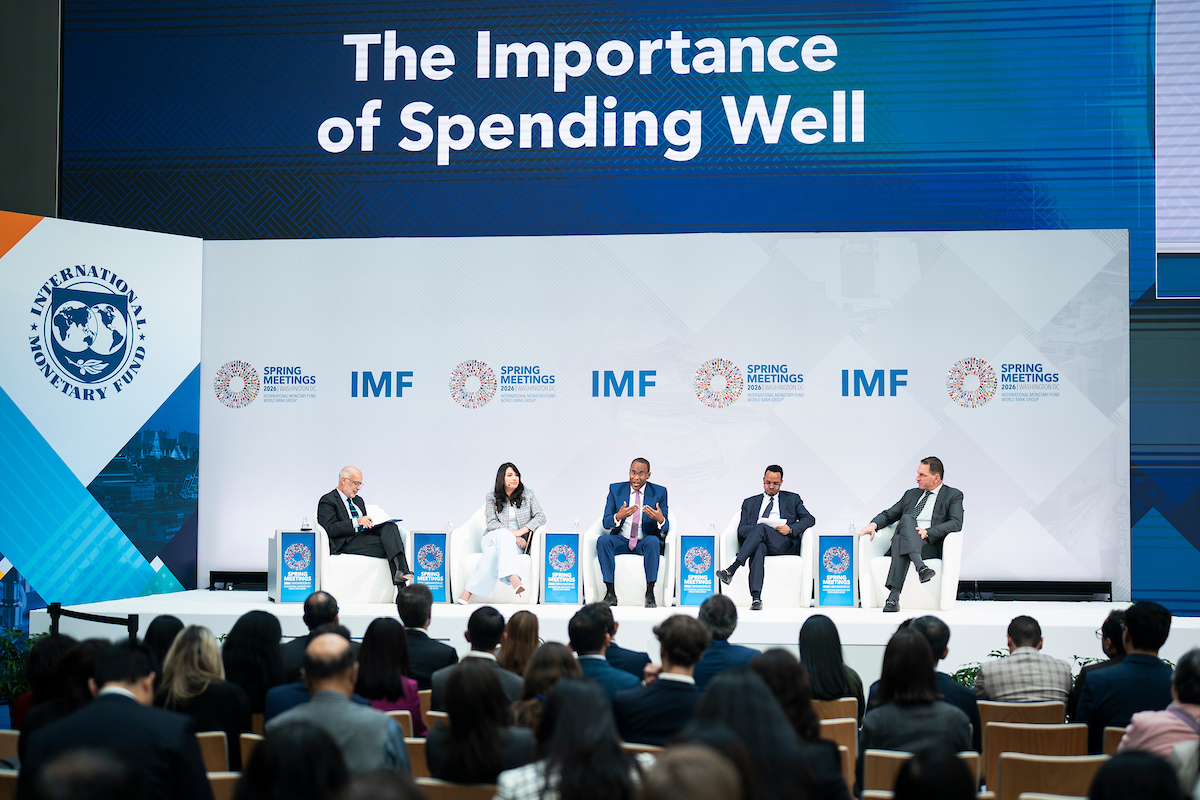
The International Monetary Fund (IMF) has declined to take a position on whether Nigeria should prioritise external or domestic borrowing, stressing the importance of overall debt sustainability instead.
This position was stated on April 16, 2026, by Abebe Aemro Selassie, Director of the African Department (AFR) at IMF, during a media briefing of the IMF’s Regional Economic Outlook for Sub-Saharan Africa, where he responded to a question on whether Nigeria should tilt more towards external borrowing or rely on domestic sources amid global economic uncertainty linked to tensions in the Middle East.
Nigeria’s total public debt rose to N159.28 trillion as of December 31, 2025, according to the Debt Management Office (DMO), reflecting a steady increase largely driven by domestic borrowing.
What the IMF is saying
Selassie said it is difficult to give a direct answer on whether Nigeria should favour external or domestic borrowing, noting that such a decision depends on a broader assessment of multiple debt-related factors rather than a single approach.
He explained that the more critical issue is ensuring that a country’s debt remains within levels it can sustainably service, meaning borrowing should be aligned with the government’s ability to meet repayment obligations without straining public finances.
- “What is really important is to keep the level of debt as manageable as possible, relative to debt service capacity,” he said.
He also emphasised the need for effective liability management strategies, explaining that governments can ease repayment pressure by restructuring obligations to extend repayment timelines, thereby spreading out debt servicing over a longer period.
- “And second, to do liability management operations that would make sure you extend maturities,” Selassie added.
While expressing confidence in Nigeria’s institutional capacity to manage its debt, Selassie noted that the country’s debt office is well-equipped to navigate such decisions, reiterating that this is why it is difficult to clearly favour one borrowing option over the other.
- He said Nigeria has a “fantastic” Debt Management Office that understands how to manage these issues, adding that “it is difficult for me to answer whether to tilt toward borrowing externally or domestically.”
Get up to speed
On April 15, Nigeria’s Minister of Finance and Coordinating Minister of the Economy, Wale Edun, called on the IMF and the World Bank to lower borrowing costs for developing countries amid rising debt pressures and constrained access to concessional financing.
Speaking during a media briefing of the Intergovernmental Group of Twenty-Four on the sidelines of the launch of the IMF’s April 2026 Global Financial Stability Report, Edun urged multilateral institutions to provide more liquidity and tools to reduce financing costs.
- “We would like them, especially at this time, to provide additional liquidity and risk management tools that reduce the cost of financing,” he said, referencing economic strain from ongoing Middle East conflicts.
What you should know
Across Africa, debt levels continue to rise, with long-term commercial borrowing by sovereigns projected to reach $155 billion in 2026, up from $140 billion in 2025, according to estimates by S&P Global Ratings. The increase is attributed to maturing debt obligations and persistent fiscal financing needs.
- In Nigeria, data from the Debt Management Office shows total public debt climbed to N159.28 trillion as of December 2025, driven largely by domestic borrowing.
- Domestic debt rose from N81.82 trillion in September 2025 to N84.85 trillion in December, while external debt stood at N74.43 trillion, representing 46.73 per cent of total public debt.
Within the same period, Nigeria spent $5.21 billion on external debt servicing in 2025, accounting for over 72% of the country’s total international payments, underscoring the growing burden of debt obligations.