
 Follow Us on Google Discover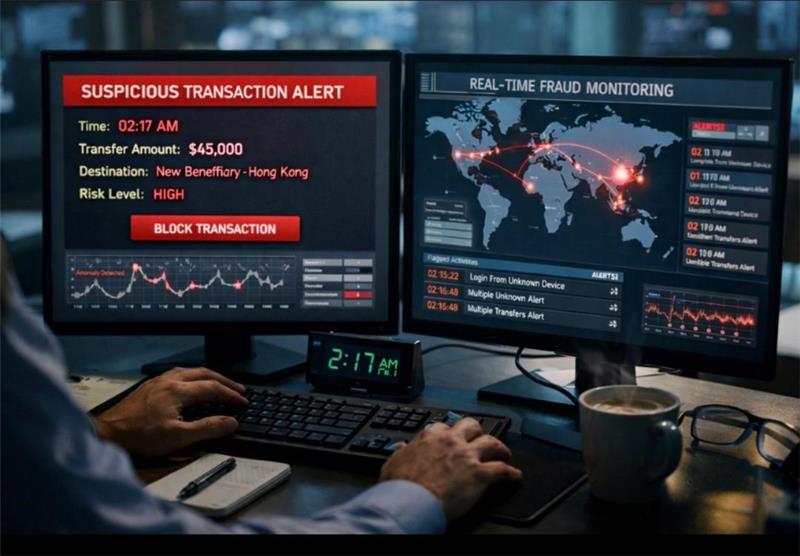
I have seen fraud happen in minutes, often at a time when most people believe nothing is happening.
Anyone who has worked within compliance, anti money laundering, or financial crime prevention understands this pattern.
Fraud does not wait for business hours.
In many cases, it deliberately avoids them.
Some of the most successful fraud incidents occur late at night or in the early hours of the morning. These are periods when attention is lower, escalation is slower, and operational coverage is limited.
In practical terms, this is what it looks like:
- Dormant accounts suddenly becoming active around 2am
- Funds moving rapidly across multiple accounts within minutes
- New beneficiaries added and used almost immediately
- Transactions structured just below internal trigger thresholds
By the time teams resume full operations in the morning, the funds have already been dispersed. That is the reality institutions are dealing with today.
Real-Time Monitoring: The Difference Between Detection and Prevention
There is a critical distinction that must be understood. Detecting fraud is not the same as stopping fraud.
Detection without speed simply means reporting what has already happened. Real-time transaction monitoring changes that. It allows institutions to act while the transaction is still in motion.
From experience, there have been situations where:
- Transactions were flagged instantly based on behavioural anomalies
- Step-up authentication was triggered before completion
- Payments were paused and reviewed within seconds
In those moments, a delay of seconds prevented losses that would have been extremely difficult to recover.
This is where real-time monitoring becomes more than a compliance requirement. It becomes a core financial control.
Nigeria’s Reality: A Growing Digital Risk Environment
Nigeria’s financial ecosystem has expanded rapidly, driven by fintech innovation, mobile payments, and increased digital adoption.
While this growth is positive, it has also increased exposure to financial crime.
Data from Nigeria Inter-Bank Settlement System (NIBSS) and regulatory insights from the Central Bank of Nigeria (CBN) continue to highlight rising fraud attempts across digital channels.
At the enforcement level, the Economic and Financial Crimes Commission (EFCC) frequently reports cases involving:
- Account takeovers
- Unauthorised transfers
- Use of mule accounts
- Rapid movement of funds across multiple accounts
Many of these incidents follow a similar pattern. They occur during periods of reduced monitoring intensity. Fraud Is Not Random. It Is Timed.
One of the biggest misconceptions about fraud is that it is purely opportunistic. In reality, it is often calculated.
Fraudsters study systems. They understand:
- When monitoring teams are less active
- How long escalation processes take
- Where manual reviews introduce delays
- Which time windows offer the least resistance
This explains why high-risk transactions often occur during odd hours. This is not coincidence. It is strategy.
A widely documented case such as the Bangladesh Bank Heist showed how fraudulent payment instructions were timed to exploit operational gaps, resulting in losses exceeding 80 million dollars.
The Recovery Problem: Once Funds Move, Control Is Lost
One of the most difficult realities in financial crime is recovery.
Once funds leave an account and are distributed across multiple channels or jurisdictions, the complexity increases significantly.
Layering, mule accounts, and cross-border transfers reduce traceability and delay recovery efforts. In many cases, the funds are not fully recovered.
This is why relying on post-incident investigation is no longer sufficient. The focus must shift to interruption, not reaction.
What Effective Institutions Are Doing Differently
From experience, institutions that are effectively managing fraud risk are not necessarily the largest. They are the most responsive.
They typically:
- Monitor transactions continuously across 24 hours, including weekends and holidays
- Use behavioural analytics beyond static rule-based systems
- Respond immediately to high-risk triggers
- Integrate device intelligence and geolocation indicators
- Treat alerts as potential incidents requiring action
These are not enhancements. They are operational requirements.
Final Perspective: Speed Is the Control
Real-time transaction monitoring is often discussed as a compliance obligation.
In practice, it is a timing issue.
Fraud does not always succeed because it is sophisticated. In many cases, it succeeds because it is fast.
If an institution cannot respond at the same speed, it is already behind.
The conversation must change. From detecting fraud after it happens to stopping it while it is happening because in today’s financial system, speed is not an advantage.It is the control.
Adedayo Aluko is a Governance, Risk, and Compliance professional with extensive experience in anti money laundering, sanctions, and financial crime prevention across banking and fintech institutions in the United Kingdom and Nigeria. He has worked with leading financial institutions including Evelyn Partners, Starling Bank, and Canara Bank UK.
He is the author of Clean Hands, Bright Future: A Youth Guide to Avoiding Financial Crime in Africa.



This is a really insightful piece, especially the part about timing not being random but strategic.
It actually makes me think about something I’ve noticed personally with my bank. There are certain hours when transaction alerts don’t come in immediately. And honestly, that delay even if it’s small creates a kind of gap. Because if a transaction can happen without me knowing right away, it makes you wonder how fast money could be moved before you even realize what’s going on.
You see similar things with network services too. There are times when things are just slower or less responsive. So it raises a valid question; if systems behave differently at certain hours, could those same periods also be where vulnerabilities exist?
Then there’s the human side of it. As much as we talk about systems and technology, people are behind them. They build them, manage them, and understand how they work. So while it may not always be the case, it’s hard to completely ignore the possibility of insider knowledge being misused or compromised.
At the end of the day, this just reinforces something important for me; “it’s not enough to have controls in place, it has to be consistent, active, and responsive at all times, not just during peak hours.”