Follow Us on Google Discover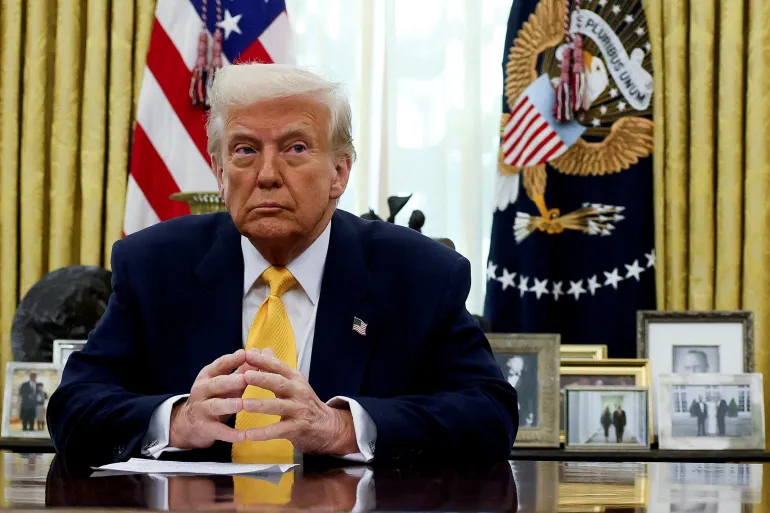
Iran has rejected US President Donald Trump’s assertion that Washington and Tehran have held discussions, contradicting his statement about ongoing efforts to resolve hostilities in the Middle East.
The rebuttal was disclosed on Monday via the official X account of Islamic Republic of Iran Broadcasting (IRIB).
Trump had earlier postponed strikes on Iranian power plants after issuing a 48-hour ultimatum, claiming the decision followed “productive talks” with Iran aimed at de-escalating the crisis.
What they are saying
Iran’s state media dismissed Trump’s claims, insisting that no communication has taken place between the two countries. The statement directly challenges the US narrative that recent interactions had temporarily paused planned military actions.
Also Read
- “No conversation has taken place between Iran and the US, and Trump’s claim about having these talks is false,” IRIB stated.
The statement emphasized that Iran’s stance on the Strait of Hormuz remains firm, signaling no change in its strategic position.
- Iranian authorities suggested that Trump’s remarks were intended to distract from prior threats targeting Iran’s energy infrastructure.
The development highlights the growing tension between both nations amid conflicting narratives over diplomatic engagement and military threats.
Backstory
- He described the pause as a result of “very good and productive conversations” with Iran aimed at ending hostilities that have lasted over three weeks.
- Trump indicated that the continuation of the pause would depend on the “success of ongoing meetings and discussions” between both nations.
- He claimed that the US and Iran had engaged in productive conversations over the prior two days to work toward a full resolution.
The US President had initially issued a 48-hour ultimatum demanding Iran reopen the Strait of Hormuz, warning of targeted strikes if the blockade persisted.
Tehran responded with threats of retaliation against critical infrastructure and facilities associated with American interests in the Middle East region.
What you should know
The conflict has severely disrupted energy infrastructure and trade in the Middle East. The International Energy Agency (IEA) reported over 40 energy assets across nine countries as “severely or very severely” damaged.
- The closure of the Strait of Hormuz has disrupted global energy trade, driving up crude and refined product prices and threatening jet fuel supplies.
- Airlines may face cancellations of long-haul flights due to anticipated jet fuel shortages caused by the Strait’s closure.
- China, Thailand, and Vietnam have restricted fuel exports to protect domestic supply, intensifying global constraints.
- In Nigeria, petrol (PMS) prices have risen to N1,300–N1,350 per litre, while jet fuel now sells above N2,200 per litre, up from N900–N1,000 before the conflict.
Days ago, Ministers of Foreign Affairs from 12 countries, including Qatar, Egypt, Saudi Arabia, and Pakistan, issued a joint statement demanding Iran cease attacks and reopen the Strait, emphasizing respect for international law and maritime security.
Fatih Birol, IEA Executive Director, warned that global supply chain disruptions could persist even after hostilities end due to the scale of destruction.