
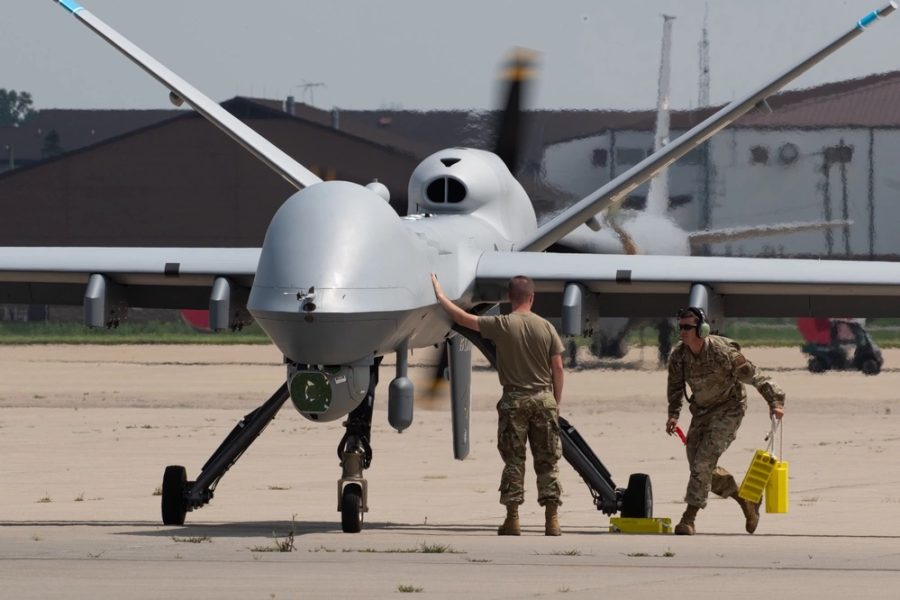
The U.S. military has deployed multiple MQ-9 drones and about 200 troops to Nigeria to support its fight against Islamist militants across the north.
This development was reported by Reuters on Saturday.
The personnel, Reuters reports, are providing training and intelligence support, but are not embedded with Nigerian frontline units, and the drones are solely for surveillance rather than carrying out airstrikes.


The deployment follows U.S. airstrikes targeting militants in northwest Nigeria in late 2025, signaling renewed U.S. involvement in countering Islamic State and al Qaeda-linked insurgencies in West Africa.
What the officials are saying
U.S. and Nigerian officials confirmed to Reuters the scope and purpose of the deployment.
A U.S. defence official said the drones and troops were deployed at Nigeria’s request to gather intelligence.
- “We see this as a shared security threat,” the official told Reuters.
Major General Samaila Uba, director of defence information at Nigeria’s Defence Headquarters, confirmed U.S. operations from Bauchi airfield in the northeast.
- Uba said the partnership builds on the U.S.-Nigeria intelligence fusion cell, which provides actionable intelligence to Nigerian field commanders.
- Both officials emphasized that U.S. forces are in a strictly non-combat role, supporting Nigerian-led operations.
The U.S. deployment aims to enhance Nigeria’s capacity to identify, track, and respond to terrorist threats, while maintaining the sovereignty of Nigerian military operations.
Get up to speed
The U.S. has previously maintained a stronger footprint in the region.
- It established a $100 million drone base in neighboring Niger with around 1,000 troops monitored militants across the Sahel, but was closed in 2024 after the Niger junta requested the U.S. withdrawal.
- The closure was part of a wider rejection of Western military support in Sahel countries, amid rising anti-Western sentiment.
- Nigeria has faced a 17-year insurgency from groups including Boko Haram and ISWAP, which continue to strike urban centers, as highlighted by a recent suicide bombing in a northeastern garrison town.
Militants have also intensified attacks in northwest Nigeria, near the borders with Benin and Niger, where banditry threatens to evolve into another Islamist operating zone.
More insights
The MQ-9 Reaper drones used by the U.S. can loiter at high altitude for over 27 hours and are capable of intelligence collection and airstrikes, though in Nigeria, they are currently restricted to surveillance.
- Neither Uba nor U.S. officials detailed instances where intelligence led to Nigerian action against militants.
- U.S. aircraft based in Ghana had previously conducted intelligence-gathering flights over Nigeria.
- The U.S. has a long-standing partnership with Nigeria, providing military training and equipment.
Airstrikes carried out by the U.S. in the northwest on Christmas Day 2025 were intended to prevent attacks on civilians in the region, particularly targeting Christians.
What you should know
In January, the United States delivered a new batch of military supplies to Nigeria, reinforcing bilateral defence cooperation as the country continues counterterrorism and internal security operations.
- Nigeria continues to face a dynamic threat from Boko Haram and ISWAP, which are adapting their tactics to maintain relevance.
The March 16 attack on a northeastern garrison town is under investigation, and responsibility has not yet been determined.