Follow Us on Google Discover
The Nigeria Sovereign Investment Authority (NSIA) has signed a deal with UK-based Asset Green Ltd to develop a $500 million large-scale dairy project in Nigeria.
The agreement was disclosed in a statement issued by NSIA on Wednesday following the signing of a Memorandum of Understanding (MoU) in London on Tuesday.
The initiative is expected to reduce Nigeria’s reliance on imported dairy products, strengthen food security, and boost local production capacity across the country.
What they are saying
The statement outlines a framework for collaboration between both parties, including commitments towards project development costs ahead of a formal shareholders’ agreement. It highlights the strategic importance of the investment in transforming Nigeria’s agricultural landscape.
- “NSIA is pleased to partner with Asset Green on this transformative investment. With a project size of almost US$500 million, this is one of the most ambitious initiatives aimed at strengthening Nigeria’s food and nutrition security in a generation,” said Aminu Umar-Sadiq, Managing Director and CEO of NSIA.
Rod Bassett, Director at Asset Green Ltd and CEO of Agrium Capital, noted that the partnership reflects the kind of innovation needed to unlock Nigeria’s agricultural potential and reduce heavy dairy imports.
British Deputy High Commissioner Jonny Baxter emphasised that the partnership demonstrates the impact of sustained UK-Nigeria institutional collaboration in driving long-term development.
The remarks collectively highlight the scale and strategic intent behind the partnership, positioning it as a landmark investment in Nigeria’s food system.
More insights
The proposed investment is structured as a fully integrated dairy platform designed to modernise agricultural practices and enhance production efficiency. It combines large-scale farming, processing, and distribution into a single ecosystem.
The project will span 20,000 hectares of climate-smart crop and forage production alongside a 10,000-milking-cow dairy operation.
- It will feature a processing facility capable of producing fresh milk, milk powder, butter, cream, and up to 15,000 metric tonnes of infant formula annually.
- Up to 10,000 rural households are expected to be integrated into the supply chain through out-grower schemes.
- The platform is projected to generate about $620 million annually, creating 2,500 direct jobs and 5,000 indirect jobs nationwide.
NSIA noted that the initiative ranks among the most ambitious dairy investments in Nigeria, targeting improved nutrition outcomes and reduced pressure on foreign exchange from imports.
Get up to speed
The dairy project aligns with broader efforts to strengthen Nigeria’s agricultural sector through climate-smart and technology-driven initiatives. Recent financing from development institutions supports similar objectives across the country.
- The African Development Bank Group recently approved a $200 million loan to fund the second phase of the National Agricultural Growth Scheme – Agro-Pocket (NAGS-AP).
- The programme expands access to quality inputs, modern technology, and data-driven farming practices nationwide.
- Phase I delivered results through an ICT-based input distribution system involving more than 600 agro-dealers.
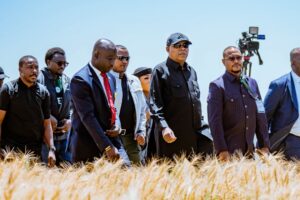
- About 650,000 smallholder farmers benefited, while national wheat output rose to an estimated 500,000 metric tonnes in 2024.
The second phase, expected to begin in March 2026, builds on these outcomes with a stronger focus on climate resilience and scaling agricultural productivity.
What you should know
Agriculture remains a critical sector in Nigeria’s economy, despite ongoing structural challenges that limit its full potential. It continues to serve as a major source of employment and economic activity.
- The sector employs about 38% of the workforce and contributes roughly a quarter of Nigeria’s gross domestic product.
- Constraints such as limited access to improved seeds and fertilisers continue to affect yields.
- Weak land tenure systems and low irrigation coverage hinder long-term investment and output stability.
- Climate stress and soil degradation further disrupt production cycles across farming regions.
The new dairy project and ongoing agricultural programmes aim to address these gaps, with targets including a fivefold increase in wheat output and a 20% rise in rice production, reinforcing the sector’s role in economic growth and food security.