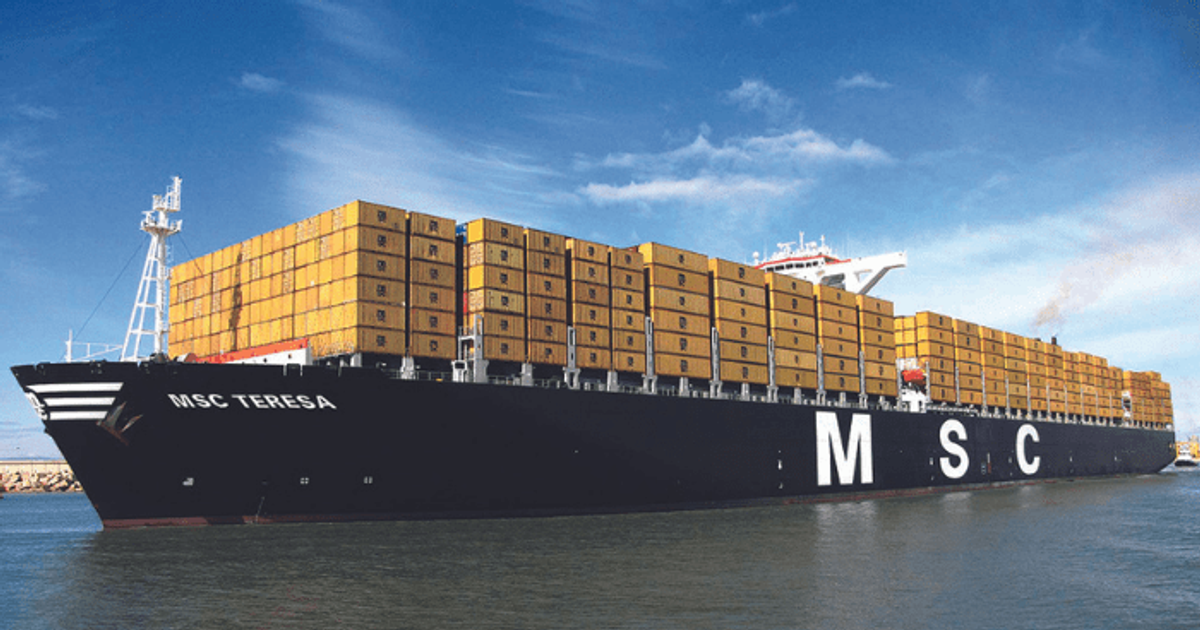
MSC Group has signed a 45-year concession agreement with Nigerdock to develop a container terminal at Snake Island Port in Lagos.
The disclosure was contained in an official statement published on the shipping company’s website on March 11, 2026.
The company also finalized Engineering, Procurement and Construction (EPC) contracts with ITB Nigeria Ltd. and DEME Group for the project.


The statement noted that this project forms part of MSC Group’s broader investment of over $1 billion in Nigeria’s infrastructure and logistics sector.
What they are saying
MSC Group described the concession agreement as a key step in strengthening logistics infrastructure in Nigeria and across Africa.
The company emphasized that the terminal is designed to enhance operational efficiency, create local jobs, and support Snake Island Port’s emergence as a major shipping hub.
- “MSC Group has signed a 45-year concession agreement with Nigerdock to develop a state-of-the-art container terminal within Snake Island Port (SIP) in Lagos, and finalized an Engineering, Procurement, and Construction (EPC) contract with ITB Nigeria Ltd. and DEME Group to develop it.”
Diego Aponte, President of MSC Group, said completing this phase alongside Nigerdock and partners demonstrates the company’s commitment to strengthening logistics infrastructure in Nigeria and Africa.
He added that the terminal is expected to enhance operational efficiency, open new economic opportunities, and support Snake Island Port’s emergence as a major global shipping centre while creating local employment and boosting economic activity.
MSC Group has been operating in Nigeria since 2003 and currently manages over 200,000 TEU of cargo annually through seven services connecting 200 global routes.
Details of the design component of the project
The planned terminal at Snake Island is designed to handle deep-sea container vessels and barges efficiently.
- It will feature a 910-metre quay with Ship-to-Shore (STS) and Mobile Harbour Cranes (MHC).
- The initial dredging depth will be 16.5 metres Chart Datum, matching the existing navigation channel.
- The container yard will cover 30 hectares and include space for future expansion with hybrid Rubber-Tired Gantry (RTG) cranes.
The terminal’s design allows for future scalability, with potential to increase dredging depth to 18 metres Chart Datum to accommodate larger vessels.
More insights
Recent port data indicate Nigeria’s maritime sector is experiencing significant growth, with Lekki Deep Sea Port emerging as the country’s busiest port in 2025.
- Lekki accounted for 40.6% of total cargo handled nationwide, followed by Onne Port at 19.1% and Apapa Port at 16.7%.
- The Nigerian Ports Authority (NPA) highlighted that this performance reflects Lekki’s growing importance as a hub for both imports and exports.
Larger vessels are increasingly calling at Lekki and Onne, with average Gross Registered Tonnage (GRT) of 55,712 and 53,022, respectively.
MSC’s Snake Island terminal will complement this growth by providing modern container-handling capacity and boosting regional logistics efficiency.
What you should know
Nigeria’s ports recorded strong growth in 2025, setting the stage for new investments like the Snake Island terminal.
- Total cargo throughput rose 24.8% to 129.3 million metric tonnes, while container traffic exceeded 2.1 million TEUs.
- Imports accounted for 59.2% of cargo, driven by industrial goods, raw materials, and consumer products, while exports contributed 39%, mainly agricultural and non-oil commodities.
- Trans-shipment grew 205.8%, reflecting Nigeria’s expanding role as a regional logistics hub.
Containerized cargo represented 24% of total throughput, while liquid bulk cargo dominated with 54.7%.
The Snake Island container terminal is therefore positioned to capitalize on rising maritime traffic, growing container throughput, and Nigeria’s evolving status as a regional shipping hub.