
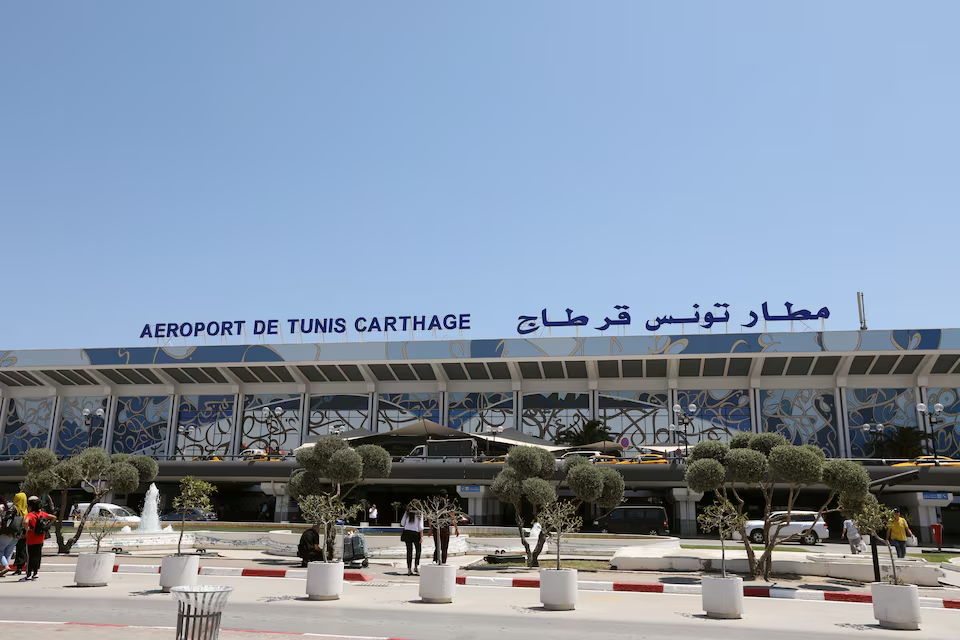
Tunisia plans to spend about $1 billion to expand Tunis-Carthage International Airport, with the project expected to increase the airport’s annual passenger handling capacity to 18.5 million.
The plan was disclosed by Tunisia’s Ministry of Transport, according to a Reuters report published on Sunday.
The expansion forms part of the country’s broader push to modernise its aviation infrastructure and accommodate rising passenger traffic in the coming years.


What they are saying
According to Reuters, Tunisia’s Ministry of Transport said the expansion project will significantly increase the airport’s passenger capacity as part of efforts to upgrade the country’s aviation infrastructure.
The ministry disclosed that the planned investment aims to nearly quadruple the airport’s passenger handling capacity by the end of the decade.
- “Tunisia plans to expand its main Tunis-Carthage airport at an estimated cost of about 3 billion dinars ($1 billion), aiming to nearly quadruple passenger capacity as part of efforts to modernise air transport infrastructure.”
- “The Transport Ministry said on Sunday the project will increase the airport’s capacity from about 5 million passengers to 18.5 million passengers annually by 2031.”
The ministry added that the expansion has already been included in the 2026 investment budget of the Office of Civil Aviation and Airports, the government agency responsible for managing Tunisia’s airports and aviation infrastructure.
More insights
The Tunisian government initially explored plans to construct a new airport to accommodate future aviation demand, but later shelved the proposal and opted to expand the existing Tunis-Carthage International Airport instead.
The expansion plan is coming on the backdrop of rising air travel demand across Africa.
African airlines recorded the highest growth in international air travel demand in January 2026, with revenue passenger kilometres (RPK) rising 11.7% year-on-year, according to the International Air Transport Association (IATA), the fastest growth among all global regions.
The planned upgrade is expected to strengthen Tunisia’s air transport network and support the country’s tourism and economic sectors by improving its ability to handle rising passenger volumes.
Get up to speed
Across Africa, several countries are investing heavily in aviation infrastructure to support rising passenger traffic and position themselves as regional aviation hubs. Ethiopia is currently undertaking one of the continent’s largest airport development projects.
- In January 2026, Ethiopian Airlines commenced construction of the Bishoftu International Airport, designed to handle up to 110 million passengers annually.
- The project is expected to ease capacity pressure at Addis Ababa Bole International Airport, which is nearing its expanded annual capacity of 25 million passengers.
- The airport’s first phase will serve about 60 million passengers annually, with the full development targeting 110 million passengers.
The total cost of the project has risen to about $12.5 billion, up from the initial $10 billion estimate announced in August 2025.
Located about 40 km southeast of Addis Ababa, the Bishoftu International Airport is expected to become one of Africa’s largest aviation hubs once completed.
What you should know
Nigeria is also expanding and modernising its busiest international gateway as part of efforts to improve aviation infrastructure and passenger experience.
- In 2025, the Federal Government approved N712.26 billion for the upgrade of the Murtala Muhammed International Airport (MMIA) in Lagos.
- The project will involve a complete rebuild of Terminal One, originally built in 1979 and currently housing Wings D and E.
- The plan also includes expansion of Terminal Two, enlargement of the aircraft apron to accommodate more wide-body aircraft, and construction of two dedicated ring roads for arrivals and departures.
A new bridge will link passengers directly to the upper floor of the departure lounge, easing traffic congestion and improving access.
The upgrades will also integrate smart technology aimed at transforming MMIA into a modern smart airport capable of meeting global aviation standards.