Follow Us on Google Discover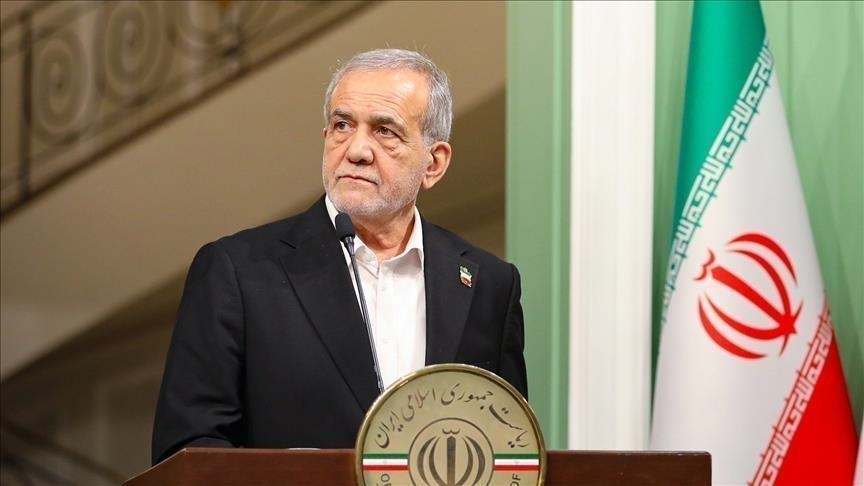
Iran has announced that it will stop targeting neighbouring countries in the ongoing war with the United States and Israel unless those countries launch attacks that originate from their territory.
The announcement was confirmed by Iranian President Masoud Pezeshkian and multiple Iranian media outlets on Saturday.
The policy shift comes as the Middle East conflict enters its second week following sustained strikes between the United States, Israel, and Iran that have escalated across the Gulf region.
What Iran is saying
President Pezeshkian said that Iran’s interim leadership council approved a motion on Friday instructing the armed forces to halt attacks on neighbouring countries unless an attack originates from them. He expressed regret for strikes on Gulf states in recent days, stressing that Tehran does not intend to violate the sovereignty of neighbouring nations.
Also Read
- “Based on the statements of His Excellency the President of the Republic, the armed forces once again affirm their respect for the interests and sovereignty of neighboring countries, and have adhered to this up to now and have not committed any aggression against them,” Iran’s IRNA News Agency X post read in part.
- Pezeshkian apologised to Gulf states that were affected by Iranian missiles and drones.
- He framed the policy as a conditional restraint, saying neighbouring states will be respected as long as they do not serve as launching points for attacks against Iran.
The statement also acknowledged that some of the earlier strikes on neighbouring countries resulted from chaotic communications within Iran’s military ranks following attacks on its command structure earlier in the conflict. Despite the apology, Iran continues to target the United States and Israeli positions and insists it will defend itself against any further aggression.
Why this matters
Iran’s decision to limit strikes on neighbouring states could help reduce the regional aviation disruption that has been triggered by airspace closures and missile activity across the Gulf, which forms one of the world’s busiest international flight corridors.
- The conflict prompted closures of airspace over Iran, Qatar, the United Arab Emirates, Kuwait, Bahrain, and other neighbouring states, forcing airlines to cancel or reroute thousands of flights.
- Major hubs such as Doha’s Hamad International Airport and Dubai International Airport experienced extensive cancellations and suspended services amid safety concerns and restricted skies.
- Gulf carriers such as Qatar Airways, Emirates, and Etihad faced severe operational constraints, with limited relief or repatriation flights replacing normal schedules.
If sustained, Tehran’s pledge to avoid strikes on neighbouring countries and therefore reduce the risk of airspace closures may allow airlines to begin restoring regular services. This could ease travel chaos for millions of passengers and alleviate broader economic disruptions tied to network connectivity and tourism in the region.
What you should know
The conflict began last Saturday when the United States and Israel launched coordinated airstrikes on Iranian cities, including Tehran, killing senior officials and triggering widespread explosions and smoke columns. Iran responded with hundreds of missiles and drones aimed at Gulf countries that host United States military bases.
- Saudi Aramco suspended operations at its 550,000 barrels per day Ras Tanura refinery in Saudi Arabia’s Eastern Province following a drone attack linked to Iran’s retaliatory strikes.
- QatarEnergy halted downstream production after attacks targeted LNG facilities in Ras Laffan Industrial City and Mesaieed Industrial City.
- The strikes affected multiple Gulf countries, including the United Arab Emirates, Kuwait, Qatar, Bahrain, and Oman.
The Ras Tanura refinery and Ras Laffan LNG facilities are critical infrastructure for global energy supply, serving as major refining and export hubs for crude oil and liquefied natural gas. The recent attacks underscore the wider economic and strategic risks posed by the ongoing conflict in the Gulf region.