Follow Us on Google Discover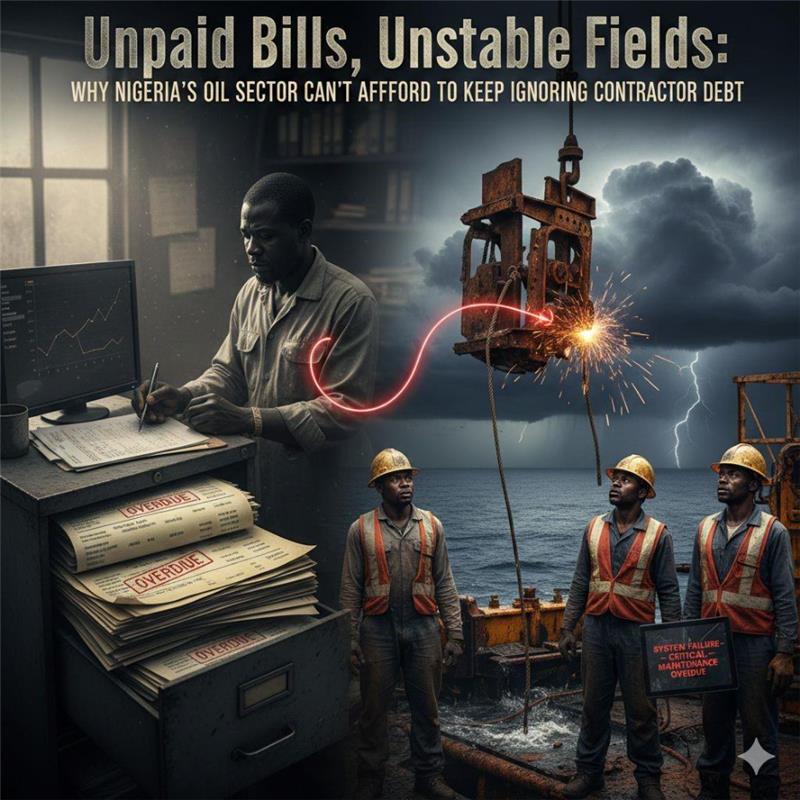
Every barrel of crude oil that flows from Nigeria’s upstream fields depends not only on geology and capital; it depends on contractors.
Drillers, engineers, logistics providers, and maintenance crews whose mobilisation is financed long before an operator issues a payment.
When those payments are delayed by months or years, the consequences ripple far beyond balance sheets. Production suffers. Banks grow cautious.
Skilled workers leave.
Also Read
And Nigeria’s ambitions for its petroleum sector quietly erode. Yet despite the sophistication of Nigeria’s Petroleum Industry Act (PIA) which addresses everything from host community levies to environmental remediation, contractor settlement discipline has never been codified with comparable clarity. That gap is not a technicality. It is a structural risk.
The quiet crisis upstream
Nigeria’s upstream sector operates through a web of specialised service relationships. Operators depend on contractors for drilling services, well completion, pipeline integrity, production chemicals, and ongoing field maintenance.
These contractors typically front significant costs- mobilising equipment, hiring crews, sourcing materials – in anticipation of payment upon delivery.
When operators delay payment beyond reasonable commercial terms, contractors face an invidious choice: absorb the liquidity strain and risk insolvency, or price future contracts to compensate for uncertainty. Both outcomes are damaging.
The first hollows out Nigeria’s indigenous service sector. The second inflates operational costs for operators, ultimately reducing the attractiveness of Nigerian assets on the global investment stage.
Modelling of extended payment cycles suggests that settlements delayed beyond 180 days materially increase refinancing risk for contractors, elevate service pricing, and reduce the quality of maintenance responsiveness, the very responsiveness on which production continuity depends.
When maintenance slips, barrels follow
The production sensitivity dimension of contractor arrears is underappreciated in policy circles. Nigeria’s liquids production system operates at approximately 1.6 million barrels per day.
A one percent reduction in maintenance efficiency across that system caused by cash-constrained contractors deferring preventive interventions, delaying equipment procurement, or reducing staffing translates to an exposure of roughly 16,000 barrels per day.
At moderate price assumptions, that figure represents annual revenue volatility exceeding several hundred million dollars. This is not speculative risk. It is the predictable consequence of treating contractor settlement as an administrative afterthought rather than an operational variable. Settlement discipline, properly understood, is a production discipline.
What the rest of the world got right
Nigeria need not look far for workable models. Three comparable producing jurisdictions have embedded contractor protection within their petroleum governance frameworks, each with measurable results.
Norway enforces strict cost reconciliation processes within joint ventures, with mandatory interest accrual on late settlements. The Norwegian model treats punctual payment not as commercial courtesy but as a condition of operational legitimacy.
United Kingdom Continental Shelf agreements incorporate financial default remedies directly linked to operational rights, contractors with unresolved payment claims have standing to escalate disputes through mechanisms that carry real consequence for operators. Brazil has gone further, deploying digital invoice certification systems that link validation of contractor invoices to payment release, compressing settlement cycles and reducing disputes through transparency rather than litigation.
Each of these models was implemented without altering fiscal architecture or undermining operator economics. They represent administrative reforms with operational dividends exactly the kind of targeted intervention Nigeria’s PIA framework is equipped to accommodate.
A reform architecture that works
The proposed reforms are specific, measurable, and enforceable within existing institutional structures. They include:
- Certified quarterly aged-payables disclosure, requiring operators to report outstanding contractor settlements to the Nigerian Upstream Petroleum Regulatory Commission (NUPRC) on a structured basis, creating a transparent record of systemic delay.
- Regulatory compliance thresholds, establishing defined limits beyond which unpaid contractor arrears constitute a reportable regulatory event, triggering supervisory engagement.
- Escrow-triggered settlement mechanisms for high-value, long-duration service contracts, ensuring that funds are ring-fenced for contractor payment independent of operator liquidity cycles.
- Automatic late-payment interest accrual, removing the commercial incentive to defer payment by attaching a prescribed interest rate to settlements outstanding beyond agreed terms.
Majority joint venture reconciliation confirmation, requiring majority partners to certify quarterly that contractor obligations across operated assets have been reviewed and addressed.
These reforms align operational incentives with financial discipline. They do not transfer risk from operators to government, they simply make the cost of delay visible and consequential.
The macroeconomic stakes
The case for reform extends beyond production efficiency. Systemic contractor arrears create elevated credit exposure across Nigeria’s banking sector, as lenders to service companies absorb default risk that originates in operator payment behaviour.
This exposure constrains the availability and pricing of working capital for the broader upstream services ecosystem, a financing drag that falls disproportionately on indigenous contractors already operating with thinner balance sheets than their international counterparts.
Institutionalising contractor settlement discipline directly addresses this transmission mechanism. It lowers systemic banking exposure. It reduces the service risk premiums embedded in contractor pricing. It supports local content retention by enabling Nigerian companies to compete without absorbing the hidden cost of delayed payment. And it enhances investor confidence by demonstrating that Nigeria’s regulatory environment treats all production stakeholders, not merely royalty recipients, with statutory seriousness.
The cost of inaction
There is a temptation in policy discussions to treat payment discipline as a private commercial matter, resolved bilaterally between contracting parties. That view is no longer defensible in a sector as systemically significant as Nigeria’s upstream oil industry.
The cost of inaction does not appear as a line item in any operator’s annual report. It accumulates invisibly: in deferred maintenance, in cancelled contracts, in skilled Nigerian engineers who accept positions elsewhere, in international service companies that quietly deprioritise Nigerian operations when allocating scarce equipment. These costs are real. They are material. And they are preventable.
Nigeria’s petroleum sector is at an inflection point. The PIA created a foundation for modern governance. Building contractor settlement discipline into that foundation is not an additional burden; it is the completion of a governance architecture that was always intended to be comprehensive.
Upstream stability, ultimately, depends on financial trust between operators and the contractors who keep their fields running. Codifying that trust in statute is not idealism. It is pragmatism measured in barrels.