
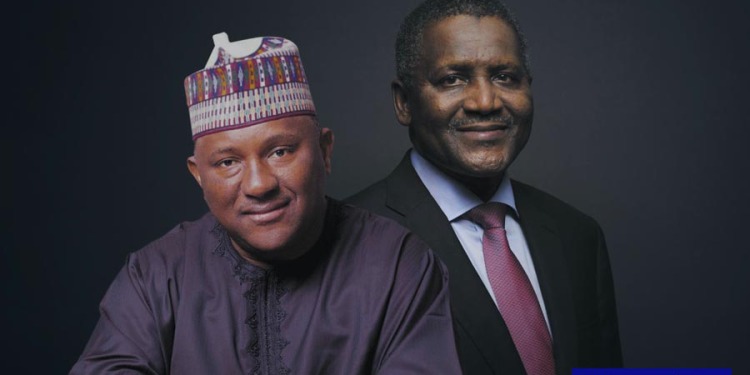
Wealth for Nigeria’s top industrialists is expected to surge rapidly due to a ‘perfect storm’ of a strengthening naira and a prosperous Nigerian major stock market in early 2026.
Aliko Dangote and Abdul Samad Rabiu have earned billions in just the first few weeks of the year. Bloomberg data showed Aliko Dangote is up by $1.84 billion, worth $31.8 billion
Rabiu, Nigeria ‘second richest man, has a year-to-date gain of $1.2 billion, worth $11.4 billion.
Nigerian naira boosts Nigeria’s richest men
The Nigerian naira has made a remarkable turnaround, recently reaching a two-year high of N1,350/$.
Nigeria’s gross external reserves have recently increased to $49 billion, an eight-year high. This gives the Central Bank (CBN) an even greater ability to control stability.
Oil & Remittances: Increased crude oil receipts and a consistent flow of diaspora remittances have positively boosted dollar liquidity in Africa’s most populous economy. CBN Reforms:
The re-engagement of Bureau De Change (BDC) operators and the implementation of the Electronic Foreign Exchange Matching System (EFEMS) have bridged the discrepancies between the official market and the parallel (black) market.
The listing of Dangote’s refinery boosts Nigeria’s men’s outlook
Dangote has comfortably re-entered the $30 billion club, as these billionaires hold numerous assets in Nigeria; a stronger naira increases the dollar value of their local assets, especially after currency revaluation.
The NGX has been among the world’s top-performing exchanges for 2026.
Analysts predict that the total market capitalization will double, crossing N150 trillion, especially as the Dangote Refinery is expected to be listed this year.
Aliko Dangote has already re-entered the $30 billion club, and this IPO is expected to boost his wealth to $50 billion in the coming years.
Markets believe that financing the Dangote Refinery and its subsequent listing on the Nigerian Stock Exchange will be the most impactful event, creating wealth across Africa.
The Dangote Refinery has hit another milestone by now processing oil at its full nameplate capacity of 650,000 barrels per day (bpd). This is a historic world record for a single-train refinery, and this record is the main driver of the recent wealth increase for Dangote.
Full Capacity: The refinery announced it achieved and optimized 100% operational capacity of its Crude Distillation Unit (CDU) and Motor Spirit (MS) block.
Petrol Output: The refinery can supply up to 75 million liters of Premium Motor Spirit (PMS) daily—more than Nigeria’s total domestic demand of about 50 million liters.
Maintenance Success: The ramp-up followed a brief maintenance window in late January 2026. Data shows crude throughput rose from 170,000 bpd on February 8 to 537,000 bpd by February 10, reaching 650,000 bpd.
Abdul Samad Rabiu back on Bloomberg’s world’s top 500 richest list
- The chairman of BUA Group, Abdul Samad Rabiu, has triumphantly returned to the Bloomberg Billionaires Index, currently ranking among the world’s 500 richest individuals. This is a huge moment for the Nigerian business landscape.
- He is currently the 302nd richest person. Rabiu is now the second-richest person in Nigeria, after Aliko Dangote, thanks to a sharp increase in his wealth as of February 2026.
- Abdul Samad Rabiu’s fortune is closely tied to his publicly listed companies, BUA Foods and BUA Cement. In the first quarter of 2026, his net worth surged to $10.8 billion after BUA Foods’ annual profits nearly doubled.
BUA Foods is a remarkable success story. It has become the most valuable listed company in Nigeria, even surpassing Dangote Cement in market capitalization.
BUA Foods is the most valuable listed company on the Nigerian Exchange. Its market value is an incredible N14.4 trillion.
Rabiu owns 92.6% of BUA Foods, which alone is worth nearly $9.5 billion, making him the wealthiest man on the Nigerian stock market.
The consistently high-margin growth of BUA Foods has outperformed the broader market.
Profit Explosion: BUA Foods achieved its highest net profit in 2025, earning over 500 billion naira thanks to its new modern production lines in Port Harcourt.
The rise of these “industrial giants” reflects the Nigerian economy. Factors like the naira’s stability, improved stock market, stable liquidity, and lowering inflation (projected to fall to 13-15% by year’s end)