

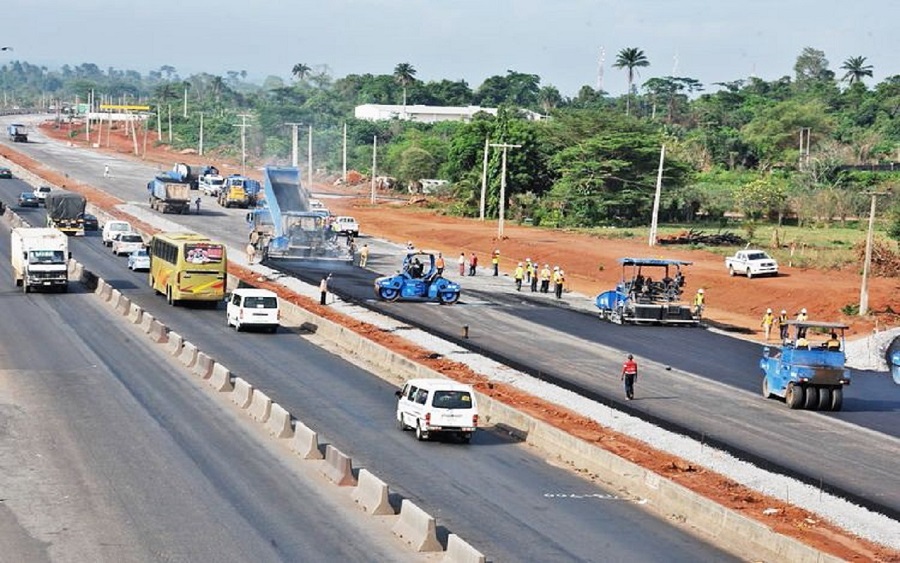
The Federal Government has included a N367.9 billion multilateral/bilateral loan for the ongoing construction and dualisation of Lafia Road and the 9th Mile–Otukpo–Makurdi corridor in the proposed 2026 budget, which totals N58.47 trillion.
The loan-backed project is one of the largest allocations under the Ministry of Works in the 2026 Appropriation Bill (Details) document.
It forms part of the government’s strategy to advance long-running federal road projects through a mix of budgetary funding and external financing.


According to the Appropriation Bill details, the Ministry of Works was allocated N3.49 trillion in the 2026 fiscal year, with N3.44 trillion set aside for capital expenditure, largely directed at ongoing road construction, rehabilitation, and dualisation projects nationwide.
What the Appropriation Bill document is saying
The document showed that the Lafia Road and 9th Mile (Enugu)–Otukpo–Makurdi project was listed under ERGP12234171 as a multilateral/bilateral tied loan, with a proposed allocation of N367,902,737,115.
- The project covered the construction of Lafia Road and the dualisation of the 9th Mile–Otukpo–Makurdi route under Keffi Phase II, a strategic corridor linking parts of the North-Central and South-East regions.
- The scale of the allocation indicated that the project would be largely financed through external borrowing, rather than direct budgetary releases, a model commonly adopted for capital-intensive federal highway projects.
The Appropriation Bill details further classified the project as ongoing, placing it among several long-term road works being supervised by the Ministry of Works.
Other notable ongoing projects under the Ministry of Works
Beyond the Lafia–Makurdi corridor, the 2026 budget includes several other significant ongoing projects under the Ministry of Works.
- Among these is the dualisation of the Kano–Katsina Road (Phase II), allocated N52.5 billion, and Phase I of the same corridor, which received N23.8 billion.
- Funding was also provided for multinational counterpart projects, such as the Lafia Bypass and the 9th Mile (Enugu)–Otukpo–Makurdi Road, with an allocation of N23.8 billion.
- Other ongoing works include the dualisation of the Kano–Maiduguri Road (Section I: Kano–Wudil–Shuarin, 105 km), allocated N13.3 billion, the reconstruction of the Ikorodu–Itoikin Road in Lagos State with N12.6 billion, and the reconstruction of the Abuja–Lokoja Road (Zuba–Abaji section) at N7.7 billion.
The construction of the Ikot Ekpene border–Aba–Owerri dualisation also received N7.7 billion, while the rehabilitation of the Numan–Jalingo Road was allocated N7.0 billion.
More insights
The dualisation of the Kano–Maiduguri Road (Damaturu–Maiduguri section) was allocated N7.0 billion, while the reconstruction of the Mubi–Maiduguri Road (Section 3) received N7.01 billion.
The Ministry of Works’ 2026 allocations also included other major ongoing and planned items.
The contingency fund (ERGP1247779) was assigned N100 billion, while proposed new projects across six geopolitical zones (ERGP1247780) were allocated N600 billion; however, the Appropriation Bill did not provide specifics on these projects.
These allocations highlight the scale of investment planned for the country’s road infrastructure. They also demonstrate that ongoing projects, alongside new initiatives, form a substantial part of the Ministry’s proposed 2026 spending.
What you should know
The Federal Government has long noted that maintaining Nigeria’s 35,000-kilometre federal road network cannot rely on budgetary allocations alone.
- In February 2025, the Minister of State for Works, Muhammad Bello Goronyo, highlighted that years of neglect, inflation, and security challenges have worsened the infrastructure deficit, emphasizing the need for alternative funding models.
- Several major projects now rely on external financing. In the 2026 proposed budget, a N367.9 billion loan was allocated for the Lafia Road and 9th Mile–Otukpo–Makurdi dualisation.
- The Benin–Asaba Superhighway, spanning 125 kilometres, is being advanced through full private-sector funding.
- The Lagos–Calabar Coastal Highway secured $747 million in July 2025 and an additional $1.2 billion in December 2025 to fund key sections.
Roads funded through such alternative arrangements are typically tolled to recover investment and ensure long-term sustainability.







Please they should include Otukpo Obi road,that road is extremely damaged,and the people there are highly suffering due to the bad road, please we are appealing to federal government should please help us the people of obi local government area of benue state, construct Obi Otukpo road,we are highly suffering here because of the bad road.