Follow Us on Google Discover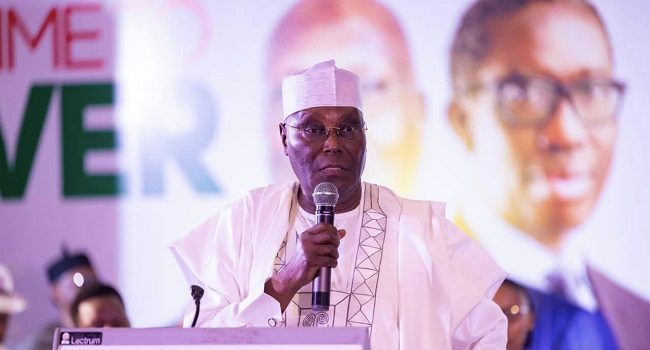
Former Vice President Atiku Abubakar has called for a fresh legislative consideration of the Tinubu administration’s tax reform laws.
Atiku, in a statement issued on Sunday night, said this is the only lawful path following confirmation by the Senate that the gazetted version of the Tax Act does not reflect what was duly passed by the National Assembly.
The call comes amid plans by the Federal Government to implement the remaining tax reform laws from January 1, 2026.
Atiku said the issue raises a serious constitutional concern that cannot be resolved through administrative shortcuts or rushed re-gazetting.
What Atiku is saying
According to Atiku, any law published in a form that was never approved by the National Assembly is legally invalid.
- He stressed that under Section 58 of the 1999 Constitution, the lawmaking process requires passage by both chambers, presidential assent, and only then gazetting.
- Atiku argued that gazetting is purely an administrative act and cannot amend, validate, or correct a defective law.
- He maintained that any post-passage insertion, deletion, or modification without legislative approval amounts to forgery, not a clerical error.
“The only lawful path is fresh legislative consideration, re-passage in identical form by both chambers, fresh presidential assent, and proper gazetting,” Atiku said.
Opposition to rushed re-gazetting
The former Vice President criticised reported attempts to fast-track a re-gazetting of the tax laws while legislative investigations into the alleged alterations are ongoing.
- According to him, such an approach undermines parliamentary oversight and sets a dangerous constitutional precedent.
- He warned that illegality cannot be cured by speed or administrative directives from the leadership of the National Assembly.
- Neither the Senate President, Godswill Akpabio, nor the Speaker of the House of Representatives, Tajudeen Abbas, he said, has the authority to validate laws that were not properly passed.
How the controversy emerged
The controversy began after members of the House of Representatives alleged that the gazetted versions of some tax reform laws differed from the versions passed by the National Assembly.
The affected laws include the Nigerian Tax Act and the Nigerian Tax Administration Act, which are scheduled to take effect from January 1, 2026.
Following investigations, the Senate confirmed that discrepancies exist between what lawmakers approved and what was gazetted, giving credence to the concerns raised by the House.
This confirmation has intensified calls for corrective legislative action.
Why this matters
The Tinubu administration’s tax reforms are a core part of its economic agenda, aimed at reducing the tax burden on low-income earners and small businesses while improving long-term revenue through economic growth and better compliance.
However, unresolved constitutional flaws could expose the laws to legal challenges and delay implementation.
Fresh legislative consideration, as proposed by Atiku, could help restore confidence in the reform process, safeguard the rule of law, and reduce the risk of future court disputes.
However, going this path would mean the government would have to defer the implementation of the laws.
What you should know
Four tax reform laws have been enacted under the Tinubu administration. Two of the laws took effect in June 2025, while two are scheduled for January 1, 2026.
Despite the controversies surrounding the two laws, Chairman of the Presidential Committee on Fiscal Policy and Tax Reforms, Taiwo Oyedele, told journalists on Friday that the implementation will proceed as planned from January 1.
Oyedele welcomed the House Committee’s engagement on the alleged alterations and said the Federal Government was willing to work with the National Assembly if any remedial action is required.