Follow Us on Google Discover
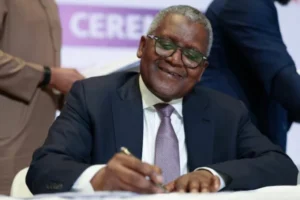
Nigerian billionaire Abdul Samad Rabiu has distributed approximately $20.7 million in cash rewards to long-serving employees of BUA Group, marking one of the largest employee reward programmes announced by a private Nigerian company in recent years.
The gesture highlights a growing focus on staff retention and welfare at a time when businesses are grappling with rising costs and economic uncertainty.
The payouts were announced on December 13, 2025, at the BUA Night of Excellence Long Service Awards held at Eko Hotel & Suites in Lagos. The event recognised employees across the group for years of service, loyalty, and sustained contributions to the company’s operations. BUA Group is one of Africa’s largest industrial conglomerates, with interests spanning cement, sugar, flour, and other manufacturing and infrastructure-related sectors.
Breakdown of the cash reward
Also Read
- According to details shared at the event, the cash rewards were structured across multiple levels of service.
- Five employees received N1 billion each, equivalent to about $691,000, while another five employees were awarded N500 million, or roughly $345,000 each.
- Several others received N100 million, while dozens of employees earned sums ranging from N5 million to N20 million, depending on their years of service and role within the organisation.
The broad spread of beneficiaries suggests an effort to extend rewards beyond top management to include long-serving staff across different cadres.
BUA’s businesses operate in sectors that are central to Nigeria’s economy but have also been affected by inflationary pressures, exchange rate volatility, and higher operating costs. In this context, the size of the payout has drawn attention as an example of how some large firms are responding to employee welfare concerns amid broader economic challenges.
What you should know
The latest awards build on a series of previous staff-focused initiatives approved by Rabiu. In February 2024, BUA Group implemented a 50% salary increase across its operations, citing the need to support employees during a period of elevated inflation and rising living expenses. Earlier, in 2021, the company announced a N2 billion share bonus for BUA Cement employees, following the company’s performance during the COVID-19 pandemic and the operational disruptions experienced at the time.
Reports note that such incentives can play a role in strengthening employee loyalty and reducing turnover, particularly in industries that rely heavily on skilled and experienced labour. For large manufacturing groups like BUA, workforce stability is often linked to operational efficiency and long-term competitiveness.
While employee reward programmes of this scale remain uncommon in Nigeria’s private sector, Rabiu’s approach positions BUA as an outlier in its emphasis on direct financial recognition for long service. The move also adds to the broader conversation around corporate responsibility, wage growth, and how large employers can balance profitability with staff welfare in a challenging economic environment.
As Nigeria’s business landscape continues to adjust to macroeconomic reforms and cost pressures, the BUA initiative provides a data point on how some companies are choosing to deploy capital not only toward expansion and investment but also toward retaining human capital.