Follow Us on Google Discover
Nigerian companies are on track to pay significantly more taxes in 2025 and of the largest payouts in corporate history.
This is according to data from a cross-section of publicly available financial statements reviewed by Nairametrics.
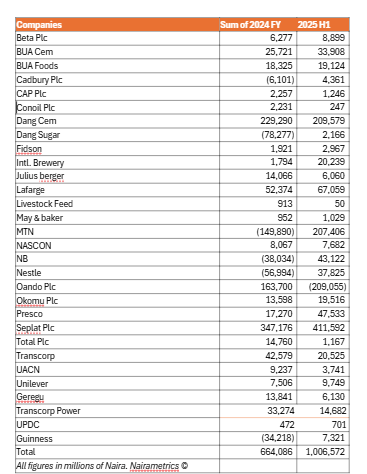
Data from about 30 listed companies on the NGX (excluding banks and insurance firms) show that about N1.007 trillion in corporate taxes was accrued in the first six months of the year, already higher than the N664.09 billion recorded for the entire 2024 financial year.
Data from the government’s medium-term expenditure framework shows non-oil corporate taxes more than doubled in 2024 to N4.6 trillion, largely on the back of devaluation and aggressive tax collection.
Also Read
Nigeria projects a total corporate tax receipt of N5.66 trillion in 2025 and N6.6 trillion in 2026 per the MTEF data.
What are the drivers?
A closer look at the data shows, manufacturing companies, telcos, and consumer goods companies on the list are likely to pay significantly more taxes in 2025 as they return to profitability following a brutal 2024.
- Seplat Energy is Nigeria’s largest taxpayer among listed companies, remitting N411 billion in H1 2025, compared to N347 billion in all of 2024.
- Dangote Cement is next incurring N209 billion in H1 2025, versus N229 billion in 2024, placing it in the top three.
- MTN Nigeria followed closely, with N207 billion in H1 2025, already surpassing the N150 billion credit it received in 2024.
- BUA Cement (N33.9 billion in H1 2025) and Lafarge Africa (N67 billion in H1 2025) also reported significantly higher tax outflows.
- Consumer staples like Nigerian Breweries (N43.1bn) and Nestlé Nigeria (N37.8bn) also reported significant tax liabilities despite operating in a weak consumption environment.
Collectively, Seplat, Dangote Cement, and MTN account for about 82% of all taxes paid by the companies in this dataset.
The only major outlier is Oando Plc, which reported a N209.1 billion tax credit in H1 2025. This credit significantly reduced the gross taxes payable of all other firms (N1.22 trillion) to the reported N1.007 trillion net.
Oando’s credit likely reflects deferred tax adjustments or accounting for prior losses, but it stands in sharp contrast to the heavy liabilities booked across the rest of corporate Nigeria.
Why 2025 is different
In 2024, most listed companies were hammered by currency devaluation, surging energy costs, and higher interest rates, leaving them with huge losses and tax credits.
- By contrast, 2025 has seen companies swing back into taxable positions, even if margins remain tight.
- The cement industry, telecoms, and oil & gas are now the backbone of government non-oil revenue collections.
- Consumer goods companies, though still under pressure, are also beginning to book taxable profits, reversing last year’s credits.
Corporate Profits for these companies printed over N2.86 trillion in the first half of this year, compared to about N923 billion in the whole of 2024.
What this means
With over N1 trillion collected from this small sample in six months, the Federal Government’s non-oil tax receipts are poised to exceed 2024 levels significantly.
- Heavy dependence on a handful of companies, particularly Seplat, MTN, and Dangote Cement, means government tax revenue is vulnerable to any downturn in these sectors.
- Rising tax charges confirm that corporates are returning to profitability in naira terms.
- However, it also means heavier pressure on net margins in 2025, especially for firms still contending with FX volatility and high input costs.
Most banks and insurance firms under our coverage are yet to release their half-year 2025 results.
However, Nairametrics expects insurance companies to post higher tax liabilities this year, reflecting the surge in profitability many insurers recorded in the first half.
For banks, tax receipts are likely to come in only slightly higher than 2024, as earnings growth is projected to remain stable, compared to the outsized profit expansion seen in the previous year.
Note: Figures in brackets indicate tax credits