Follow Us on Google Discover
We are accustomed to the Central Bank of Nigeria (CBN) limiting Naira liquidity for fear of upsetting the foreign exchange market. Now the CBN is unafraid of liquidity and is pushing growth – for now. Fixed income rates are falling.
FX
This year US$18.79bn has flowed into the NAFEX market with Foreign Portfolio Investment (FPI) accounting for 65.40% of inflows (US$12.29bn). The CBN’s supply of US dollars to the NAFEX market has been 3.02% of inflows (US$0.57bn). In effect, FPI is supplying sufficient US dollars to take the pressure off the CBN, hence our confidence that the exchange rate will hold this year. And the CBN has new-found confidence to target growth.
Bonds & T-bills
The yield on a Federal Government of Nigeria (FGN) Naira bond with 10 years to maturity fell by 24bps to 13.95%, and at 3 years declined by 25bps to 13.20% last week. The yield on a 364-day T-bill fell by 51bps to 12.50%. The yield on a T-bill with 3 months to maturity declined by 27bps to 10.30%.
Investors are reacting to the CBN’s revised Standing Deposit Facility (SDF) placement by banks which is now capped at N2.0 billion (US$5.7 million) from N7.5 billion previously. The T-bill market is currently characterised by high demand and strong market liquidity which depressed yields this past week. In the absence of frequent Naira fixed income auctions by the CBN, we expect yields to be stable and not derail significantly from current levels. With this amount of liquidity in the market the initiative lies with the CBN to set rates.
Also Read
Oil
The price of Brent rose by 3.99% last week to US$66.72/bbl. The average price, year-to-date, is US$66.10/bbl, 7.80% lower than the average of US$71.69/bbl in 2018, but 20.75% higher than the US$54.75/bbl average seen in 2017.
The 2019 oil market is themed by supply cuts, for the most part. The latest report from the International Energy Agency (IEA) shows that oil supply exceeded demand by 0.9 million barrels per day for the first half of the year. This comes on top of pre-existing stockpiles and rising shale production. With oil price protection in view, OPEC’s tightening measures are understandable, especially with the US/China trade war still unresolved.
Equities
The Nigerian Stock Exchange (NSE) All-Share Index lost 2.41% last week, resulting in a year-to-date return of negative 9.11%. Last week Cadbury Nigeria (+8.64%), Flour Mills of Nigeria (+8.00%) and Unilever Nigeria (+3.13%) closed positive while Forte Oil (-23.33%), PZ Cussons (-10.14%) and Nestle Nigeria (-8.92%) fell.
Last week saw the listing of Airtel Africa which closed the week at N323.50/share, down 18.98% from its listing price of N363.00/share. Such a reception continues to show weak investor sentiment in the market. While investors maintain a cautious stance on investing in equities, some stocks are trading close to multi-year lows and present a good entry point for investors, in our view.
The CBN pushes the growth pedal
The last few weeks have seen a flurry of activity from the CBN; a circular on mobile money & financial inclusion; hints of banking sector re-capitalisation 2.0; another circular prohibiting banks from a loan to deposit ratio less than 60%; and finally a ‘no thank you’ note to banks which may wish to park excess cash in the CBN vault, for excess cash balances above two billion Naira (US$5.6m).
What is the overall signal?
The CBN’s recent focus for the past two years has been on monetary stability. Following a 7.50 percentage point decline in inflation, a rise in foreign exchange reserves and hard-earned currency stability, one could argue that it has won the battle. And it has been helped by the downward prospects for US dollar interest rates, which take the pressure off emerging market currencies to some extent. Now the CBN can return to its other agenda. It wants economic growth.
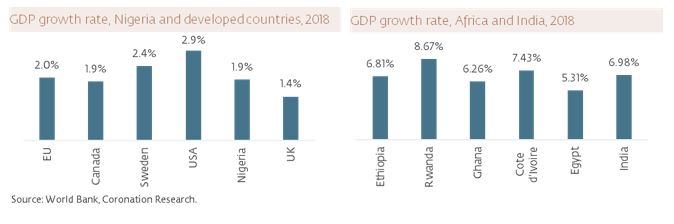
Nigeria’s GDP growth rate mimics the growth rates of developed countries even though it isn’t one. One sign of sluggish growth has been slow growth in commercial bank loans, which suggests, among other things that the supply side of the economy is weak. The CBN’s approach to galvanising growth had been skewed towards the supply side, and it has deliberately held down loan rates in several areas, such as agriculture, in order to implement its policy. The problem with this initiative is that commercial bank loans have not grown as a result, leading the CBN to come up with more radical measures than before.
Typically banks keep cash balances when the CBN Open Market Operation (OMO) auctions are imminent, driving up overnight lending rates around auction dates. But there is a clear downward trend this year in the rate at which very short-term unsecured loans are traded between banks around OMO auction dates.
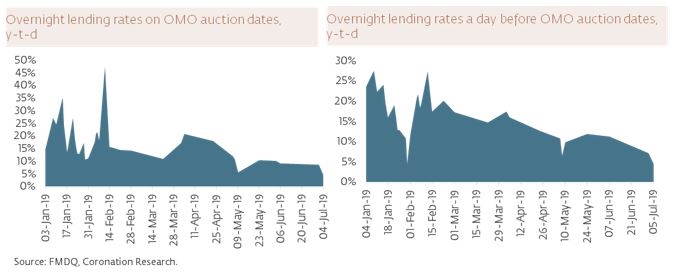
In fact, on 4 July the cost of overnight loans between banks fell to its lowest this year (4.86%) suggesting that for a given level of liquidity mop-up by the CBN, banks are willing to lend to themselves at cheaper rates than before. During H2 2018, this relationship was upward trending (when adjusted for outliers).
The CBN is attempting, through its circulars, to unlock excess liquidity trapped within the banking system in the hope that it will be channeled towards the real economy. Banks now have an extra incentive to target firms, and the affluent with (soft) loans when other forms of risk-free income become pressured.
All of this reads well for consumer spending, which is the dominant component of aggregate demand, but it may mean thinner margins for banks. The argument that banks may still expect to improve or maintain their margins without a corresponding expansion in loan books must be nuanced with the guidance that the CBN may restrict banks’ participation in the OMO and T-bill market for their own account. By and large, the CBN’s actions are likely to drag down interest rates until the point is reached where it finds Naira liquidity is negative for the currency.
Indeed, in our view the CBN may be wary of a steep reduction in market interest rates and what they could mean for the Naira exchange rate, on two counts. One, some of the excess liquidity in the banking system could find its way into the FX market. If stability remains a priority, the CBN will have to part with more of its dollar reserves. Two, moderating market interest rates could erode the appeal of the naira carry trade prompting foreign portfolio investors to unwind their positions.
But these are still early days, and we await the CBN’s upcoming auctions to learn more of its rate policy.